A Conceptual Loom
artist resources blog contemporary art criticism TPG7
We’ve decided to elevate this piece by Eva Repo out of the comments section.
Text/ile includes the two conditions of the contemporary art object: tautology and mythology. These two conditions are the main forms of the object after 60′s, the so called conceptual object. Upon the management of their balance or imbalance is based the mass of all the theories and practices since then. The first years of that period there was a prominence of the tautological form. The object was a lectical, anatomical, logical extract. In the revolutionary 70′s the object had to abandon this introversial tautology and develop communicative patterns with the urban environment, the society, the humanity. The object releases all the mythology forms that used to expel. It becomes biographical, social, ethnographical. Since 2000, there is a great interest towards the mythological forms of the object as a light struggle towards globalization and leveling of cultures. The object reveals all the elements expressing its variation, codification and hetetotis (otherness). From another point of view there is the aspect of a new kind of colonization : the accumulation of a variety of ethnographic mythologies to the Western based institutional art system. But this comprises subjects of a future judgement.
According to the above standards, Maggie Leininger presents an object in various and overlapping levels of tautology and mythology. The first notice is the cover of some medical content. This box provides some information that stamp a kind of ‘scientificality’. And this is not a latency. It is the reliance of Leininger’s venture. On this first notice, the ‘form’ of the human genome is indicated and the content of samples is implied. The word ‘legend’ though is written and already provokes a different kind of expectations for the content of the box.
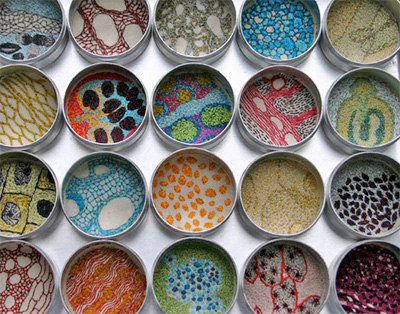
The content of the box are the metaphorical samples of a medical experiment. There are the modulors of Leininger’s experiment: the phenomenon of chromosomes, the procedures of a multiplicity and the one stroke procedure of creating from zero to a whole. Leininger does not aim to offer information or cognitive values. This is the point where she treats her object in a different way from what Joseph Kosuth maybe would do in the 1968, she skips its tautology and enters its mythology.
Weaving segments is the model of her research. Those black and white pieces of textile don’t offer any knowledge. Howbeit this technique is regarding to a strict rationalization as it follows specific traditions to produce the manufacture. The patterns are taken out of the box and they are exposed on the wall. This exposition creates the final impression of the object as the model and the prototype are conceived in the procedure of repetition and proliferation of the main pattern. This is the point where Leininger’s object exposes an irregularity. So far it can be described through all this reading of its readable layers. But now the exposition on the wall offers the optical obvious of the experiment. The object becomes an aesthetic item. The pile of the boxes in the corner is a hasty representation of the chromosome assumption and do not manage to complete as a concept and as an image the initial expectations. The textiles become an interesting gimmick in an unformed object.
The above formal debility is resolved by an extra connotation of Leininger’s project:
The technique used by Leininger provides her with the possibility of an interface with the economic and cultural conditions of her locality. The American textile workers lost their employment as the textils travel to Asia, South America and other places so as to be manufactured by cheaper hands. This long thread starting from the micro human structure to reach -theoretically- the macro structure of the contemporary economy, also represents the to-and-fro state of the conceptual and physical object between a tautology (now it becomes the tautology of the economic mechanism) and a mythology (the poetic weaving of textiles, plots and stories).
This concern of Leininger is creating a link to a feminine heterotis of object construction. It brings to mind the objects of Sheela Gowda who works with dyed ropes as metaphor for the umbilical cord and the birth, but also implies the Indian textile tradition and the colonization of their industry in 18th century. And a look to Sheela Gowda goes back to Eva Hesse and her almost common repetition practice. The long fiber of a connected feminine object is also an aspect of a feminine mythology. An expletory factor is that Maggie Leininger figures a consistent american allure, as a different kind of sensitivity in comparison to Gowda.
In conclusion, the Text/ile is a structure that is articulated in an acrobat’s way among critical points. It is an initial draft of a research in the system of chromosomes. It is the directing of the methodological tools for this research, the patterns of textiles. And it is the presentation of these pieces in a repetition formula and the implications of a transfer to a macro-level of the textile industry affairs. This procedure inevitably follows the moves of a conceptual loom as the conception of the object has to operate in to-and-fro and up-and-down levels of the whole scenery.
-by Eva Repo