Code is the New Craft by Mike Bianco

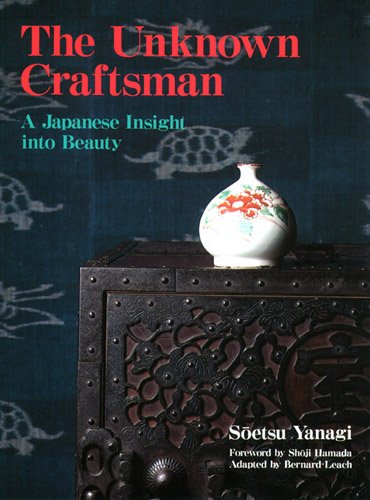
As both a curator invested in contemporary art practices, and as a potter of almost twenty years, I often find myself asking “What does ‘Craft’ mean anymore?” Craft is often considered a four-letter-word in the “big A” art world, and relished in the neo-DIY movement, but is rarely theorized anymore in relationship to our current cultural climate. As a result, I often find myself musing about the two supposedly disparate practices of “High Art” and “High Craft” and the aesthetic interconnections between them. Whenever confronted with this dichotomy I return to the seminal craft philosopher Soetsu Yanagi and his analysis of art and craft in his book The Unknown Craftsman.

theunknowncraftsman

For Yanagi – the founder of the Japanese Arts and Crafts, or Mingei movement, of the early 20th century – hand-crafted objects were the way to re-connect industrialized society with the natural world. First published in English in 1972 during the birth of the microprocessor, the book’s chapter Pattern formulates Yanagi’s manifesto: How pattern is derived, what constitutes both a good and bad pattern, and the ability for pattern to provoke in man a full capacity to perceive the beauty of the natural world. His argument is hinged on the question: “Why have painting and pattern separated? The same cause underlies the idea that divides art and craft: the growth of individualism.”

Yanagi’s question is based on the notion of a “Viewpoint,” a human perspective that allows the artist to distill the beauty of nature into a more refined pattern. When using the example of translating a bamboo leaf into a “mon” – or Japanese crest-  Yanagi creates his theory of pattern based on some of the following principles:

*A pattern is both true to nature and artificial.

*Pattern is nature plus a human viewpoint, and the viewpoint is what
gives content; All patterns are products of a viewpoint.

*Good pattern is frequently rather terrifying. And any good pattern has
an element of the grotesque.

*Pattern does not explain; it’s beauty is determined by the viewers
imagination.

This theory of pattern underscores Yanagi’s entire philosophy of beauty, and articulates his perceived division between art and craft, individualism and collectivism. However, this system of pattern creates a problematic condition for both contemporary pattern makers and painters alike. Yanagi’s model for pattern production is fundamentally productive except for the variable value of the viewpoint. Yanagi’s post-industrial viewpoint has been diminished; our new viewpoint is post-digital.

For most inhabitants of the “developed” world, the simulacric lens of the computer, where all nature is synthesized into a simulation, has become the new viewpoint. Rivers have been traded for iPhone aps, expeditions for Google Earth, and communal banquets for cocktails in Second Life. And the basis of this digital sublimation is the highly skilled craft of code.

Emerging in 1801 from Joseph Marie Jacquard’s binary punched card loom, computer code has become the densest language mankind has invented to express the narrative of the world. Through it’s abstract syntax and consortium of disjointed symbols, code has created the algorithm to translate reality into a fragmented arena of spectacle that is as thin as a computer screen and as vast as the surface of the globe. If language precedes perception, then code has certainly shifted the “viewpoint” from the natural to the digital.

comparison

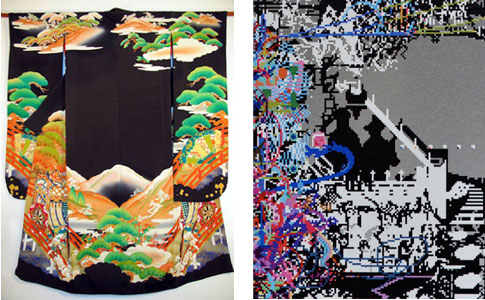
There is a new generation of artists and pattern makers engaging the structure of pattern from the post-digital viewpoint: Matthew Cella is one of them. Cella, like Yanagi, is nostalgic for the past; for the nature of his youth. The difference is the nature of Yanagi’s childhood is of rice paddies and Mt. Fuji, while Cella’s is comprised of similar subjects represented in the synthetic landscapes of Atari, Nintendo, and Sega. And what Cella does with digital nature is in practice no different than what Yanagi describes in the translation of an actual bamboo leaf into a pattern; he refines it into something more than the original could be. Furthermore, Cella – like Yanagi’s own desires -employs his patterns into utilitarian forms such as rugs. But the question remains: How, if at all, is Cella’s work bridging the craft/painting divide?

As programmer Charles Petzold states in Beautiful Code: “Code is just a smart kind of data – data designed to trigger processors into performing useful or amusing acts.”  One could almost think of this statement in terms of weaving: code is the craft of weaving itself, and the useful act which once produced blankets and baskets, now results in the infinite cloth of pixels that our eyes scour for information. And although Yanagi saw the technological as the bondage of mankind, in what way is this ever increasing craft of code – and all of it’s resulting patterns of pixels – creating a new utilitarian form, new unknown craftsmen, and bringing us together in ways Yanagi had originally only thought possible through our interactions with ceramics and textiles?

In many textile traditions, landscape and narrative are literally woven together through the production of pattern. The socio-technological changes of our world have shifted our forms of representation, transforming our sense of landscape-narrative from the geographic to the sociological. Landscapes and histories have been replaced by networks and communities founded on the craft of code. Perhaps Cella is presenting textile traditions in a new way. Each pixel of Cella’s work represents a collaged fragment of information. It is as if he has cut up the narrative textile traditions of the Pueblo, Celts, and Akan, and haphazardly stitched them back together with the digital pop-culture of the 1980s: The result is the fragmented quilt of the post-modern world.

I wonder what could be gained from a more comprehensive melding of the arts and crafts with digital production? Perhaps Comp-Sci programs could be more experimental within arts and crafts institutions rather than liberal arts colleges and poly-technical schools. Could dot-coms be more productive if they established micro-potteries and looms for their employees rather than ping-pong tables and bi-weekly office parties? In addition to programs such as Google’s local produce initiative, could companies find a qualitative improvement in their employees and product by supporting local artisanal practices? If we accept that our lives have become chaotic and fragmented – largely due to the digitization of our reality – then the incorporation of the ephemerally digital with the haptically crafted seems like a very interesting path to follow.

.

Mike Bianco is an independent curator and artist based out of Marfa, Texas, and is the recently appointed associate curator at Ballroom Marfa. Prior to moving to Marfa, Bianco was the co-founder of Queen’s Nails Projects, an offshoot of Queen’s Nails Annex in San Francisco. In addition, Bianco is also the founder of the alternative arts space The Waypoint, in Marfa, Texas. More recently, Bianco has been focused on developing his projects The California Arts Cemetery in Lone Pine, CA., and a contemporary ceramics residency in Marfa, Texas. For more information about Bianco and his work you can visit www.biancoprojects.com

Long Day’s Journey: 8 Hours With Artist Marina Abramovic" class='title'>Long Day’s Journey: 8 Hours With Artist Marina Abramovic

A really wonderful account and review of the experience of standing in line for “The Artist is Present”

Rhizome’s Seven on Seven a Success" class='title'>Rhizome’s Seven on Seven a Success

I love the nature of this program: match up artists and technologists for 48 hrs and see what you get.  And it is great to hear that it worked to some degree.  I too, would love to see more of these programs.

The Bullshit Artists" class='title'>The Bullshit Artists

Leon Neyfakh calls out the vagery and BS that gives art a bad rap.  It would be so refreshing if this type of language was cut out of the art world. But it’s a fine line.  Sometimes the things that artists are exploring are pretty vague and broad.  But that doesn’t necessarily make their work bad.

The Center For Missed Connections: Charting Loneliness and Social Irrealities

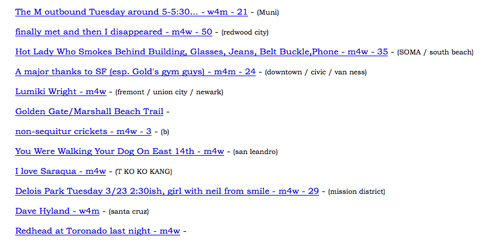
If you live in a city, or even if you don’t, you have likely heard of and/or utilized Craigslist.  From its humble beginnings, the website has grown to international proportions; used to place ads for jobs, housing, and those looking for human contact.  Perhaps the most compelling aspect of the site is its category Missed Connections (MCs).  Here, people post anything from one line to many paragraphs; seeking out those whose path they’ve crossed, people they’ve lost contact with, strangers they’ve seen in bars or cafes or streets that caught their attention.   These posts reflect a desire to try and make real contact, when so much of our lives are spent surrounded by strangers, hours at work, or online.  In the past year alone, these anonymous listings have inspired a book deal, blogs dedicated to the best of MCs, and artists’ work.  Baltimore-based artist Ingrid Burrington has created a piece utilizing Missed Connections that is at once tongue-in-cheek and an adept response to the culture in which we live.

missed-connections

Using her “think tank initiative,” the Center For Missed Connections (CMC), Burrington examines MCs in five cities, charts their trends, and offers a work- booklet so that we might keep a log of our own missed connections as we go about our daily routine.  Were someone to stumble upon her findings, one might imagine these graphs and worksheets to be yet another new dating device aimed at an increasingly lonely urban population.  Rather, Burrington has created an untraditional piece of work that experiments with and questions our understanding of illusion and reality, blurring the two, while also offering an honest commentary on this phenomenon of communal loneliness and need for human connection in our country.  This “outreach initiative” provides a critique of the way in which we communicate, date, relate, and experience loneliness and one another:

“You are in the world, in a city, somewhere crowded and vibrant, full of people.  And you are alert with an awareness tempered by the wonderful, unspeakable loneliness of being among strangers… Missed Connections are the embodiment of one of the major lures of cities and urban centers: they are a temporary engagement with a total stranger in uncertain, finite intimacy.”

Burrington takes a humorous look at what constitutes a missed connection, its various forms, and how one may make their post most successful.  Various categories of what she deems the “gray area” include, “holla,” “bitches ain’t shit,” and “why doesn’t anyone want to date me.”  It’s this superficial cheekiness that cushions the subtext of her work.  Rather than beat her audience over the head with the kind of heavy-handedness one might find in some artists’ whose work deals with social commentary; Burrington’s take is comical, relatable, and an astute critique of the way in which our culture often chooses to interact with one another.

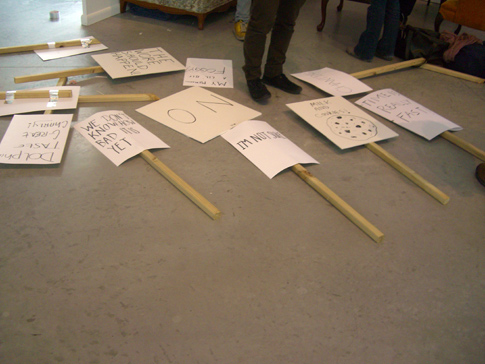
Many of Burrington’s projects take things that are mundane- date books, puzzles, and rulers to name a few- and recontextualize them; endowing everyday objects with cultural substance and social critique.  Her work is often collaborative, and text appears in nearly every piece.  Some take the form of pamphlets and index cards, while others are protest signs or banners that demand “milk & cookies!” or “revolution can be avoided.”

ingrid-protestwhat do we want? NOW! when do we want it? NOW! .     Ingrid Burrington and Matt Bettine  2008.
Her work offers a means of resistance to traditional artistic genres, as well as to our current culture and what is valued.  In “Tips for experiencing a missed connection,” Burrington advises her reader how to go about becoming an MC.  Among them, the artist suggests you: be attractive; identify which an adjective (cute, hot, sexy, etc) that best suits you and try to embody it; leave before any actual contact can be made; and start living.  How very apropos that in trying to really live, we abandon actual interaction and possibility in favor of an online fantasy.  It is here, and in other pieces, that Burrington subtly dismantles socially constituted norms and brings them into question.

Burrington manages to avoid heavy handedness as she maps the world of MCs.  Rather than create a piece that mocks those who flock to Missed Connections in lieu of real human contact, the artist offers us a thoughtful, rather blithe take on the palpable loneliness that seems to proliferate so many of these posts.  Between Match.com, OkCupid, eHarmony, and myriad other dating sites, it’s no surprise that we (the collective we) have become disconnected.

If such sites weren’t to exist, would we still feel the same lack of connectedness?  It seems that in attempting to quell the feeling of loneliness and isolation, dating sites may compound the feeling; allowing people to search for others at their leisure and in the comfort of their home.  Rather than step out into the world where rejection is a real possibility, those who date online only have to face a virtual one, and can quickly move on to the next profile.  CMC is a critical look at this delusional approach to interaction, and acknowledges the irony in our attempts to establish contact via Missed Connections with those we wish to engage in reality, but actively choose not to.

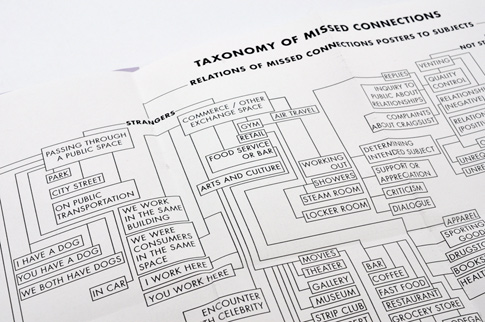
taxonomydetail_485Taxonomy of Missed Connections, detail.  In the Center for Missed Connections Citizen’s Field Guide, Center for Missed Connections Information Initiative, 2010


In CMC, we are given statistics, pie charts, and insights into the workings of each city’s MCs.  It’s in this urban sea of strangers that we make a connection, and perhaps we find comfort in this collected loneliness.  In CMC and other pieces, the artist dares the viewer to ignore this current state of detachment in which we seem to exist.  As Burrington navigates the world of interreality through various non-traditional formats, she manages to create works of art that are simultaneously provocative, critical, and humorous; and through them we are given a glimpse at how our culture has dissociated, as well as our genuine desire to find a connection amidst this often self-imposed isolation.

.

.

.

Madeleine Zinn is a writer and erstwhile artist based in Oakland.  Her main interests include non-fiction, community arts, pop culture, and queer theory and identity politics.  She is currently pursuing a dual MFA/MA in Writing and Visual & Critical Studies at California College of the Arts.

And I feel Fine by Heidi De Vries

It is a truth universally acknowledged that many Californians, despite willingly living on land that could open up at their feet and swallow them whole at any given moment, possess nothing even remotely resembling a proper emergency kit.  Until very recently I was no exception.  I was born and raised in California and have ridden out more earthquakes than I care to count, and still it took me until I was in my early 30s before I finally ordered a pre-packed bag full of emergency supplies from the Red Cross.  Of course my grasp of what to do with the many items in that backpack is tenuous at best, but I’m operating under the assumption that if disaster strikes I’ll have a spare moment to read its enclosed manual.

Upon first inventory the purpose of the contents of Whitney Lynn’s survival kit might seem similarly mysterious, but here too there is a manual.  Her pamphlet immediately inspires confidence with its promise of useful information, its cover printed with an official-looking logo as well as a variety of acronyms that could be military codes.  Lynn did not make these up; they are actual acronyms that would be familiar to anyone in the survivalism movement.  For example, “SHTF” stands for “Shit Hits The Fan”.  “TEOTWAWKI” is “The End Of The World As We Know It”.  Survivalists do have a sense of humor.

By inviting participation in the piece Lynn quickly draws you into an imagined narrative, encouraging you to picture yourself in a situation in which this kit might be necessary and useful.  Perhaps you’ve chosen to sequester yourself away in the woods to kick-start your creative process with a dose of isolation and would use the items to meet some of your basic needs, like the alcohol you can make with the yeast and the balloon.  In a more pessimistic scenario, perhaps one of the laundry list of catastrophes called out in the pamphlet has occurred and it’s every individual for themselves, in which case assembly of the DIY Survival Weapon, cleverly labeled as such, takes on a new sheen of urgency.  In any event you can always draw motivation from the artwork on the back of the pamphlet, included to provide inspiration.

Our ancestors who lived a lot closer to the land than many of us do might be puzzled about why we would need this kit, and they would also probably laugh at the earnestness with which the present-day sustainability movement exhorts all human beings to reduce/reuse/recycle.  There was a time when such a philosophy wasn’t even optional.  However, in these days of industrial agriculture and the supermarkets’ pale, hothouse-grown tomatoes, it can feel like a powerful decision to eat a fresh heirloom from a home garden or a local farm.  But then ideas about self-sufficiency are taken to a whole other level by the modern survivalists who in the case of societal collapse are prepared to live completely by their own means — and surrounded by all the supplies they have purchased in advance.

Lynn has chosen banal, everyday objects for her kit but invests them with unexpected meanings by framing them up within the new context of “failure management“, and in this way she nods to the genuine resourcefulness and creativity required to be a successful survivalist.  She has also created a cohesive brand for the kit that slyly pulls from survivalism literature and terminology, referencing both the consumerist culture that survivalists need in order to stock their bunkers as well as the fear of its disintegration that drives their actions.  Buy early and buy often, before there are no stores left.

The ideal of stubborn individualism is deeply ingrained in the stories of the early United States, from almost-mythical figures like Daniel Boone and Davy Crockett to images of the ‘49ers and other pioneers staking out new territory during the country’s insatiable expansion west.  Modern survivalists might feel like they are tapping into that spirit of the original American do-it-yourselfers when they visualize themselves hunkering down alone in a well-provisioned cabin.  Except the people who actually did survive in those days of yore were the ones who turned to their neighbors for mutual help and support instead of locking their doors against them.

Heidi De Vries works as a manager at an advertising company by day and freelances as a writer and a music consultant.  She is also a volunteer DJ at KALX Berkeley 90.7fm, and though her show is currently on hiatus she would be happy to recommend some awesome tunes for you anytime. You can find her at her blog, Engineer’s Daughter.

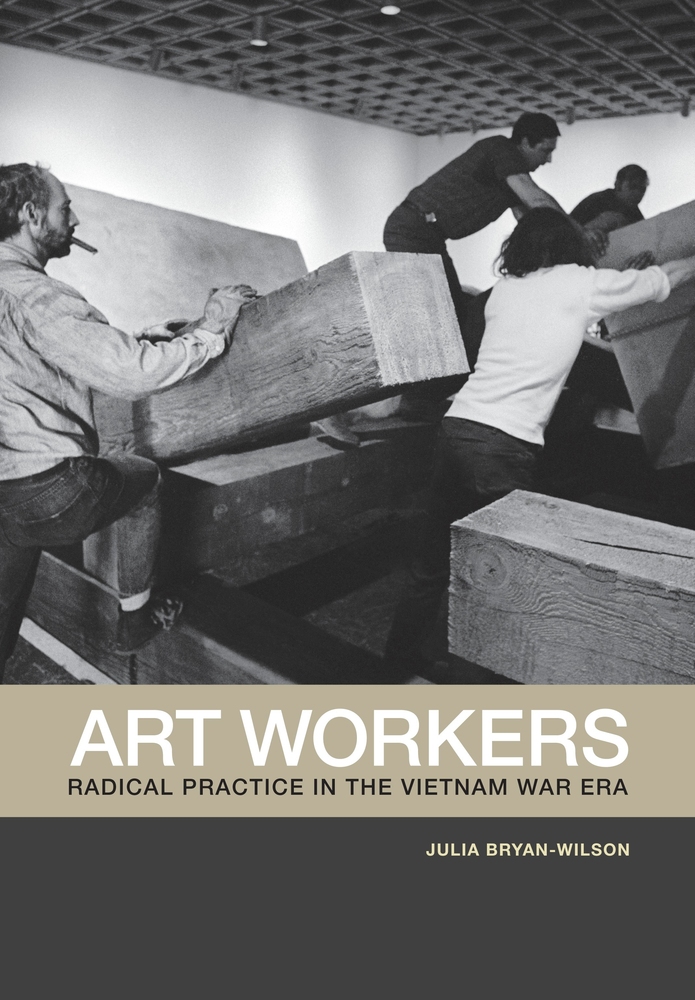
Art Workers: Radical Practice in the Vietnam War Era

artworkersbook

Julia Bryan-Wilson, director of the Ph.D. program in visual studies at the University of California, Irvine, investigates in her new book the movement to create a new recognition of artists as workers and laborers in the 60′s and 70′s.   Their efforts created some change within the museum structure, yet it continues to be a struggle today, as seen with efforts of W.A.G.E. and our “State of the Arts” project led by Joseph del Pesco.

Julia Bryan-Wilson on Artforum.com:

THE MORE INTERESTED I became in the legacies of the Art Workers’ Coalition and the New York Art Strike, the more I became concerned with how artistic labor registers––or doesn’t––within a wider field. It was both inspiring and somewhat vexing to consider how artists and critics attempted to organize as workers and label themselves as such, particularly during the Vietnam War, when debates about the value of artistic production were raging within culture and within protest politics. How does art work? This question challenged me and pushed the project forward.

…read more on Artforum.com

Her book has been published by University of California Press and there will be a release party at Printed Matter in NYC on November 7th.

A Time Alongside Time by Matthew David Rana

“[A] qualitative alteration of time…would have the weightiest consequence.”
-Giorgio Agamben, Infancy and History

Waxing its way to fullness, or waning its way to newness, the double promise of enrichment and becoming has been brought to bear on the moon. As a venerated celestial body and object of astronomical contemplation, the moon has been made to transcend itself as a powerful and resonant symbol. It is capable of teaching us about our position in the cosmos while providing a distant location on which to pin our hopes and desires.Whether it?s being shot for or leapt upon, the moon, like the starry firmament that surrounds it, is a reminder both of our limitations as terrestrial creatures and our intractable persistence in the face of an incomprehensible vastness.

In his book Infancy and History, Giorgio Agamben speaks to this kind of existential angst when he writes of time as a moment of tension where action and potentiality converge and life is revealed in its totality. Drawing on the ancient Greek notion of cairos, he emphasizes not being a slave to time as a universal or historically unfolding abstraction. Rather, for him, time issues from the specificity of human acts. As action without time
would be meaningless, so is time without action rendered desolate, void. To paraphrase Hakim Bey, it?s the idea that since we refuse to be nothing, there must be a project. In this sense, time can be thought of as something intensely personal, a unique form of temporality inflected by one?s actions within the flow of experience.

While not quite the revelation that Agamben described, my experience with Helena Keefe?s “Phases of the Moon,” was of qualitative alteration. The time that issued from the modest gesture, enacted daily for one synodic month, of affixing to my clothes a pin representing the changes in the moon?s phase, was a peculiar one in which my place and position in the world were thrown. As I repeated this aesthetic act, a major principle around which my daily life is organized began to loosen its hold. My orientation shifted away from a solar calendar and towards a lunar one. Although the new structure remained cyclic and related to the sun, I began to behave differently. I developed a ritual: check the widget, replace the previous day?s pin and attach the new one (rarely have I dressed myself with such intentionality and care). Having gained an awareness of the moon that I previously lacked, I began seeking it out at night, verifying that I was properly synched up. Although the act bore similarities to the careful placement of a flower in a lapel or the jauntiness of a feather in a cap, it was more than an anachronistic or ironic flourish. Somewhere between a Victorian-era locket and a campaign button, the pins themselves drew equivalences between the time produced by ritual and remembrance and the time produced by discourse and communication. More subtly, they came to represent a time in which what?s private and what?s public can productively exist together.

For a time, I was in a time alongside time. To try to recover or extend that time, to cultivate it and make it something enduring would, I think, be to somewhat miss the point. The message is a bit less dramatic than that. It?s even less complicated than a faith in the promise of the fleeting moment. In fact, it?s deceptively simple: for even our smallest gestures, there are weighty consequences


Matthew David Rana
is an artist and writer based in Oakland. He is a featured contributor to Art Practical and his writing has appeared in the books, There is No Two Without Three and I’m a Park and You’re a Deer. Matthew is also co-director, with Michelle Blade, of The Living Room, a storefront project in Oakland. He is currently pursuing a dual MFA/MA in Social Practice and Visual & Critical Studies at the California College of the Arts.

Supermarket Still Life

“Tell me what you eat, and I will tell you what you are.” -Jean Anthelme Brillat-Savarin1

As an omnivore, the human body can survive and maintain its health on an astounding array of diets. Our ideas about the foods we eat, however, are cultural. Until only the past few generations, eating habits and food cultures were passed down the generations by the shared meal experiences of families and social groups. The industrial farming practices and global shipping routes developed in the 20th century upended these evolutionary relationships, supplanting the ideological roles of mother and tribe with supermarket capitalism. Not only do agribusinesses provide the diverse foods we eat, they provide their own cultural context, communicating new memes of taste, health, and culture. In a critique of the marketing of industrial organic foods, Michael Pollen unpacks such culinary signifiers in The Omnivores Dilemma:

“Taken as a whole, the story on offer in Whole Foods is a pastoral narrative in which farm animals live much as they did in the books we read as children, and our fruits and vegetables grow in well-composted soil … “Organic” on the label conjures up a rich narrative, even if it is the consumer who fills in most of the details, supplying the hero (American Family Farmer), the villain (Agribuisnessman), and the literary genre, which I’ve come to think of as Supermarket Pastoral. By now we may know better than to believe this too simple story, but not much better, and the grocery store poets do everything they can to encourage us in our willing suspension of disbelief.”2

This disconnect between our ideals of food production and its practical realities is bridged by visual language. As the narratives are consumed, they produce comfortable illusions about the substance of our food, providing a false culinary wholeness, like a gastronomic Potemkin village.

It is the cocoon of food packaging that envelops Stephanie Dean’s Modern Groceries series in contemporary consumer life. The photographs reenact Dutch still life master paintings from the fifteenth century, capturing the oblique soft light and deep shadows in saturated color. Objects are arranged with the same aesthetic fetish, displaying the bounties of the harvest and trade, as well as objects of curiosity, arranged perfectly askew over intricate linens and drapery. The produce, meats, and cheeses in the photographs are the same as their historical counterparts, but revealed to be modern industrial agricultural products by their packaging. Their presence subverts the bucolic ideals of the produce; the plastic is there to protect the food while it is transported globally and provides the surface where a plant can be re-branded into an emblem of the Supermarket Pastoral. The most visually subtle image in the series, “Still Life with Strawberries,” generates this subversion with only transparent plastics and a cluster of pricing stickers. An ironic disposable quality leaches from the packages, given their synthetic ecological permanence, in contrast to the finely crafted tableware and voluptuous produce.

citrus2008
Citrus, 2008

By employing the visual archetype of the still life, Dean frames the work within the historical tropes of the Dutch master painting. The Dutch still life marked a shift in the visual content and economics of European painting in the fifteenth century. These canvases were commissioned by a rising merchant class, not the aristocracy or church, who had underwritten most previous art production. The merchant-traders sought depictions of what brought them power – goods produced by guilds or secured in trade – just as the aristocrats and popes commissioned works of religious, mythical or political authority that supported their ideological dominance. These paintings built a representative system that redefined the commercial products of the time into an ideal, much like the marketing techniques documented in contemporary grocery stores by Michael Pollan. Furthermore, the down-to-earth aesthetic of understated wealth on display in the paintings mirrors the criticisms of elitism and affluence frequently pointed at today’s progressive food movements such as Slow Food.

In this way, the Modern Groceries series can be seen as a critique not only of contemporary agricultural practices, but of the manipulative power of visual language. At the same time, the photographs delight in the pleasure of the food and the seductive beauty of nature and light. The images dwell in a cognitive disconnect of the sensory and the political – a feeling that many of us experience every week, as we push our carts down the aisles of our favorite grocery markets.

linebreak

1 Jean Anthelme Brillat-Savarin, The Physiology of Taste, 1825
2
Michael Pollan, The Omnivore’s Dilemma: A Natural History of Four Meals (New York, USA: Penguin Group (USA) Inc., 2006), 137.

Brian Andrews is an artist who works with photography, video, and emerging media. Not content to just make things, he records as the west coast producer for Bad at Sports Contemporary Art Podcast. His critical writings can be found on Artnet and in Beautiful/Decay Magazine, as well as in numerous catalogs. Currently, he is the Course Director for the compositing program in animation and visual effects at Expression College for Digital Art in Emeryville, California.

Call for writers: new Flash Points topic wants you! | Art21 Blog

Attention writers! Our newest Flash Points topic, Contemporary Art + Economics, launches next week. This time, we’re opening up the editorial process and inviting you to participate. Have an idea for a post? Interested in what’s going down on Capitol Hill or how the current economic climate has affected the arts closer to home, in your own community? Propose a Flash Points blog post and have a chance to be featured on this site.

Posted via web from thepresentgroup’s posterous

Swelling, Shrinking, Fragments: David Horvitz By Genevieve Quick

Synecdoche allows a part to stand in for the whole, pars pro toto, as in using the word “wheels” to stand in for a car.  Synecdoche not only substitutes, but “swells” the part and “fragments” the whole.

Asyndeton eliminates conjunctions and adverbs in a series and uses “fragments”, rhythm, and timing to “shrink” the descriptive, communicative, or narrative act, to produce an extemporaneous or climatic tone.

David Horvitz’s work intervenes in the banality of the everyday through simple gestures that harness everyday media (web-based, print, photographic, and audio media) to engage his viewers in his activities.  In The Practices of Everyday Life, Michel De Certeau illuminates the myriad of creative opportunities that exist within the minutia of everyday activities using the grammatical principles of synecdoche and asyndeton.  When applied to the pedestrian aspects of life, typically taken for granted, they allow the everyday to be inscribed and read with nuance, complexity, and a multitude of meaning.  Horvitz’s work demonstrates how the synecdochical quality of souvenirs and the asyndetic nature of the View-Master swell, shrink, and fragment ideas and images and how banal media formats (e.g., photographs, texts, etc.) and distribution channels (e.g., websites, email, and the postal service) can be mined for their ability to share and extend narratives to remote observers and participants.

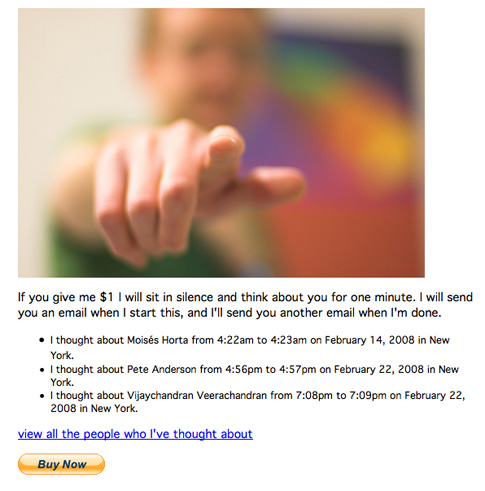
In the ultimate victorious gesture for the capitalist world, in 1989 Macy’s sold fragments of the Berlin Wall to allow people to share in an event that while globally significant, really only effected most US citizens remotely.  Souvenirs’ material quality, i.e., its ability for a sea shell to stand in for a trip to the beach, creates an expansiveness, a “swelling” of the reference and of the networks of participants to include those who are only remotely involved in the actual event.  In his series Things for Sale I will Mail You, Horvitz harnesses the web and Pay-Pal to interact with his viewers.  On Horvitz’s website he has established several goals to achieve and accompanying budgets that he invites his audience to purchase, or donate towards, and in exchange receive mailed documentation or souvenirs from the piece.  The gestures in this body of work range from the simplest, where Horvitz will think about you for one minute, sending you emails at the beginning and end of your dedicated time, to the more elaborate that stipulate that Horvitz will travel to Iceland; rent a car; mail you a lava rock, a photograph of the Aurora Borealis, and a photograph of him inthingsforsale the hot springs thinking about you.  All three items will be mailed to participants who donate more than $150 or who buy the whole piece for $2,443.   For some, Horvitz’s work begins with his website, then progresses to purchasing or donating through Pay-pal, then receiving documentation or souvenirs through the mail, and lastly the participant may monitor his website for further updates.  All of this may occur without ever meeting or speaking to Horvitz himself.  For most of us who do not participate by donating or purchasing Things for Sale. . ., our involvement is even more remote, as we only participate through monitoring Horvitz’s website.  Moreover, the souvenirs and documents that Horvitz mails his participants and displays on his website verify that the events have actually taken place, as the anonymity of the web makes us all incredulous consumers and participants.  Susan Stewart explains that, “[w]e do not need or desire souvenirs of events that are repeatable.  Rather, we need and desire souvenirs of events that are reportable, events whose materiality has escaped us, events that thereby exist only through the invention of narrative.” (135 Stewart)  Because the, “materiality [of Horvitz’s work] has escaped us”, the only ways that we, as remote viewers of his work, can experience Things for Sale. . .  are through his website where he constructs his narratives and through the synecdochical souvenirs and documents.  The souvenirs that Horvitz mails his participants are traces or residue of the art act itself.  The art piece is not so much the lava rock or the photographs, but the act of trust and cooperation that occurs between Horvitz and his participants.

In Hermosa Beach, CA, Horvitz utilizes the View-Master, which was based on the late nineteenth century stereoscope and debuted at the 1939 New York World’s Fair as a 3-D alternative to the post-card, itself a souvenir.  Like the stereopticon and magic lantern (the forerunner to the slide projector) that preceded the development of the motion picture camera, the View-Master operates asyndetically:  like jump cuts, it shrinks time by juxtaposing or creating a series of ideas, words, or images without transitions.  When the viewers are screening the images in Hermosa Beach, CA with the View-Master, they do not see the sequence numbers printed on the reels and quickly loose track of where they are in the series of images, as the only difference is the shifting formation of waves in the background.  The beginning and end are irrelevant or nonexistent as the viewer moves abruptly from image to image.  While Horvitz indicates in the accompanying text that the whole shoot took an hour or two, the time frame between images is ambiguous, as any transitions that would indicate how much time has passed have been eliminated.  Moreover, Horvitz explains that he would shoot his images, tell his mother he was done, she would turn around, and he would reload his camera and repeat the process with much of the time spent in silence.  The repetitiveness and silence of the shooting is mirrored in the viewer’s experience of screening the images through the View-Master.  The narrative that Horvitz provides transforms the images on the View-Master reels into documents or souvenirs of an event and urges the viewers to compare their experience of looking through the View-Master with what we know from the text about this event in December 2008.  Like much of Horvitz’s other work, the viewers participate in this event remotely, voyeuristically, through rather banal textual and image based narratives.

Horvitz’s strategies range from mailing souvenirs from distant locations and sharing simplistic images all with a wry sense of humor or a sincerity suggestive of a naive boyishness.  Horvitz uses the ease with which communication is established (email, YouTube, Tumblr, websites, etc.) to establish contact with his viewers and balances the alienation of the web, where everyone is a MySpace friend, with the very personal relationships between friends and family.  While Horvitz’s participants may do very little in terms of actual interaction with him, they are necessary for the work to be successful.  As, De Certeau would assert, while most of us are not primary producers, from a top down perspective, we are neither passive consumers.  Rather, by working within the pre-existing social, spatial, conceptual structures, we have the ability to reconfigure and restructure meaning.  By applying synecdochical and asyndetic devices, Horvitz creates alternative stylistic ways of organizing the world, communicating with each other, and creating narratives.

Sources:
De Certeau, Michel,  The Practices of Everyday Life,  University of California Press,  Berkeley, Los Angeles, London,  1984.

Stewart, Susan,  On Longing:  Narratives of the Miniature, the Gigantic, the Souvenir, the Collection,  Duke University Press,  Durham and London,  1993.

Genevieve Quick received her MFA from the San Francisco Art Institute and has shown her work in galleries in the Bay Area.  She has done residencies at Yaddo and Djerassi and included in exhibitions at the Headland’s Center for the Arts.  Quick is co-curator of the traveling exhibition “Gold Rush: Artist as Prospector”,

Her personal website is www.genevievequick.com.

A Conceptual Loom

We’ve decided to elevate this piece by Eva Repo out of the comments section.

Text/ile includes the two conditions of the contemporary art object: tautology and mythology. These two conditions are the main forms of the object after 60′s, the so called conceptual object. Upon the management of their balance or imbalance is based the mass of all the theories and practices since then. The first years of that period there was a prominence of the tautological form. The object was a lectical, anatomical, logical extract. In the revolutionary 70′s the object had to abandon this introversial tautology and develop communicative patterns with the urban environment, the society, the humanity. The object releases all the mythology forms that used to expel. It becomes biographical, social, ethnographical. Since 2000, there is a great interest towards the mythological forms of the object as a light struggle towards globalization and leveling of cultures. The object reveals all the elements expressing its variation, codification and hetetotis (otherness). From another point of view there is the aspect of a new kind of colonization : the accumulation of a variety of ethnographic mythologies to the Western based institutional art system. But this comprises subjects of a future judgement.

According to the above standards, Maggie Leininger presents an object in various and overlapping levels of tautology and mythology. The first notice is the cover of some medical content. This box provides some information that stamp a kind of ‘scientificality’. And this is not a latency. It is the reliance of Leininger’s venture. On this first notice, the ‘form’ of the human genome is indicated and the content of samples is implied. The word ‘legend’ though is written and already provokes a different kind of expectations for the content of the box.

The content of the box are the metaphorical samples of a medical experiment. There are the modulors of Leininger’s experiment: the phenomenon of chromosomes, the procedures of a multiplicity and the one stroke procedure of creating from zero to a whole. Leininger does not aim to offer information or cognitive values. This is the point where she treats her object in a different way from what Joseph Kosuth maybe would do in the 1968, she skips its tautology and enters its mythology.

Weaving segments is the model of her research. Those black and white pieces of textile don’t offer any knowledge. Howbeit this technique is regarding to a strict rationalization as it follows specific traditions to produce the manufacture. The patterns are taken out of the box and they are exposed on the wall. This exposition creates the final impression of the object as the model and the prototype are conceived in the procedure of repetition and proliferation of the main pattern. This is the point where Leininger’s object exposes an irregularity. So far it can be described through all this reading of its readable layers. But now the exposition on the wall offers the optical obvious of the experiment. The object becomes an aesthetic item. The pile of the boxes in the corner is a hasty representation of the chromosome assumption and do not manage to complete as a concept and as an image the initial expectations. The textiles become an interesting gimmick in an unformed object.

The above formal debility is resolved by an extra connotation of Leininger’s project:
The technique used by Leininger provides her with the possibility of an interface with the economic and cultural conditions of her locality. The American textile workers lost their employment as the textils travel to Asia, South America and other places so as to be manufactured by cheaper hands. This long thread starting from the micro human structure to reach -theoretically- the macro structure of the contemporary economy, also represents the to-and-fro state of the conceptual and physical object between a tautology (now it becomes the tautology of the economic mechanism) and a mythology (the poetic weaving of textiles, plots and stories).

This concern of Leininger is creating a link to a feminine heterotis of object construction. It brings to mind the objects of Sheela Gowda who works with dyed ropes as metaphor for the umbilical cord and the birth, but also implies the Indian textile tradition and the colonization of their industry in 18th century. And a look to Sheela Gowda goes back to Eva Hesse and her almost common repetition practice. The long fiber of a connected feminine object is also an aspect of a feminine mythology. An expletory factor is that Maggie Leininger figures a consistent american allure, as a different kind of sensitivity in comparison to Gowda.
In conclusion, the Text/ile is a structure that is articulated in an acrobat’s way among critical points. It is an initial draft of a research in the system of chromosomes. It is the directing of the methodological tools for this research, the patterns of textiles. And it is the presentation of these pieces in a repetition formula and the implications of a transfer to a macro-level of the textile industry affairs. This procedure inevitably follows the moves of a conceptual loom as the conception of the object has to operate in to-and-fro and up-and-down levels of the whole scenery.

-by Eva Repo

Nature As A Text: Complexity theory and the Modernist eye in Maggie Leininger’s “Text/ile” By Andrew Venell

“It’s a kind of microscopic herd mentality…Cells figure out which passages [in DNA] to pay attention to by observing signals from the cells around them: only with that local interaction can complex neighborhoods of cell types come into being.”
–Steven Johnson, Emergence

“It is safe, I suppose, to assume that today most if not all of us have had the experience of looking down from an airplane onto this earth. What we see is a free flow of forms intersected here and there by straight lines, rectangles, circles and evenly drawn curves; that is, by shapes of great regularity…[H]ere before us we can recognize the essence of designing, a visually comprehensible, simplified organization of forms that is distinct from nature’s secretive and complex working.”
–Anni Albers, “Designing As Visual Organization”

A white plastic box inscribed with a colorful legend, anonymously medical or scientific in origin, opens to reveal a woven textile, folded upon itself, black and white threads that merge into a shifting pattern of gray rectangles. Unrolled and displayed vertically, the swatch immediately brings to mind the reductive shapes and optical experimentation of Modernist abstraction. If pressed for a literal reference, I might say that the textile looks like nothing so much as the generically industrial, grainy landscapes of aerial photography: a cluster of buildings, parking lots, a straight road.

However, the framing–the ambiguously medical plastic, the charts on the sticker, with terms like “probes” and “polymorphism”–hints at a different meaning in the flat gray shapes. Because in fact Maggie Leininger’s “Text/ile” does have a literal reference, and it is in the basic informational structure of the human body. For this project, scientific diagrams of chromosomes–8 of the 23 found in human cells–have been reduced to grayscale patterns composed of black and white thread and woven on a Jacquard Loom into textiles remarkable in how they bring to mind not data but the abstract patterns of Modernist design.

Maggie Leininger works systematically on these multiple layers of representation and reference, finding within the building blocks of life hints of other forms, of city blocks and aerial topographies. Here the forms of Modernism, once so carefully divorced from literal reference, are found to contain the elemental information that guides the functioning of human cells. In her previous works the connection between microscopic and macroscopic forms was even more overt. In “Specimen” (2004) aluminum cylinders–resembling specimen jars or assay plates–are stitched with colorful patterns that could be cells seen under the microscope, could be colonies of bacteria on a petri dish, or could equally be mineral deposits in an estuary viewed from an airplane window.

Specimen by Maggie Leininger
Specimen by Maggie Leininger (2004)

In science the curious repetition of forms across multiple scales is a familiar idea. The term “self-similarity” describes a form that can be broken down into infinitely smaller parts, each a tiny likeness of the first. Self-similarity is behind the recursively complex structures of fractal geometry, perhaps familiar from its brief popularity in the early years of digital art. In nature self-similarity is more approximate, but is clearly present in forms like Romanesco broccoli or the way a tree trunk branches off into branches into branches…. Self-similarity has a central place in Complexity theory, which attempts to describe the way in which infinitely complex systems can arise from the interaction of a few simple rules or processes. This, too, is an idea obliquely referenced in Leininger’s work, concerned as she is with the simple structures that combine to form organisms and superorganisms. Complexity displays across many scales, from micro to macro: from the way that cells form an organism to the way that a few settlements form neighborhoods, which in turn weave themselves into a city. Complexity theory and the principle of Emergence seek to describe the ways in which these complex structures come into being without organized planning, without top-down interference from a central authority. Leininger has a stated interest in the systems behind urban structures, in neighborhoods bounded by the “invisible lines known only by the inhabitants,” and so it makes sense that she would find hints of the automatic, organic assembling of cells in a city seen from a great height.

And so the curious slash in the title, “Text/ile”, deliberately breaking out the word “text”, underscores perhaps how meaning is a similar system, how it is woven by the combination of words, how words themselves can be broken down into phonemes, into letters, themselves the building blocks of communication. Like cells or a city, language is a complex system built from the interactions of simple rules. The three poems meant to accompany the piece hint at a personal narrative not necessarily present in a representation of human chromosomes, with concepts like ‘artifact’, ‘birth’, ‘death’, ‘memory’ acting as ciphers to suggest whatever simple concept, whatever hidden connotations, they hold for each of us. Yet DNA is, in a sense, an artifact, a legacy woven through generations of organisms, and the Human Genome Project treats DNA almost as a language, as a code that can be cracked.

Ultimately with “Text/ile” these references are shadowed by the overwhelming allusion to Modernist design in the woven swatches, and here perhaps is where the most interesting connective thread peeks out from the weave. There is an obvious aesthetic precedent in the work of Anni Albers, textile artist and member of the Bauhaus, a German craft and design school highly influential in popularizing Modernist design philosophy in the first quarter of the twentieth century. Albers, equally fascinated by language, wrote extensively on design, and, along with Bauhaus colleagues like Walter Gropius and her husband, Josef Albers, helped to publicize a modern aesthetic that focused on radically reduced shapes, an emphasis on rationality and the harmony of form and function. Modernism as a movement affirmed mankind’s relentless march into the future, aided by the constant progress and improvements allowed by science and technology.
The vision afforded to the Modernist subject is rational, clinical and–aided by advancements in optics like the camera, the microscope–Modernist vision is unparalleled in its powers of observation, its ability to see the world across a range of scales, from deep into the cell to deep into the cosmos. The viewer of “Text/ile”, armed with the technological heir to this Modernist eye, takes what writer and complexity theorist Steven Johnson calls “the long zoom”: a perspective that shifts fluidly from the macro to the micro. In fact, it is a sort of “god’s eye view” that forms the connective thread between all of Leininger’s works, the way in which whatever is represented is represented as from above, whether it is through the lens of a microscope or a spy satellite. In the forms that comprise her work the viewer is given the benefit of a distance that makes vague the distinctions between the very small and the very large in order to emphasize their visual similarity at all scales. Modernism grants the eye the power to reduce the world into its constituent parts, to arrange even our bodies into a text that can be read and understood. Where once pictorial tapestries might have advertised the power and riches of the nobles, Leininger’s textile works seem to affirm the optical power of modernity, our ability through science to apprehend the world from the microscopic elements of the human body to the daily actions and interactions that form the structure and life of a city.

Ancient Writing by Anni Albers
Ancient Writing by Anni Albers (1936)

Nature, certainly no less complex than in Anni Alber’s time, but perhaps a great deal less “secretive”, has in Leininger’s work arrayed itself like a text for human viewing. And humans are furnished with a power of vision once reserved for gods. Seen from above, the distinctions between the design of cities and the organic forms of nature are much less pronounced than when Albers wrote “Designing as Visual Organization”, woven as they are from simple patterns and rules, iterated outward into works of infinite complexity.
.
.
.
.

Andrew Venell is a designer, hypertext author and multimedia artist whose works explore issues of urbanism, surveillance, commerce and mass communication.

A Message For Each Other by Victoria Gannon

I don’t know the man who addresses me in Aaron Cedolia’s “A message for you.” Only that his name is Javier, and he has dark hair and a nice smile. He looks up from his book, which he quietly reads in a public park somewhere in New York, to speak four simple sentences to me. “Hello Victoria. I love you. I miss you. I wish you were here,” he says, so earnestly that I believe him.

victoria.jpg

You don’t know the other people in the videos, either. Still they say your names, look into the camera like it’s your eyes, and present an identical message. In fifty-two separate videos, people we know only by first name – Youngmi, Samantha, Melissa, Javier -speak to us. Their names and personalities imbue the uniform script with individuality, introducing nuance and spark into the repeated phrase. Two teenage girls in an acting class smile for the camera like a school picture; a doorman hurries through the words from behind his desk, punctuating the last phrase with his hand; a man in a green tee-shirt conjures surprisingly sincere emotion. The messages’ differences remind us that even amidst apparent sameness, we are all unique.

Cedolia is a New-York based video artist whose background is in acting. His solo work and his projects with peoplmovr, an artist collaborative he formed with Geoffrey Scott, reflect his desire to reach people within their everyday situations, outside the traditional theater venue. “A message for you” can be understood as “social practice,” also known as “relational aesthetics,” a genre of art that takes social relations as both its subject and form. Recontextualized within the realm of aesthetics, social relationships become representations of themselves, playful reflections that leave room for possibility in a way “real” social interactions often don’t.

learningtoloveyoumore.jpg

Prominent practitioners of social practice include Harrell Fletcher, whom Cedolia cites as an influence. One of Fletcher’s best known projects is the participatory Web site, “Learning to Love You More.” The site, conceived and created by Fletcher and video artist and writer Miranda July, posts simple instructions: take a flash photograph beneath your bed, write your life story in a day, draw a constellation from someone’s freckles. The site’s users post their assignments online, creating a personal and startling virtual gallery. Like Cedolia’s work for The Present Group, Fletcher and July’s project disperses identical instructions among a diverse population and revels in the range, subjectivity, and intimacy of the responses.

“A message for you” explores the possibility of cultivating intimacy within the city’s anonymity. Filmed in New York City, the phrases’ repetition mirror the numerous interactions among strangers involved in the work’s production and reception. The artist first introduced himself to people he had only seen, never spoken to, and explained his work. “New Yorkers give you about five seconds to ask them something before they move on so I had to be brief,” he recalled. He told them he was working on a video about New York residents; he told them the sentences he wanted them to say. Participants then addressed strangers with words normally used for loved ones. Eventually Present Group subscribers watch the videos, surprised to hear someone they’ve never seen or met say their name with such familiarity.

With each interaction, the relationship between intimacy and anonymity is reconfigured, and the alienation of urban life is temporarily disrupted. The seemingly faceless crowd is composed of individuals with whom sincere and unique connections are always possible. Even today, even in the city, in a building lobby or bland cubicle. Even between two people who have never met. This, as much as the spoken words, is “A message for you”s real message.

.

.

Victoria Gannon is an Oakland-based freelance writer who recently earned her masters degree in Visual and Critical Studies from California College of the Arts. She enjoys writing about art, cultural and personal geographies, and the frequent intersections between the two. She recently collaborated with Oakland filmmaker and fellow CCA alum Michael Goodier on “Love Lafayette.” The 11-minute film is based on her essay about the East Bay suburb in which she grew up. Gannon’s master’s thesis investigated informal day laborer hiring sites within the context of their surrounding landscapes. victoriagannon@gmail.com

The Space Between Us and Ourselves by Scott Oliver

It’s an understatement to say that the people who surround us, especially those we call familiar, tell us a lot about who we are. Indeed it is difficult to imagine having any sense of one’s self without the presence of others. Perhaps this is why we associate solitude and isolation with madness. Certainly our ideas about individuality and personal freedom are dependent upon a group (and social and cultural norms within that group). But more to the point our identities are inextricably bound up in the relationships we have with others. We see ourselves reflected back to us in their actions and words, in the things they share or withhold from us, and in our misunderstandings as much as our unanimity. The constant influx of external information has an internal counterpart as we perpetually revise and update the story of our lives, constructing and reconstructing an image of ourselves that is responsive to our surroundings. Without this ongoing social process we would not so much lose ourselves, as lose our places. Then again, just who and where we are seem rather inextricable too.A Project With My Father

All this negotiating of the self in relation to others – what contemporary psychoanalysis has termed intersubjectivity – is at the heart of Davin Youngs’ photographic portraiture. Rather than focus exclusively on the literal subjects of his photos, or his own subjectivity as a photographer, Youngs prefers to concentrate on the dynamic space that arises between these, and more specifically, on the transactions that take place therein. Larry Sultan‘s Pictures from Home (1982-91) and Jim Goldberg‘s Raised by Wolves (1985-95) are significant precedents that come to mind, but the camera itself provides equal encouragement for such reciprocal approaches to photography. Creating simultaneous intimacy and distance, the camera’s lens lends itself to a certain reflexivity- a looking at looking. Of course this is all with the benefit of hindsight, but it seems inevitable that photographers would begin to think about the agency of their subjects and involve them more directly in the taking and making of their images, even as it complicates representation and challenges traditionally held beliefs about the camera’s objectivity.

Larry SultanAs with Sultan’s Pictures from Home, Youngs interest in creating a feedback loop with his subjects -opening up a space for the co-creation of meaning- began at home. In A Project with My Father (2007), Youngs initiated an e-mail correspondence with his dad wherein he asked pointed questions about their relationship. Just before and during this period of correspondence Youngs made portraits of himself and his father. He presented these, interspersed with text from their correspondence, and historical portraits of Youngs grandfather (his dad’s dad) in a right-to-left, scrolling narrative on his web site. Ultimately another transactional space is opened up here, that between the viewer and the artwork- or more precisely, between the viewer, the artist, and the subject.

In You were there, too, Youngs focuses on his relationships with three long-time friends. In many ways the project is an expansion of A Project with My Father, but less didactic and more ambiguous. The final form is a set of three intimately sized booklets, each entitled with the name of their respective subjects: Jennifer, Sara, and David. Each contains portraits of these individuals taken over an undefined period of time (hairstyles, clothes, and eyeglasses change, and there is a sense these people have aged, even if only slightly). As with his father Youngs has prompted his friends to reflect on their relationships with him in writing, and again he has paired their words with his images. But this time his visage and questions are absent, allowing for only an implied presence.

The effect is subtle, one of emotional mood rather than detailed biography. The text and images resonate with one another but do not provide much in terms of specific knowledge. Instead one is left with a feeling about each of the relationships depicted: stormy and perhaps unbalanced with Jennifer (the most forthcoming of the three); comfortably familial with Sara; somewhat cagey and reserved with David. But I do not quite trust these feelings. I know these portraits are partial, transitory, in-progress- permanently provisional. What strikes me more sharply about Youngs’ project is the shared awareness (consciously or not) of transition and change. All the people that make up this constellation of relationships- Jennifer, Sara, David, and Davin- are in their late twenties. My own late twenties might be best characterized as bittersweet. With childhood sufficiently distant and the twenty-year-old’s field of fuzzy possibility somewhat foreshortened it is a time marked by the dawning realization that life is finite. This is what You were there, too best captures. And the sense of impending adulthood (and accompanying melancholy) is made almost palpable as each participant recalls their history with Youngs and reaffirms the constancy of their relationship with him.

While Youngs’ project is highly personal his process is certainly not. We may easily enter into it through our own experiences with the ubiquitous medium of photography. That is to say, unlike oil painting or welding most of us have used a camera, and even more of us have been photographed. And like Youngs, we use photography to document our relationships and fortify our memories so that we might always know where we have been. But photographs can raise as many questions as they answer. I have often looked into the two dimensional eyes of my younger self, studied my facial expression and body language and wondered, “who is that person!?” “What was I thinking about?” “How did I imagine my future?” Youngs seems to be accounting for this indeterminacy of photographs upfront, building it into the interpretation of his images as he invites his subjects to become participants, and his audience members to become witnesses. You were there, too, is not simply a reference to Youngs’ subjects, but to us as well- invoking the cameras’ special ability to act as our proxy while undermining our trust in its fidelity. What emerges is an oblique, complex and shifting form of self-portraiture, open to multiple readings.

.

Scott Oliver is a sculptor and project-based artist living and working in Oakland, California. His work has been exhibited at UCLA in Los Angeles, Pulliam Deffenbaugh Gallery in Portland, Oregon, and Grounds for Sculpture in Hamilton, New Jersey. He has shown widely at local venues, including the Oakland Museum, Yerba Buena Center for the Arts, San Francisco Arts Commission, Southern Exposure, and the de Young Art Center.

In September of 2005 Oliver co-founded Shotgun Review, a web site featuring reviews of Bay Area art exhibitions, with collaborator Joseph del Pesco. Oliver was a 2007 artist-in-residence at SF Recycling & Disposal (a.k.a. the city dump) and will be teaching in the sculpture department at UC Berkeley this fall.

Fellow Feeling by DeWitt Cheng

A few years ago I became aware of resistentialism, that parody version of existentialism propounded by humorist Paul Jennings in 1948, and subsequently explored by Thomas Pynchon, that reveals that inanimate objects have it in for us: “Les choses sont contre nous” — “Things are against us”. The English author Terry Pratchett cites one example: “the tendency of garden hoses, no matter how carefully one coils and stores them, to unloop themselves overnight and tie the bicycle to the lawnmower.” Anyone who has struggled with balky objects knows the poetic and prosaic truth of this. We are all Laocoon (the Trojan priest seized by the serpent) afflicted by the gods.

The animistic notion that objects have a life of their own is the basis of primitive religion, of course, and the magical sense of reality is something all young children know, their rationality-stupefied parents able to share that enchantment only vicariously. It is verified and expressed in art sometimes, as in Chirico’s metaphysical still lifes – with their children’s toys, draftsman’s tools, antique statuary, and even indeterminate objects lingering in deserted Italian piazzas as evening falls. Scientists, too, incline toward viewing life and sentience from a wider, trans-human perspective: the earth is an intricate living organism, just as the “primitives” told us all along.

The humorous, deadpan prints of Brian Stuparyk provoke such wry musings about the interaction between human and other (i.e., ostensibly inanimate) life. His beautifully executed photo-silkscreens depict the unseen, unremarked stuff of daily life —a band-aid, a lottery ticket, a fortune cookie, the umbrella from a tiki bar drink, popsicles- in the bright, shadowless lighting that we recognize from advertising. The colors glow almost preternaturally with incandescent longing; they demand to be consumed, like the foods in Wonderland (“Eat me”, “Drink me”). In these works, however, the objects of desire, though, are affectionately humanized and imperfect: they’re used, they’re remnants – leftovers: a cigarette butt, an empty condom package, an Second Place ribbon, a rejection note, crumbs, puddles.

005stuparyk.jpgThe artist calls these images, which take Pop Art’s love of the commercial vernacular and replace its determined democratic iconoclasm with an amused affection for the invisible artifact as a kind of human surrogate. He looks askance at a hyper-competitive society of self-declared strivers and winners: “In my work, failure is as important as success. My subjects are tokens of life’s little defeats, everyday failures, impossibilities and things that don’t necessarily need to be celebrated.” Each print is a “keepsake of failure, unrequited love or losing struggle.” Given that most of us lose more often than we win, a certain wry humor about oneself seems an eminently reasonable and sensible attitude toward quotidian life with its thousand natural shocks.

Stuparyk studied photography in Canada and printmaking at Cranbrook Academy in Michigan. He has taught in Ohio and Michigan, has exhibited nationally, and is currently Artist in Residence at John Talleur Print Studio in Lawrence, Kansas.

.

.

.

.

DeWitt Cheng is a San Francisco artist and freelance art writer for Artweek, Art Ltd., SanFranciscoArtMagazine.com and Shotgun-Review-com. He curated “Hybrids” at the Peninsula Museum of Art in 2006 and is co-curator the Meridian Gallery’s 2008 “The Art of Democracy” show. He will be teaching Contemporary Art Theory and Criticism at UC Berkeley Extension, San Francisco, in the spring of 2008.

Building Between Worlds by Anuradha Vikram

Christine Kesler’s series of drawings is part landscape painting, part collage. The surfaces of some pieces are heavily built up from found bits of paper and debris, while others are delicately rendered in pencil and thin washes. Each describes a specific topography that Kesler encountered on her recent drive across the United States. Her meandering journey from Brooklyn to San Francisco included tours through the backroads of West Virginia, South Dakota and Utah.

#2, Brooklyn, NY by Christine Kesler from "I began building on a piece of land"The result of her labors is a series of psychogeographical maps. Colorful scraps bearing handwriting from a thousand strangers, their most intimate moments momentarily recorded and then tossed aside, are worked into graceful drawings on paper, worked with pen, pencil, india ink, watercolor, gesso and pastel. Kesler collects and saves these cast-off pieces from everywhere she goes, combining particulate matter from sites present and past with handwriting and drawing of her own. She observes natural terrain with an architect’s eye, focusing on the uneasy relationship between humans and their environment. The fine pencil lines that run through the frame could be interstate highways or horizon lines, running endlessly through time. The faint outlines of rivers and mountains she draws form an abstracted timeline of separation, change, and renewal.

The daily practice of drawing became an endurance test for Kesler, demanding discipline and a degree of compulsion. She worked in the car and in motel rooms – the confined spaces that frame the open road. There is claustrophobia evident in the crumpled paper that pushes against the edges of several drawings, and in the rapidly converging perspective of many others. There is also expansiveness, as in the open lines that radiate from a peaceful blue center of water in one drawing. The regular size and shape of each work in the group highlights the tension between these moments.

It is important to understand that these 65 drawings, though distributed individually, are elements of a larger work. Each individual image is a complete portrait of a moment and a place, and as a collection they act as a personal history of transition and discovery. Ownership of one of these works is membership in a community, which begins with the unknown collaborators whose leavings Kesler appropriates and regifts to the owners of her work. She is the conduit for a material connection between two groups of people unknown to one another or to her.

mirrordisplacementSome precedents exist for Kesler’s collapsing of fragments of time, places, and physical material onto a single plane, yet in her work, these devices are used for narrative and poetic ends. Robert Smithson’s Yucatan Mirror Displacements (1969), in which he used mirrors to disrupt the spatial and temporal landscape of a site, posited the image as both a reflection of the space and time we inhabit, and a permeable barrier collapsing here and elsewhere. This is a concept which Kesler transfers back onto the page, by presenting the remnants of her journeys in a manner that similarly flattens four dimensions. Her take on this is a narrative one, but abstractly so, presenting countless fragments of stories. She has touched down in many places, collecting histories but leaving no mark of her own.

Kesler’s act of collecting the detritus of lives as she travels recalls a documentary tradition in photography, a medium in which she also works. She references Robert Frank’s The Americans as an inspiration, recognizing that seminal book for its geographic range and its penetrating look at all levels of society. Yet Kesler’s work is not documentary, but rather poetry of a visual kind, and as such it also draws on the legacy of the Beat writers’ poetic travelogues. She herself is a poet, and the sparcity of language in her texts is reflective of the spare hand she brings to her art.Robert Frank's

This series began its life cycle as an installation, created in a warehouse in Prospect Heights, Brooklyn, which the artist dismantled and recycled into the work we see today. Her exploration is tempered by the anxiety of homelessness. As she took apart and packaged up her life for the move, so she did the same with her art, reflecting a personal experience that resonates with so many individuals who have similarly abandoned one home to establish another. This sense of displacement is at the emotional core of the work; being without a place in the world can be liberating and terrifying. This pervasive feeling of uncertainty deepens her perspective beyond that of a tourist, into that of a modern-day landless settler in search of a new world.

Her impermanence – indeed, her mortality, her humanity – is at the essence of these artworks. Despite our best efforts as a species, that impermanence haunts us all. Perhaps by participating in communities such as the one Kesler weaves, we can each leave our mark.

.

.

.

.

Anuradha Vikram, a curator and writer based in San Francisco’s East Bay, is Program Director at Headlands Center for the Arts in Sausalito, California, where she curates public programs, studio work-in-progress and temporary exhibitions, and supervises the residency and commissions programs. In the summer of 2006, she was Associate Producer of the ISEA2006 Symposium and concurrent Zero One San Jose: A Global Festival of Art on the Edge, August 7-13, 2006, in San Jose, CA, where she co-curated C4F3: The Café for the Interactive City at the San Jose Museum of Art and produced 50 installations and performances by international artists. Prior to the festival, Anuradha was Exhibitions Director at the Richmond Art Center from 2005-2006, where she curated the group exhibition Dress: Clothing as Art and solo exhibitions by Ala Ebtekar, Mads Lynnerup and Beth Cook, and organized numerous others. Anuradha was awarded an M.A. in Curatorial Practice from California College of the Arts, San Francisco, in 2005, and holds a B.S. in Studio Art from New York University, completed 1997.

Anuradha is currently Programs Co-Chair for Northern California ArtTable, and a Curatorial Advisor for Pro Arts, Oakland, CA. She served on the jury for the San Francisco Foundation Murphy and Cadogan Fellowships in June 2006. Anuradha was studio and collections manager for sculptors Claes Oldenburg and Coosje van Bruggen from 1998-2002; project manager for commissions for San Francisco glass artist Nikolas Weinstein from 2002-2004; and an intern in the Department of Painting and Sculpture at the San Francisco Museum of Modern Art in 2004. Recent independent projects include Beyond Explanation: Automatic Abstraction, a group exhibition at the National Institute for Art and Disabilities (NIAD), Richmond, CA, September 5-October 13, 2006; Winter Dreams, Transmissions Gallery, Berkeley, CA, November 1-December 23, 2006; and several reviews published in online and print publications.

Presley Martin’s Innocence by Emily Kuenstler

Presley Martin’s oeuvre may be said to exemplify the interdisciplinary pull shared by many young artists today, comprised as it is of several distinct voices: modish, elegant, expressive, and mysterious ceramics vie for attention next to an archive of consumer detritus, painstakingly collected and catalogued in plastic bags. Another trajectory is his text-based work: a wooden specimen case holds found text — excised from the sea of printed matter we produce and discard — each word stuck on the head of a pin, a box poem which rants from within its confine. He acts out of familiarity with topics relevant to both the new crafts movement and so-called “relational aesthetics“; conceptual ritual and post-pop love for civilization’s remnants, its clues re-contextualized, reinterpreted.

words-of-the-bay1The temptation to experiment with a variety of mediums is great; the challenge to integrate ones predecessors and to retain something resembling an original voice is equally exacting. It is gratifying to see this privilege – that freedom – used so sincerely and to such sensitive ends, as in the case of Mr. Martin. His entire oeuvre bears the mark of originality in its earnest pursuit of an intellectual/ spiritual ideal. I see in Martin’s work a consistent, victorious marrying of beauty and intellectual experimentation.

It takes (as the Zen saying goes) “Beginner’s Mind,” to approach one’s life and work this way, and he should be commended for making new what he inherits from influences as diverse as: Lee Bontecou‘s fatigued/distressed materials bearing a patina of knowing, of age; Tom Phillip’s word texts that are scraps and tomes at once; and the heavenly painter Richard Pousette-Dart. His use of black glaze also evokes Allan McCollum‘s reliquaries, in which a monochromatic grey-black ceramic finish accents forms, silhouettes and micro-form within a larger whole; and of course, Louise Nevelson assemblage. Again, like Nevelson, his love of found objects is balanced with an aesthete’s sensitivity to form. Presley shares a quality of understatement similar to Italian arte povera, a sculpture movement that arose in response to WWII and used many found objects to evoke existential states. A true descendent of several converging schools of 20th century art, Martin has forged a unique and fresh working method that authentically rearticulates potent phrases from minimalism, conceptualism, and earth art.

When I first encountered Presley Martin’s new piece, “Earth-Kiln-Bay-Kiln-Bay,” I recognized its debt to monumental “Earth Art” from the seventies (Heizer, Smithson) and Andy Goldsworthy. But the difference is that of scale, both metaphoric and physical. Though, for example, Goldsworthy uses delicate materials, his impact is of total aesthetic redesign: the forest is completely transformed into his flag of pattern, whatever he may choose. And the Earth Art of the 1970′s specifically took on the entire landscape, seeking a proscenium for sculpture outside institutional walls. Ana Mendieta and Ann Hamilton might be better comparisons for Martin’s art where natural materials come into aesthetic play in virtue of personal ritual, in service to the artist’s search for meaning. He calls it a piece timed in order “to insert myself into the process.”

If pressed, he says, “I would have to say that the amount of waste we are producing isn’t good. My work, however, is a description of what happens to an object once it’s use value is forgotten; it has a whole second life cracked or stained by its journey to the bay after being thrown away.” He is in good company with Nevelson, who said, “When you put together things that other people have thrown out, you’re really bringing them to life – a spiritual life that surpasses the life for which they were originally created.” The sensibility common across much of Martin’s work could be viewed as belief in the magic of objects. In “The Bay Project,” objects link us to earlier times. In his process-oriented “Earth-Kiln-Bay-Kiln-Bay” the bricks are part of the ritual which renders them more than their mundane former selves, animated like a tribal map in their final configuration. His text pieces are perhaps the most spare and really highlight the enchantment aspect of his treatment of everyday things: simply by cutting and rearranging the language of advertising circulars and magazines, they become anguished and florid spells/poems.

bricks from Presley Martin's "Earth-Kiln-Bay-Kiln-Bay"At some point walking the stretch of Bay beach in Berkeley CA, Martin saw the strewn bricks washed up that would eventually be incorporated into “Earth-Kiln-Bay- Kiln-Bay.” In this most recent piece, he calls the original bricks “virgin” in contrast with their white, ceramic-glazed cousins which reappear on the beach, marking the time that has passed and highlighting their man-made status among “real” rocks. So, from the suggestion of production intrinsic in consumer detritus, the artist Martin powerfully inhabits the beach, and personalizes the production of the bricks themselves, becoming a maker of what is found there. This potent metaphor acts in counterpoint to the generally thoughtless chain of consuming and casting off.

One can often glean – but not quite define – sincerity in a given artist’s work. It is as if they would do just what they are doing even if everyone stopped watching. This is so palpable in some (including Mr. Martin’s work) that it enriches the viewer, like a quiet conversation. To borrow and patchwork together many styles for the sake of relevance or innovation would never nourish the maker the way a gentle digesting of life itself does. In this way the art accrues meaning from contemplation, and observing it makes the world altogether clearer. I find Martin’s work especially relevant to the times in which we now live. While the seriousness of world events and crises require daily reckoning with meaning, reclaimed objects inherently illicit new meanings, recontextualized. Rethinking where we have been as a society -and how we have gotten here – is crucial; doing so in a pure, considered aesthetic gesture is restorative.

.

.

Emily Kuenstler is an artist and writer living and working in the San Francisco Bay Area. Her writings have appeared in AfterImage and Stretcher.org.

Fear, The Robot, Resistance – by Michael Betancourt

Anthroptic is a collaboration between new media artist Ethan Ham and writer Benjamin Rosenbaum. What is immediately striking about this collaboration is the way that their combined efforts exceed the individual contributions of either artist; the whole is more than a sum of parts. Each image and its companion text present us with a brief glimpse into an imaginary world. Opened and closed by a pair of poetic vignettes, the eight sections of this work assume a serial character whose collective impact is a sense of both fear and foreboding. This sensation is crucial to the meaning of the whole.

The threat of these tales, when coupled with the opening and the associated images, requires some background. Each image in this work was chosen from the on-line database of pictures known as Flickr by an automated program, a sophisticated piece of software that does something we humans usually take for granted: it recognizes faces. Facial recognition is normally taken to be a sign of sentience of some sort; does the machine then qualify as intelligent? No, or at least not in the sense that the functional AIs of popular entertainment are “intelligent.” This machine is not HAL; instead it is a variety of program that has been developed for a variety of uses-and the most famous of these all have sinister overtones of surveillance, automated control, and suggestions of totalitarian police-state tactics:

The robot watches.

The poetic opening frames what follows, but what follows is different than the threat these statements of automated observation imply. Of the eight photographs this software system has identified as faces, two are pictures of faces, but not actual faces, one is a Public Market sign in Seattle, one is a cat, another a flower, a third is the background behind a man drinking beer, a section of a city, and finally a tram. Sometimes we see a “good gestalt” and other times we don’t. Should we relax? These are all “false-positives” things the machine believes to be faces, but we being humans can instantly recognize that they aren’t. The robot is broken.
However, it is the possibility that the software may not be broken that is implicit in each of these stories and it is this possibility that produces the threat. In looking at the pictures we can imagine the program is not broken at all, but is instead daydreaming. We can imagine the software is insane. This potential interpretation requires us to admit that the machine can be like a human; at the same time, it means that people are like machines. It is the overlap of human and machine that disturbs the easy assumptions of there being a difference between intelligence (human) and device (robot).

There are elements to these pictures that support an overlapping of mechanical and biological intelligences. If we look at the photographs of things we don’t commonly see as “faces” – such as the tram – and allow ourselves to see them as the machine has, what we find are faces. It is the observation made in the Italian Renaissance by Leonardo-that when confronted by a random splattering of paint our imaginations start to see definite shapes, people, animals, faces. They are there only for the duration of our glance, then they vanish. It is these that the robot has found, presenting them to us for our inspection.

In Ethan Ham’s original project, the photographs were presented on a website where viewers could see both the current photo being considered and past identified faces. The idea of this project was simple: his robot was set loose on Flickr to find one face, that of the artist. In a sense, it was sent to try and find it’s maker. But demiurge-like, Ham “tweaked” the robot’s face recognition processes at the start of the project so it would misidentify faces. Some of these faces are part of Anthroptic. However, the joke is on us: because the machine “sees” faces where there are none, Ham has introduced a variable into it that under normal circumstances would be error. Yet, what it finds can be recognized as “faces” if we allow ourselves the opportunity to look at these pictures with eyes trained by a century of avant-garde art such as Surrealism or Cubism. In doing so, we share in the robot’s delusion.

Benjamin Rosenbaum’s narratives range across a wide territory. The Public Market narrative offers a degree of explanation about what is happening, that the robot is simply a software program that measures certain physical measurements, like the aspect ratio and the distance between the eyes. While this may be true of the mechanism driving the software, his description is also lacking in a crucial aspect – affect – thus his explanation of how his robot identifies faces is similar to describing color by the specific wavelength of light. Rosenbaum’s narrative recognizes this fact about the images.

The historical conflict between artists and scientists over the nature of humanity and the world that shaped the art world in the early twentieth century – the conflict over whether humans are machines, (or machine-like), or not – is implicitly in this work. The sense of threat and fear that pervade these stories is the heritage of this division between the empirical, technical description of reality and the subjective, interpretative response to reality. Abstraction may be one of the most visible of the results of this debate; to be able to locate it continuing in a contemporary work may be a necessity since that debate never actually ended. The threat the robot poses arises precisely because it is instrumental in its engagement with the world; the robot, being a machine necessarily engages the world in a mechanical fashion. Software does not dream, it cannot be insane. To consider that possibility it to admit the machine into the realm of the human. This admission forces us to also admit that there is something machine-like about humanity. Thus when confronted by these images, we try to avoid the threat the robot always poses for us. The robot threatens the idea of what it means to be “human.” The irony of this situation is that we assign the robot more human characteristics, bringing it closer to ourselves as a way to dispel the fear it evokes.

We humans may prefer to see these “errors” as the robot dreaming or as insane than to consider the alternative, mechanistic implication: that we are closer to the machine than it is to us. The idea of a bifurcation – the mind/body split, the “ghost in the machine,” – has been a way of avoiding the implication that humans are elaborate systems, physical in nature and subject to malfunctions of the same type as the robot.

It is comforting to imagine the artist as demiurge deluding his creation in its search for its creator on Flickr. But this imaginary narrative is just that, a comforting tale invented to dispel the threat the robot implicitly poses to our ideas of being”human.” The various serial narratives that emerge in Rosenbaum’s writings all speak to this fear: that the robot is mechanical, not intelligent, that it acts is service of other humans, able only to follow instructions and do what it is built to do. The AI fantasy of a dreaming machine is just that – and the repressed fear emerges in these stories as a managed threat. The International Banker who rules the world by accident, and then does nothing with it; the photographer who shoots a picture, uncertain of her subject’s true nature; the domestication of humans.

Semiologist Umberto Eco has observed that serials build depth through repetition, and the complexity of serials is a result of what doesn’t change. The constants here are the robot’s recognitions, the threats contained and implied by these stories and the resistance to the underlying proposition that we are like the machine. This is the message of the paired poetic vignettes: one is the robot, the other is you, the reader. Superimpose one on the other and we can recognize both the fear and the resistance. Our invention of these stories helps cushion the fear the robot poses. They are an act of resistance that describe a complex engagement with the pictures and their implications. It is this combination that makes Anthroptic a true collaboration. Each artist reveals something implicit in the other through their mutual engagement.

.

.

Michael Betancourt is a curator, avant-garde theorist, and multi-disciplinary artist. He has been making movies, site-specific installations, and non-traditional art forms (and exhibiting his work in unseen, unusual, or public spaces) since 1992. Journals such as Leonardo, Semiotica and CTheory have published his essays. His blog is located at cinegraphic.net and his portfolio can be seen at www.michaelbetancourt.com.

  • TPG14
  • TPG13
  • TPG12
  • TPG11
  • TPG10
  • TPG9
  • TPG8
  • TPG7
  • TPG6
  • TPG5
  • TPG4
  • TPG3
  • TPG2
  • TPG1

Celebrity Book Club: A List to End All Lists
Because, well, it’s sortof awesome.

Are "Artists' Statements" Really Necessary?
The pros and cons about that nemesis for most artists.

This to That
You tell it what you’ve got and it’ll tell you what to glue them together with.

Work of art: Online store for buyers, sellers
Not the TV show!  Kelly Lynn Jones from Little Paper Planes is interviewed on her project, gives us a cheat sheet to local affordable art resources.

How to make a Daft Punk helmet in 17 months
whoa.

The Annual League of NH Craftsmen’s Fair - the Oldest Craft Fair in America
An amazing conglomerate of fine craft in Newbury, NH August 7th -15th.  Check out the show and say hi to my Mom in booth 406.

Wringing Art Out of the Rubble in Detroit
Detroit doesn’t cease to fascinate me.

New Media, New Modes: On 'Rethinking Curating: Art after New Media'
Nathaniel Stern takes a look at this new book by Sarah Cook and Beryl Graham, co-editors of the CRUMB site and list (the Curatorial Resource for Upstart Media Bliss

California Legal Requirements When Selling Multiples
Good to know

Congolese Dandies
Apparently there is a new trend in the Congo: gentlemen, in both appearance and action.  The Société des Ambianceurs et des Personnes Élégantes (SAPE), which roughly translates to a society of elegant people that have an ambiance about them, has a dress code restricted to 3 colors and encourages pacifism.