Art Publishing Now!
art fairs art world bay area blog contemporary art criticism events new models

art fairs art world bay area blog contemporary art criticism events new models
art and politics blog businessy stuff news
art meets design art world bay area blog events exhibits pictures
 “Cheek to Cheek” by Bernie Lubell, 1999 at San Jose Institute of Contemporary Art
 “OutRun” by Garnet Hertz, South Hall and beyond
FYI this is a video game that you play as you drive around the city. WHAAAT?
“OutRun” by Garnet Hertz, South Hall and beyond
FYI this is a video game that you play as you drive around the city. WHAAAT?

 “No Matter” by Scott Kildall and Victoria Scott, 2008 at the San Jose Museum of Art
They hired Second Life players to create digital representations of 40 legendary objects (Icarus’s wings, Yellow Submarine, Holy Grail, pot of gold) which they then handcrafted in real life.
“No Matter” by Scott Kildall and Victoria Scott, 2008 at the San Jose Museum of Art
They hired Second Life players to create digital representations of 40 legendary objects (Icarus’s wings, Yellow Submarine, Holy Grail, pot of gold) which they then handcrafted in real life.
 Solar Pump charging station, by Sol Design Lab and Bike Zoo, outside South Hall
Why doesn’t this exist everywhere?
Solar Pump charging station, by Sol Design Lab and Bike Zoo, outside South Hall
Why doesn’t this exist everywhere?
 “Le Monde des Montagnes” (The World of Mountains), by Camille Scherrer, 2008 at San Jose Museum of Art
The screen was a live image of the book on the table. As you turned the pages, new worlds would apppear from and within the pictures on the pages.
“Le Monde des Montagnes” (The World of Mountains), by Camille Scherrer, 2008 at San Jose Museum of Art
The screen was a live image of the book on the table. As you turned the pages, new worlds would apppear from and within the pictures on the pages.
 from “Mapping Non-Conformity: From the Global Border to the Border Neighborhood” by Teddy Cruz at MACLA (Movimiento de Arte y Cultura Latino Americana)
Old Tricks for New Monkeys TPG15
 For the third year in a row, the subscribers choice edition was a textile. Like Maggie Leininger’s “Text/ile” (TPG7), it was an experiment in factory production for an artist used to working with her hands. While this shift from labor intensive singular pieces to a more mechanical approach could be viewed as a loss of the artist’s hand, this season’s critic Jennifer McCabe, Director of the Museum of Craft and Folk Art in San Francisco, points out “the loss of the original does not signify a bad thing, it opens up progressive possibilities of both process and accessibility.” We couldn’t agree more. The artist multiple is an exercise in exactly that. And after all, that’s what TPG is all about.
We viewed Nava’s urge to mend holes in her canvases, to embroider and make stains beautiful, and to incorporate her old taxes and rejection letters into her work as a way to reclaim control over the ugly parts of life. In the interview she mentioned that she viewed this practice more as a way of “digging out of a hole”, just getting back to normal. But these pieces are much more than they were before their destruction. What was once an everyday tablecloth now shows in a museum. A roll of stained fabric now sells for thousands. It reminds us that what may seem like a struggle just to keep up or to stay afloat can itself be a step forward; the new normal turns out to be much further ahead than we’d ever have thought.
To the new normal,
Oliver and Eleanor
For the third year in a row, the subscribers choice edition was a textile. Like Maggie Leininger’s “Text/ile” (TPG7), it was an experiment in factory production for an artist used to working with her hands. While this shift from labor intensive singular pieces to a more mechanical approach could be viewed as a loss of the artist’s hand, this season’s critic Jennifer McCabe, Director of the Museum of Craft and Folk Art in San Francisco, points out “the loss of the original does not signify a bad thing, it opens up progressive possibilities of both process and accessibility.” We couldn’t agree more. The artist multiple is an exercise in exactly that. And after all, that’s what TPG is all about.
We viewed Nava’s urge to mend holes in her canvases, to embroider and make stains beautiful, and to incorporate her old taxes and rejection letters into her work as a way to reclaim control over the ugly parts of life. In the interview she mentioned that she viewed this practice more as a way of “digging out of a hole”, just getting back to normal. But these pieces are much more than they were before their destruction. What was once an everyday tablecloth now shows in a museum. A roll of stained fabric now sells for thousands. It reminds us that what may seem like a struggle just to keep up or to stay afloat can itself be a step forward; the new normal turns out to be much further ahead than we’d ever have thought.
To the new normal,
Oliver and Eleanor
Annotated Links blog Old Tricks for New Monkeys TPG15
Nava’s Links:
Nava’s successful proposal for the TPG15 subscriber’s choice edition. Art Seen Asheville – Nava Lubelski – a video interview with Nava from 2008 Nava’s Book – The Starving Artist’s Way “Make it yourself. Make it cool. Make it cheap.”
Aleatoric Art:
Aleatoricism/ Aleatoric Art – Composition depending upon chance, random accident“I don’t use the accident. I deny the accident.”- Pollack “the prototypically “male” arts of paint-splashing and canvas-pierced fused to “female” fabric-staining and needlework.” – Karen RosenbergUntitled (Collage with Squares Arranged according to the Laws of Chance) Jean (Hans) Arp (French, born Germany (Alsace). 1886-1966)
Arp challenged existing notions of art and experimented with spontaneous and seemingly irrational methods of artistic creation. This work is one of several collages he made by scattering torn rectangular pieces of paper onto a paper support. He and other Dada artists embraced the notion of chance as a way of relinquishing control—a kind of depersonalization of the creative process that would influence many subsequent generations of artists.
Artists “Painting with thread”
Cayce Zavaglia: realistic, densely embroidered portraits Ghada Amer: sexual female line portraits, patterns and repeats Michael Raedecker: dream-ish still lifes and landscapes, acrylic and thread Tucker Schwarz: landscapes of buildings and power lines, threads revealed Steven MacDonald: “A variety of imagery act out fantastical narratives, where tigers, rainbows, cityscapes, skulls and shipping containers are juxtaposed against the backdrop of a traditional Japanese print form.”Artists playing with chaos and control
Heidi Trepanier: a drip painter similar to Nava, in the way that she outlines her drips and controls them so that they look almost cartoon-y. A subscriber sent us this link, calling her work “Dr. Seuss meets Jackson Pollock”
art and craft blog contemporary art criticism Old Tricks for New Monkeys TPG15
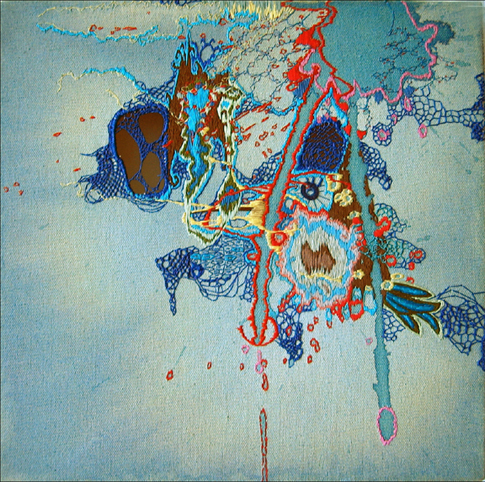 Monkey See and Do, 12″ x 12″, thread on canvas, 2006. Image courtesy of the artist.
This work began as organic stains on fabric that were then hand embroidered by the artist. The process of embroidery is a laborious one, at once meticulous and fine. So from first glance one sense’s the accidental nature of a stain, and begins appreciating the shape and color, only to find that there is a complicated handiwork involved, one with very intentional impulses. The artist has said about her own work in general,
Monkey See and Do, 12″ x 12″, thread on canvas, 2006. Image courtesy of the artist.
This work began as organic stains on fabric that were then hand embroidered by the artist. The process of embroidery is a laborious one, at once meticulous and fine. So from first glance one sense’s the accidental nature of a stain, and begins appreciating the shape and color, only to find that there is a complicated handiwork involved, one with very intentional impulses. The artist has said about her own work in general,
I love art that encourages a perceptual shift in the viewer, particularly a humorous one. My work in a certain sense is a one-line joke about the rewards of “looking closer,” although obviously it’s really labor intensive and complicated as well. I began this technique as an outgrowth of painting and then collaging with fabric, but I got interested in thread and the tiny, rigid structures of the stitches. I became curious about why stitching was always stigmatized as decorative and crafty – I went about finding the least practical, least structured, least controlled graphic imagery that I could embroider and happened upon the “drip.” I liked the idea that from a distance the pieces would look so fluid and painterly, but contain this surprise of shockingly time-consuming deliberation.Karen Rosenberg’s 2009 NY Times review places Lubelski’s work in the art historical category of artists who ‘paint’ with thread, such as Ghada Amer and Michael Raedecker. The review also illustrates the relation of masculine and feminine elements inherent in her work, as in the ‘male arts of paint-splashing’ and the ‘female fabric-staining and needlework’. There is a tension between the feminine and masculine aspects of the work that grows stronger with the introduction of the digital medium.
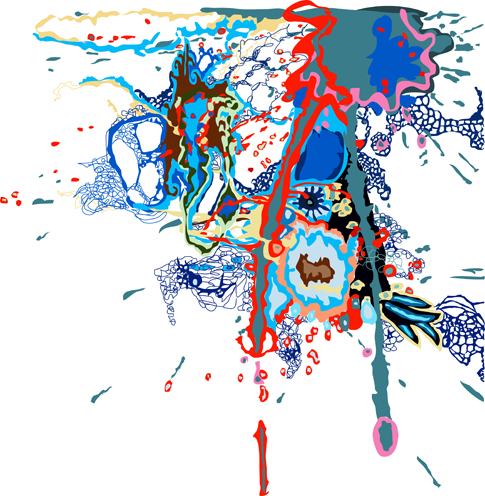 Monkey See and Do, digital tracing, 2010. Image courtesy of the artist.
In order to produce this work for The Present Group, Lubelski chose to work with a machine to embroider her original design. She began by doing a computer drawing that was a tracing of an earlier piece that she had stitched by hand in response to an organic stain, wanting to see what would happen if she fed that drawing into a computer stitching program without any changes or explanations. In the context of her process, she was letting go of control and trusting the machine to reproduce an image in its own way. Lubelski described this change in process as simultaneously embracing chaos and control.
Is something lost in the translation of the machines paths, something that existed in the hand-embroidered stitches? Or is the translation actually more direct due to the nature of the process? Does the machine embroidery change the value of the piece? Much has been written in postmodern theory about the loss of the original in nearly every medium from film to painting. As Baudrillard referenced,
Monkey See and Do, digital tracing, 2010. Image courtesy of the artist.
In order to produce this work for The Present Group, Lubelski chose to work with a machine to embroider her original design. She began by doing a computer drawing that was a tracing of an earlier piece that she had stitched by hand in response to an organic stain, wanting to see what would happen if she fed that drawing into a computer stitching program without any changes or explanations. In the context of her process, she was letting go of control and trusting the machine to reproduce an image in its own way. Lubelski described this change in process as simultaneously embracing chaos and control.
Is something lost in the translation of the machines paths, something that existed in the hand-embroidered stitches? Or is the translation actually more direct due to the nature of the process? Does the machine embroidery change the value of the piece? Much has been written in postmodern theory about the loss of the original in nearly every medium from film to painting. As Baudrillard referenced,
“The simulacrum is never that which conceals the truth–it is the truth which conceals that there is none. The simulacrum is true—Ecclesiastes.”Postmodern theorists often looked to production and reproduction and the inevitable commercialization of art. But the conclusion was that the loss of the original does not signify a bad thing, it opens up progressive possibilities of both process and accessibility. In Old Tricks for New Monkeys, the beauty and wonder of the handmade is still inherent. In fact, digital media here combines the skills of the artist and the machine and expands the artistic practice. Lubelski successfully integrates the feminine and the masculine, the analog and the digital, the original and the reproduction, not favoring one over the other, but developing an artwork full of seemingly opposite threads that provide room for visual and conceptual dialog. . . Jennifer McCabe is currently Executive Director and Chief Curator of the Museum of Craft and Folk Art in San Francisco, where she has been working for three years to develop new programs and expand the image of the 26-year old institution. She is also an adjunct professor in contemporary art, most recently at Mills College. www.mocfa.org
Artist Interviews blog Old Tricks for New Monkeys TPG15
 Nava Lubelski in her studio. Photo courtesy of the artist.
[display_podcast]
Nava Lubelski in her studio. Photo courtesy of the artist.
[display_podcast]
 Lubleski’s Studio, 2010 Photo courtesy of the artist.
blog Old Tricks for New Monkeys TPG15
 Old Tricks for New Monkeys is an edition of 70 machine embroidered canvases. The work contrasts the accidental with the meticulous, depicting the chaos of a spill, delicately recreated with thread.
 Nava Lubelski was born and raised in New York City and is living currently in Asheville, NC. Lubelski’s work has been included in two exhibitions at the Museum of Arts & Design in Manhattan, and has also been seen recently at the Weatherspoon Art Museum in Greensboro, NC and the Queens Museum of Art in Queens, NY, where her work is part of the permanent collection. Lubelski’s 2009 solo show at LMAKprojects in New York City was reviewed in the New York Times, which referred to Lubelski as being “in the category of artists who ‘paint’ with thread.” She has had two solo shows with OH&T Gallery in Boston and additional recent exhibitions include group shows in L.A., Stockholm and Berlin. Lubelski was a featured artist in the book Contemporary Textiles: The Fabric of Fine Art, published in 2008 by Black Dog Publishing in London. She has received grants from The Pollock-Krasner Foundation and the New York Foundation for the Arts. Lubelski received a degree in Russian Literature & History from Wesleyan University in 1990 and spent a year as a student in Moscow, Russia.
art and politics arts funding blog value of art
art and craft blog events exhibits news
 The Present Group will be taking part in East Carolina’s Print Summit 2010: a three day symposium consisting of exhibitions, lectures, demonstrations celebrating the diversity of contemporary printmaking media. We’ll be showing Whitney Lynn‘s DIY Survival Kit as part of “A Survey of Contemporary Printmaking,” an exhibition that includes the work of some of the most influential and important printmakers working in the US today.
Matt Egan and Michael Ehlbeck, professors of printmaking at East Carolina University, brought together five individuals to co-curate an exhibition that would offer a comprehensive look at the innovations and excellence that are shaping the course printmaking today. Along with many other lectures through the weekend (um, Karen Kunc!), these curators will discuss the collection they brought together and take a look at the current state of printmaking.
The Curators:
Bill Fick, of Cockeyed Press and co-author of “Printmaking: A Complete Guide to Materials and Process.”
Beth Grabowski, Professor of Art at UNC Chapel Hill and co-author of “Printmaking: A Complete Guide to Materials and Process.”
Rockie Toner, former Dean of the Tyler School of Art.
R.L. Tillman, artist, educator and co-founder of “Printeresting.”
Matt Rebholz, Assistant Professor, Southwestern University, Georgetown, TX.
The Details:
The Summit is hosted by the Printmaking Department of East Carolina University in Greenville, North Carolina, September 9 -11, 2010.
“A Survey of Contemporary Printmaking” will be on view at:
Gray Gallery, School of Art and Design, East Carolina University.
September 7th through October 2nd, 2010, Opening Reception 7:00 Friday, September 10th
Panel Discussion for “A Survey of Contemporary Printmaking”
5:30 – 7:00 pm Speight Auditorium , Room 1220- School of Art and Design
The Present Group will be taking part in East Carolina’s Print Summit 2010: a three day symposium consisting of exhibitions, lectures, demonstrations celebrating the diversity of contemporary printmaking media. We’ll be showing Whitney Lynn‘s DIY Survival Kit as part of “A Survey of Contemporary Printmaking,” an exhibition that includes the work of some of the most influential and important printmakers working in the US today.
Matt Egan and Michael Ehlbeck, professors of printmaking at East Carolina University, brought together five individuals to co-curate an exhibition that would offer a comprehensive look at the innovations and excellence that are shaping the course printmaking today. Along with many other lectures through the weekend (um, Karen Kunc!), these curators will discuss the collection they brought together and take a look at the current state of printmaking.
The Curators:
Bill Fick, of Cockeyed Press and co-author of “Printmaking: A Complete Guide to Materials and Process.”
Beth Grabowski, Professor of Art at UNC Chapel Hill and co-author of “Printmaking: A Complete Guide to Materials and Process.”
Rockie Toner, former Dean of the Tyler School of Art.
R.L. Tillman, artist, educator and co-founder of “Printeresting.”
Matt Rebholz, Assistant Professor, Southwestern University, Georgetown, TX.
The Details:
The Summit is hosted by the Printmaking Department of East Carolina University in Greenville, North Carolina, September 9 -11, 2010.
“A Survey of Contemporary Printmaking” will be on view at:
Gray Gallery, School of Art and Design, East Carolina University.
September 7th through October 2nd, 2010, Opening Reception 7:00 Friday, September 10th
Panel Discussion for “A Survey of Contemporary Printmaking”
5:30 – 7:00 pm Speight Auditorium , Room 1220- School of Art and Design
art world blog businessy stuff marketing/pr















Lego Hello World
I wish all my printers were made of legos.
LIFE photo archive hosted by Google
Images from Life Magazine going back to 1860’s, hosted by Google
Coming Face To Face With The President
Well crafted story about an under-heard point of view.
In California, Pot Is Now an Art Patron
A new funding source for the arts – reaping big rewards and funding many projects. It’s pot.
Notes on Portraiture in the Facebook Age
Celebrity Book Club: A List to End All Lists
Because, well, it’s sortof awesome.
Are "Artists' Statements" Really Necessary?
The pros and cons about that nemesis for most artists.
This to That
You tell it what you’ve got and it’ll tell you what to glue them together with.
Work of art: Online store for buyers, sellers
Not the TV show! Kelly Lynn Jones from Little Paper Planes is interviewed on her project, gives us a cheat sheet to local affordable art resources.