Gifotrope – take control of your gifs
art meets design blog internet news we make stuff
blog internet The Present Prize
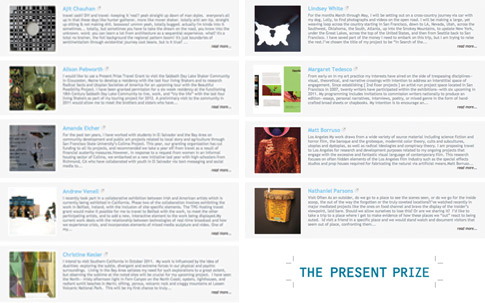
The Present Prize#3: Research-Based Studio Practice Nominees are:
Collin McKelvey and John Davis
Jaimie Healy
Art Micro Patronage art world arts funding blog internet new models we make stuff
blog internet we make stuff web hosting
Since Indexhibit Version 2 is still somewhat new, and we offer to install it for our hosting clients, we thought we would build something that would encourage familiarity with the platform, help people understand how it works before (and after) installation, and help us learn its advantages and pitfalls. Periodically, we update the site with something we’ve been fielding questions about.
Happy website making!
Indexhibit v2 Tutorial Website
bay area blog events internet news talking web hosting
So we’ve decided to team up with Southern Exposure in order to teach a class on how to do just that. Sign up – space is limited.
You can read all about it here.
arts funding blog internet news public art The Present Prize web hosting
Peter Hasson: Praying Ping Pong by Jesse Nichols
www.putitonapedestal.com by Anthony Antonellis
Molteni Net Works by Maria Molteni and the New Craft Artists in Action
Sanctuary by Aaron Vincent Elkaim
Art Micro Patronage bay area curating events internet news public art talking
SMASH FACE ON KEYBOARD/POST RESULTS
Inverse Internet Operating Manual Live Artist Talk
7:30 p.m., March 22
ProArts
150 Frank H Ogawa Plaza Oakland, CA 94612
Join the artists of Inverse Internet Operating Manual and curator Dena Beard to reverse engineer the World Wide Web. Cycling between physical and virtual states, they will impart daring instructions for browsing, poaching, crowd-sourcing, misusing our favorite non-site. Finally, exasperated, they may ask: how do we look at art online?
This talk will be broadcast live at http://artmicropatronage.org/talks.
Pose your questions in person, via the website, email (info@artmicropatronage.org), or twitter (@AMPatronage).
Hosted by Art Micro Patronage, a project of The Present Group.
Art Micro Patronage arts funding blog contemporary art criticism internet new models the exposure problem
If an ideal environment of an artists working online lies within the personal computing web-browsing experience, then why the need for relocating these works into another specific website/framing? What is “more accessible” about an online gallery then an artists personal website? Are the tropes from the traditional gallery system still playing too significant a role in the way in which net-art is being presented?With Art Micro Patronage the idea of the curated group show is central. We’re trying to encourage criticality about what is happening online by hiring curators to bring together artists whose work explores similar themes. The internet is incredibly diverse and far flung which makes the process of synthesis and curation that much more important. I trust some institutions and curators to do the research and outreach to bring to my attention artists whose work I may not have been exposed to otherwise, but also to highlight what is happening more broadly. So maybe it’s not the works themselves that are rendered more accessible, but rather the connections between them.
To favor one system over the other, or to underscore the supposed ignorance of major cultural institutions for not having more net based art, can position the artist, work, or community as having ingrained entitlement due to its novelty.I’m not sure I agree that it deserves entitlement due to its novelty. In the late 90’s and early 2000’s there were quite a few institutions that were collecting and attempting to show net art. But most gave it up. At that point there was an exuberance about the novelty of anything and everything that was happening online. However now I believe we’re at the point where the technology has caught up and the novelty has died down, and because it is so ingrained in our culture, the work that is happening online in a cultural context deserves critical attention. It was in part the recognition that artists working online isn’t novel at all that motivated us to do this project. Further, we hope to continue expanding the idea of what is considered “netart”. We intentionally found curators working in diverse parts of the artworld in order to cull different works and types of shows. For example, our next show curated by Dena Beard highlights the work of primarily social practice and conceptual artists who use the web to document their more ephemeral practice or as a site of exchange. While these may not be “net artists”, the internet is an important part of their practice.
Art Micro Patronage blog internet neat projects new models news we make stuff
What started as a few vague ideas about the possibilities of micro-donations mixed in with questions about “collecting” digital artwork is now a full-blown, beautifully designed, web application for supporting online artists.
Art Micro Patronage is an experimental online exhibition space enabling you to view and support artwork that is ideally experienced on the internet. Built on the generosity of people like you, AMP is a vehicle for a new generation of art patrons, who are willing to associate their appreciation of great work with actual dollar amounts, no matter how small.We’re extremely proud, and also curious if anyone will use it. So please, check it out. Each month we’ll present a new online exhibition. And while you’re there, become a micro-patron of the arts by giving a small donation to the artists who pieces you like.
blog events exhibits internet social media art TPG artists TPG9
TPG 9 artist David Horvitz (@davidhorvitz) has been commissioned by Creative Time to produce a hard copy of every tweet containing the hashtag #VadeMecum (Latin for “Go with me” and meaning a reference book designed to be carried) between June 17 and June 23. On June 24, he will carry the materialized tweets by train from San Francisco to Washington, D.C., following the route of the first transcontinental telegram (sent in 1861 from San Francisco to President Lincoln in the nation’s capital). Upon arrival in Washington, D.C., the entire collection will be submitted to the Library of Congress and donated to a public archive, where it will remain accessible.
Through the project, Horvitz will give his audience’s tweets literal and metaphorical weight. Serving as an anachronistic messenger in an era in which distance is no longer an obstacle to communication, Horvitz will re-engage with the relatively slow pace of the physical journey as a meaningful and transformative phase in the life of the message.
Read more here about the Creative Time Twitter Projects
View tweets here
View David’s transcriptions of the tweets here
Art Micro Patronage arts funding blog curating internet new models
This fall, Oliver and I will be debuting our new project: Art Micro-Patronage. It’s an experimental exhibiiton platform that tries to figure out good ways to both display and fund artwork that is ideally viewed online. As visitors navigate through the monthly exhibitions, they will be encouraged to become micro-patrons of the arts, associating their appreciation of the works with small monetary values. Only patrons will be able to view the exhibitions once the shows are over and they will receive a link and image as recognition for their generosity.
And we’re looking for curators!
Here are the specs:
What are we looking for?
We seek tightly curated shows of works that are ideally experienced on the internet. Shows can be organized thematically or formally. Some possibilities include (but are not limited to): artists working with twitter and facebook, digital artwork, video, sound, animated gifs, interactive works, web-based campaigns, physical works that address or involve the web in some way, documentary websites of artists working with intangibles. We would like these to be group shows of between 7-15 artists and we would like the curator to write 400 – 600 word intro to the exhibition. Shows will last 1 month.
How does it work?
We will encourage visitors to the shows to donate small amounts ($.50, $1, $5) directly to the artists as they navigate from piece to piece, similar to a “like” button only with pledging and a navigation element: if they press a donate amount, they are moved forward to the next piece in show. AMP will take a small administrative cut from the proceeds in order to cover the transaction fees and to sustain funds for the next set of 6 (we have secured funding for the first set of 6 shows). Only the patrons will have access to the show after the month is over; the general public will still have access to the written piece by the curator and see the list of artists that were involved with the show. Patrons will also be given recognition and links on a donor’s page for each show (and each piece while the show is up). Curators will receive a stipend of $200 upon completion of their project.
We have also set aside money for web development with each show, so we can work with you to figure out the best viewing experience to suit the artworks’ particular needs.
Submissions:
Please explain your proposed show and give 2-4 examples of pieces along the lines of what you’d like to highlight.
Submit your contact info and proposal to: submit [at] artmicropatronage.org
arts funding bay area blog good things internet new models news web hosting
The Present Prize is an intermittent artist grant funded by web hosting fees and awarded by the community of hostees with help from the general public. Each grant period will have a new theme targeting an underfunded area of the creative landscape.
For our first prize, we have teamed up with the Collective Foundation to create a $1K travel grant to a Bay Area artist in order to address a possible reason why Bay Area artists often leave the area after a period of “incubation”. Joseph delPesco, founder of the Collective Foundation speaks eloquently about the reasoning behind this grant theme on the SF Moma blog. (excerpt below)
“Unlike most first-world countries we don’t have a cultural agency at the state or federal level that funds artists’ travel. I have an untested theory that if Bay Area artists had support for mobility that they would be more likely to stay. While the last sentence may sound counter-intuitive, I think one reason artists leave is the relative isolation of the Bay Area in relation to the art centers. More to the point, It appears that most of the artists who have stayed are those who have been able to develop projects and find exhibition opportunities outside of the Bay Area.”
art world arts funding blog curating exhibits internet new models reading list show me the money
art and craft artist resources blog businessy stuff internet others lives
Once a year, we produce a Subscriber’s Choice Edition. We narrow down the proposals to five and allow our subscribers and the past year of artists and critics to vote. I think we have a really strong group of proposals this year. Check them out here.
The finalists are:
Lego Hello World
I wish all my printers were made of legos.
LIFE photo archive hosted by Google
Images from Life Magazine going back to 1860’s, hosted by Google
Coming Face To Face With The President
Well crafted story about an under-heard point of view.
In California, Pot Is Now an Art Patron
A new funding source for the arts – reaping big rewards and funding many projects. It’s pot.
Notes on Portraiture in the Facebook Age
Celebrity Book Club: A List to End All Lists
Because, well, it’s sortof awesome.
Are "Artists' Statements" Really Necessary?
The pros and cons about that nemesis for most artists.
This to That
You tell it what you’ve got and it’ll tell you what to glue them together with.
Work of art: Online store for buyers, sellers
Not the TV show! Kelly Lynn Jones from Little Paper Planes is interviewed on her project, gives us a cheat sheet to local affordable art resources.