Annotated Links for TPG 21
Annotated Links blog Ten Banners for Home and Office TPG21
Christine’s Links:
 Elaine Fox’s Rainy Brain, Sunny Brain (2012)
A cognitive psychologist looks at optimism and pessimism.
This is an enjoyable new mass-market book revealing the neurological centers of approach and avoidance instincts. Fox’s voice is a welcome addition to my understanding of the field of positive psychology. After just the first chapter, I recast my personal setbacks in running with a more positive perspective on my progress. Just as pleasure is fleeting, my ability to stay optimistic can waver over time. Books such as this are like nutrients that remind me to activate the skills of optimism.
———————————————————————————-
Mihaly Csikszentmihalyi and Rick Emery Robinson’s The Art of Seeing: An Interpretation of the Aesthetic Encounter (1990)
This book may be purchased at http://www.powells.com/biblio/61-9780892361564-1In 1985, the Getty commissioned a pair of researchers to conduct a study on the nature of the aesthetic experience, with a focus on finding correlations with flow, or optimal experience. The methods and findings are detailed in this out-of-print, academically-written book. Artists and curators will find some of the results basic, however, the rigor with which the researchers parsed the dimensions of aesthetic experience helped clarify my understanding of how art objects function, what viewers must bring to aesthetic experiences, and how viewers shape their experiences with artworks.
———————————————————————————-
Constructing personal devil and angel archetypes
Elaine Fox’s Rainy Brain, Sunny Brain (2012)
A cognitive psychologist looks at optimism and pessimism.
This is an enjoyable new mass-market book revealing the neurological centers of approach and avoidance instincts. Fox’s voice is a welcome addition to my understanding of the field of positive psychology. After just the first chapter, I recast my personal setbacks in running with a more positive perspective on my progress. Just as pleasure is fleeting, my ability to stay optimistic can waver over time. Books such as this are like nutrients that remind me to activate the skills of optimism.
———————————————————————————-
Mihaly Csikszentmihalyi and Rick Emery Robinson’s The Art of Seeing: An Interpretation of the Aesthetic Encounter (1990)
This book may be purchased at http://www.powells.com/biblio/61-9780892361564-1In 1985, the Getty commissioned a pair of researchers to conduct a study on the nature of the aesthetic experience, with a focus on finding correlations with flow, or optimal experience. The methods and findings are detailed in this out-of-print, academically-written book. Artists and curators will find some of the results basic, however, the rigor with which the researchers parsed the dimensions of aesthetic experience helped clarify my understanding of how art objects function, what viewers must bring to aesthetic experiences, and how viewers shape their experiences with artworks.
———————————————————————————-
Constructing personal devil and angel archetypes
 Actor Henry Winkler Plays “Not My Job,” and “Fabulous” New Yorkers
I was tired and lost on the Van Wyck Expressway when I heard a seven-minute interview with Henry Winkler that snapped me outside of my miserable, inward perspective. Winkler seems irrepressibly happy, with no complaints or regrets. The interview reminded me that you find what you look for in daily life, whether conflicts or beauty, complaints or humor.
I have been thinking a lot about how being in New York is changing me for the better and worse, illustrated by extreme New Yorker archetypes. The first is the stereotypical obnoxious, complaining, defensive New Yorker. (This is mostly caricature, though the city’s density can breed impatience for social niceties.) The other archetype is the one that Winkler seems to exemplify: the live-and-let-live New Yorker, who is constantly finding things “fabulous” and appreciates life in all its manifestations. Winkler would make a great happiness role model.
———————————————————————————-
Greater Good Science Center at UC Berkeley
Actor Henry Winkler Plays “Not My Job,” and “Fabulous” New Yorkers
I was tired and lost on the Van Wyck Expressway when I heard a seven-minute interview with Henry Winkler that snapped me outside of my miserable, inward perspective. Winkler seems irrepressibly happy, with no complaints or regrets. The interview reminded me that you find what you look for in daily life, whether conflicts or beauty, complaints or humor.
I have been thinking a lot about how being in New York is changing me for the better and worse, illustrated by extreme New Yorker archetypes. The first is the stereotypical obnoxious, complaining, defensive New Yorker. (This is mostly caricature, though the city’s density can breed impatience for social niceties.) The other archetype is the one that Winkler seems to exemplify: the live-and-let-live New Yorker, who is constantly finding things “fabulous” and appreciates life in all its manifestations. Winkler would make a great happiness role model.
———————————————————————————-
Greater Good Science Center at UC Berkeley
 GGSC’s blog features short, practical articles written by positive psychologists. The advice for improving subjective well-being is straightforward and, crucially, rooted in empirical studies (unlike self-help). Recommended for those with interest in‚ but not much time for‚ applying positive psychology in their lives.
———————————————————————————-
Simon and Tom Bloor
GGSC’s blog features short, practical articles written by positive psychologists. The advice for improving subjective well-being is straightforward and, crucially, rooted in empirical studies (unlike self-help). Recommended for those with interest in‚ but not much time for‚ applying positive psychology in their lives.
———————————————————————————-
Simon and Tom Bloor
 Fraternal artists based in Birmingham and London, UK.
The Bloors make drawings, paintings, wall texts, sculptures, and public projects around play, public space, and modernist forms. Their latest projects, including schoolyard commissions, attempt to inspire informal interactions. I find that their works balance a cheery, earnest tone with formal and typographic sophistication and an open-endedness that invites intellectual engagement.
———————————————————————————-
Michael Jones McKean’s The Rainbow: Certain Principles of Light and Shapes Between Forms
Fraternal artists based in Birmingham and London, UK.
The Bloors make drawings, paintings, wall texts, sculptures, and public projects around play, public space, and modernist forms. Their latest projects, including schoolyard commissions, attempt to inspire informal interactions. I find that their works balance a cheery, earnest tone with formal and typographic sophistication and an open-endedness that invites intellectual engagement.
———————————————————————————-
Michael Jones McKean’s The Rainbow: Certain Principles of Light and Shapes Between Forms
 Ambitious site-specific weather project at the Bemis Center for Contemporary Art, Omaha, NE
———————————————————————————-
McMaster-Carr’s website
Ambitious site-specific weather project at the Bemis Center for Contemporary Art, Omaha, NE
———————————————————————————-
McMaster-Carr’s website
 I wish every website I use for procurement was as clean, informative, and easy to navigate as this.
The speed and ease of the virtual world can create false expectations, making manipulating the material world seem frustrating and slow. McMaster-Carr’s site provides generous access to material information, dimensions, and technical illustrations, exemplifying how material problem-solving can be facilitated with elegantly-dense interaction design.
———————————————————————————-
Hida Tool
I wish every website I use for procurement was as clean, informative, and easy to navigate as this.
The speed and ease of the virtual world can create false expectations, making manipulating the material world seem frustrating and slow. McMaster-Carr’s site provides generous access to material information, dimensions, and technical illustrations, exemplifying how material problem-solving can be facilitated with elegantly-dense interaction design.
———————————————————————————-
Hida Tool
 Though I use common materials in my work, I love fine tools. One of the great tragedies of our generation is the rarity of our encounters with objects that will last a lifetime, and further, specialists with wells of knowledge and enthusiasm for particular materials or tools. Hida is one such loci of connoisseurship. Based in Berkeley, this mom-and-pop shop sells Japanese hand tools, specializing in kitchen knives, gardening implements, and woodworking tools. I purchased wood-carving gouges from Hida 15 years ago, and they are holding up promisingly well. Hida’s specialness was recently brought to the fore again, when I decided to buy a Japanese saw, and could find no suitable counterpart in New York City.
———————————————————————————-
TPG’s Links:
Christine’s work is influenced by the field of Positive Psychology.
This is a field concerned with why minds function well rather than the opposite… A brief primer can be found
courtesy of Wikipedia.
http://en.wikipedia.org/wiki/Positive_psychology
———————————————————————————-
Thrive! – The Living Well Show
Though I use common materials in my work, I love fine tools. One of the great tragedies of our generation is the rarity of our encounters with objects that will last a lifetime, and further, specialists with wells of knowledge and enthusiasm for particular materials or tools. Hida is one such loci of connoisseurship. Based in Berkeley, this mom-and-pop shop sells Japanese hand tools, specializing in kitchen knives, gardening implements, and woodworking tools. I purchased wood-carving gouges from Hida 15 years ago, and they are holding up promisingly well. Hida’s specialness was recently brought to the fore again, when I decided to buy a Japanese saw, and could find no suitable counterpart in New York City.
———————————————————————————-
TPG’s Links:
Christine’s work is influenced by the field of Positive Psychology.
This is a field concerned with why minds function well rather than the opposite… A brief primer can be found
courtesy of Wikipedia.
http://en.wikipedia.org/wiki/Positive_psychology
———————————————————————————-
Thrive! – The Living Well Show
 Online radio webcasting about positive psychology.
———————————————————————————-
Flow, the Secret to Happiness
Online radio webcasting about positive psychology.
———————————————————————————-
Flow, the Secret to Happiness
 Christine references the work of Mihaly Csikszentmihalyi. In this TED talk he discusses the creative ‘flow’ state.
—
How That Sausage of Happiness Is Made
Christine references the work of Mihaly Csikszentmihalyi. In this TED talk he discusses the creative ‘flow’ state.
—
How That Sausage of Happiness Is Made
 Stefan Sagmeister is another artist who investigates notions of happiness. This article describes a recent show of his and an upcoming movie project. Both are concerned with what constitutes happiness and how it may be achieved.
Elaine Fox’s Rainy Brain, Sunny Brain (2012)
A cognitive psychologist looks at optimism and pessimism.
This is an enjoyable new mass-market book revealing the neurological centers of approach and avoidance instincts. Fox’s voice is a welcome addition to my understanding of the field of positive psychology. After just the first chapter, I recast my personal setbacks in running with a more positive perspective on my progress. Just as pleasure is fleeting, my ability to stay optimistic can waver over time. Books such as this are like nutrients that remind me to activate the skills of optimism.
———————————————————————————-
Mihaly Csikszentmihalyi and Rick Emery Robinson’s The Art of Seeing: An Interpretation of the Aesthetic Encounter (1990)
This book may be purchased at http://www.powells.com/biblio/61-9780892361564-1In 1985, the Getty commissioned a pair of researchers to conduct a study on the nature of the aesthetic experience, with a focus on finding correlations with flow, or optimal experience. The methods and findings are detailed in this out-of-print, academically-written book. Artists and curators will find some of the results basic, however, the rigor with which the researchers parsed the dimensions of aesthetic experience helped clarify my understanding of how art objects function, what viewers must bring to aesthetic experiences, and how viewers shape their experiences with artworks.
———————————————————————————-
Constructing personal devil and angel archetypes
Actor Henry Winkler Plays “Not My Job,” and “Fabulous” New Yorkers
I was tired and lost on the Van Wyck Expressway when I heard a seven-minute interview with Henry Winkler that snapped me outside of my miserable, inward perspective. Winkler seems irrepressibly happy, with no complaints or regrets. The interview reminded me that you find what you look for in daily life, whether conflicts or beauty, complaints or humor.
I have been thinking a lot about how being in New York is changing me for the better and worse, illustrated by extreme New Yorker archetypes. The first is the stereotypical obnoxious, complaining, defensive New Yorker. (This is mostly caricature, though the city’s density can breed impatience for social niceties.) The other archetype is the one that Winkler seems to exemplify: the live-and-let-live New Yorker, who is constantly finding things “fabulous” and appreciates life in all its manifestations. Winkler would make a great happiness role model.
———————————————————————————-
Greater Good Science Center at UC Berkeley
GGSC’s blog features short, practical articles written by positive psychologists. The advice for improving subjective well-being is straightforward and, crucially, rooted in empirical studies (unlike self-help). Recommended for those with interest in‚ but not much time for‚ applying positive psychology in their lives.
———————————————————————————-
Simon and Tom Bloor
Fraternal artists based in Birmingham and London, UK.
The Bloors make drawings, paintings, wall texts, sculptures, and public projects around play, public space, and modernist forms. Their latest projects, including schoolyard commissions, attempt to inspire informal interactions. I find that their works balance a cheery, earnest tone with formal and typographic sophistication and an open-endedness that invites intellectual engagement.
———————————————————————————-
Michael Jones McKean’s The Rainbow: Certain Principles of Light and Shapes Between Forms
Ambitious site-specific weather project at the Bemis Center for Contemporary Art, Omaha, NE
———————————————————————————-
McMaster-Carr’s website
I wish every website I use for procurement was as clean, informative, and easy to navigate as this.
The speed and ease of the virtual world can create false expectations, making manipulating the material world seem frustrating and slow. McMaster-Carr’s site provides generous access to material information, dimensions, and technical illustrations, exemplifying how material problem-solving can be facilitated with elegantly-dense interaction design.
———————————————————————————-
Hida Tool
Though I use common materials in my work, I love fine tools. One of the great tragedies of our generation is the rarity of our encounters with objects that will last a lifetime, and further, specialists with wells of knowledge and enthusiasm for particular materials or tools. Hida is one such loci of connoisseurship. Based in Berkeley, this mom-and-pop shop sells Japanese hand tools, specializing in kitchen knives, gardening implements, and woodworking tools. I purchased wood-carving gouges from Hida 15 years ago, and they are holding up promisingly well. Hida’s specialness was recently brought to the fore again, when I decided to buy a Japanese saw, and could find no suitable counterpart in New York City.
———————————————————————————-
TPG’s Links:
Christine’s work is influenced by the field of Positive Psychology.
This is a field concerned with why minds function well rather than the opposite… A brief primer can be found
courtesy of Wikipedia.
http://en.wikipedia.org/wiki/Positive_psychology
———————————————————————————-
Thrive! – The Living Well Show
Online radio webcasting about positive psychology.
———————————————————————————-
Flow, the Secret to Happiness
Christine references the work of Mihaly Csikszentmihalyi. In this TED talk he discusses the creative ‘flow’ state.
—
How That Sausage of Happiness Is Made
Stefan Sagmeister is another artist who investigates notions of happiness. This article describes a recent show of his and an upcoming movie project. Both are concerned with what constitutes happiness and how it may be achieved.
 Two decades later, faced with Christine’s Present Group piece Ten Banners for Home and Office, I have a very different impulse. I want to peel the banners from their paper backing and stick them everywhere. I want to use them as labels, pronouncements, and notices. I want them on notebooks, newspaper boxes, and a card to my best friend. I realize now any sense of loss I might feel from the initial removal of a sticker from my possession will be more than countered by the cheer it will eventually bring both me and others. Instead of preserving the sticker sheet as a whole, I want to test the sticker’s ability to dazzle me for days on end. My six-year-old self wouldn’t understand, but Christine’s stickers lead me to understand something of myself and her practice simultaneously: distributing good and cheerful things into the world begets real and lasting pleasure. Happiness comes from sharing ideas and resources, forging new connections within a community of one’s own making. If Christine’s stickers are a present, in my hands they yearn to be re-gifted.
If all this sounds a bit sappy, I blame the effects of holographic vinyl on my brain.
Christine’s work fosters this elevated mood—in everything from her Positive Signs series to ribbon texts, from Flag Snowflakes to mixed media installations. She encourages the viewer not only to be happier, but to question the conditions of that happiness. She is drawn to innocent declarative modes: gel pens on graph paper, hand-sewn banners, cheery office supplies, dollar store finds, and general “knickknackery.” Too often, she argues, cheap disposable materials are seen as depressing. Making this connection allows pessimism to be more commonplace than it needs to be and, in turn, undermines the very real pleasure that can be extracted from brightly-colored plastic objects.
Two decades later, faced with Christine’s Present Group piece Ten Banners for Home and Office, I have a very different impulse. I want to peel the banners from their paper backing and stick them everywhere. I want to use them as labels, pronouncements, and notices. I want them on notebooks, newspaper boxes, and a card to my best friend. I realize now any sense of loss I might feel from the initial removal of a sticker from my possession will be more than countered by the cheer it will eventually bring both me and others. Instead of preserving the sticker sheet as a whole, I want to test the sticker’s ability to dazzle me for days on end. My six-year-old self wouldn’t understand, but Christine’s stickers lead me to understand something of myself and her practice simultaneously: distributing good and cheerful things into the world begets real and lasting pleasure. Happiness comes from sharing ideas and resources, forging new connections within a community of one’s own making. If Christine’s stickers are a present, in my hands they yearn to be re-gifted.
If all this sounds a bit sappy, I blame the effects of holographic vinyl on my brain.
Christine’s work fosters this elevated mood—in everything from her Positive Signs series to ribbon texts, from Flag Snowflakes to mixed media installations. She encourages the viewer not only to be happier, but to question the conditions of that happiness. She is drawn to innocent declarative modes: gel pens on graph paper, hand-sewn banners, cheery office supplies, dollar store finds, and general “knickknackery.” Too often, she argues, cheap disposable materials are seen as depressing. Making this connection allows pessimism to be more commonplace than it needs to be and, in turn, undermines the very real pleasure that can be extracted from brightly-colored plastic objects.
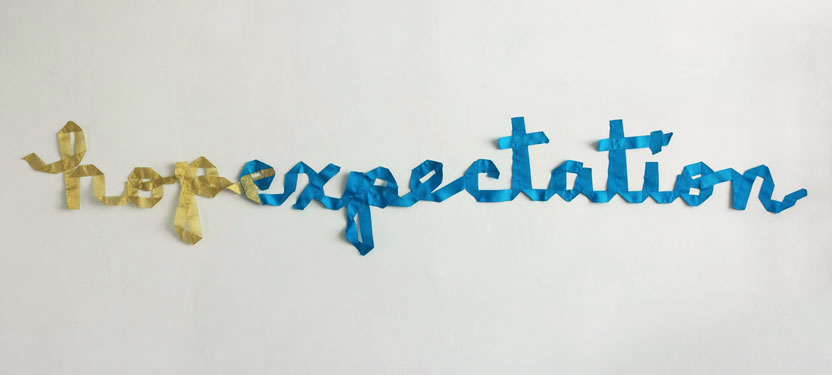 Christine Wong Yap, hopexpectation, 2011, 101 x 18 x 1 in

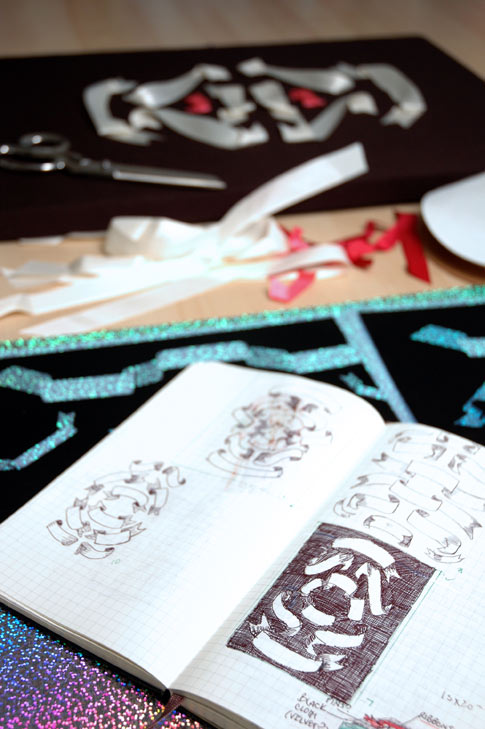
 By artist Christine Wong Yap, Ten Banners for Home and Office is an edition of 50 three color silk-screened holographic glitter vinyl posters with 8 peel off stickers. This super-sized sticker sheet reminds us that everyday there is something worthy of a little recognition and exaltation. Whether or not you actually fill in the blank stickers or ever remove them from their backing sheet, they act as both an invitation and a challenge to focus on the good parts of everyday.


 This week we’ll be finally sending out
 We’re very pleased to announce that the artist for TPG #21 is