Art Market Money
art and politics art market blog TPG8
via NPR:

art and politics art market blog TPG8
 Panelists for the Feb. 3 debate included (from left) Jerry Saltz, Amy Cappellazzo, Chuck Close and Adam Lindemann. Longview Photography
art and politics bay area blog events news State of the Arts TPG8
 Building on the discussion that began with our eighth issue, “State of the Arts“, we’ll be hosting a Visual Arts Town Hall Meeting in Old Oakland Saturday February 21st from 3-5. Moderated by curator Joseph del Pesco, the meeting will be a chance for artists, gallerists, political figures and the public to discuss the way government can influence and support local art production. We’ll share opportunities that already exist and try to identify simple steps to creating a more sustainable visual arts community.
Participants will include: David Huff (Program Coordinator/Curator Pro Arts), V Smoothe (“A Better Oakland” blog Editor ), Mike Bianco (Queens Nails Projects), Christian L. Frock (Invisible Venue), Kerri Johnson (Blankspace Gallery) Svea Lin Vezzone (Swarm Gallery) and artists: Amy Balkin, Steven Barich (Artopic.org), Helena Keeffe, Aaron Gach, Chris Sollars, David Stein
Visual Arts Town Hall
465 Ninth St. Oakland, CA 94607
February 21st: 3-5 pm
1st hour: moderated panel of gallerists, arts administrators, and politicos
coffee and snack break
2nd hour: artists from the State of the Arts project take the “stage” and respond to the panel and audience questions and comments
This event is sponsored in part by PSAI Old Oakland Associates and Southern Exposure
Building on the discussion that began with our eighth issue, “State of the Arts“, we’ll be hosting a Visual Arts Town Hall Meeting in Old Oakland Saturday February 21st from 3-5. Moderated by curator Joseph del Pesco, the meeting will be a chance for artists, gallerists, political figures and the public to discuss the way government can influence and support local art production. We’ll share opportunities that already exist and try to identify simple steps to creating a more sustainable visual arts community.
Participants will include: David Huff (Program Coordinator/Curator Pro Arts), V Smoothe (“A Better Oakland” blog Editor ), Mike Bianco (Queens Nails Projects), Christian L. Frock (Invisible Venue), Kerri Johnson (Blankspace Gallery) Svea Lin Vezzone (Swarm Gallery) and artists: Amy Balkin, Steven Barich (Artopic.org), Helena Keeffe, Aaron Gach, Chris Sollars, David Stein
Visual Arts Town Hall
465 Ninth St. Oakland, CA 94607
February 21st: 3-5 pm
1st hour: moderated panel of gallerists, arts administrators, and politicos
coffee and snack break
2nd hour: artists from the State of the Arts project take the “stage” and respond to the panel and audience questions and comments
This event is sponsored in part by PSAI Old Oakland Associates and Southern Exposure
art and politics bay area blog TPG8
art and politics bay area blog TPG8
art and politics bay area blog TPG8
 City Hall, San Francisco


 This stack awaits delivery to the mailboxes of the San Francisco Board of Supervisors


 On January 29th, we delivered to elected officials in Oakland. It was weird how many of the offices of all the state representatives in Oakland had bullet proof glass separating the secretaries from the public. Barbara Lee’s office had the most relaxed atmosphere, with workers in jeans. The secretary of Mayor Dellums was very nice, while Loni Hancock’s secretary asked the most questions and seemed the most interested in our project.


art and politics State of the Arts TPG8
 Gran Fury:A group in the 80’s and 90’s focused mostly on AIDS awareness, education, and visibility. They produced images and staged events to increase awareness, almost an ad campaign for AIDS awareness and education, yet funded through art institutions. An interview with Avram Finkelstein, an original member.
Guerrilla Girls: Raising awareness about sexism and racism in the art world since 1985.
Women’s Action Coalition [WAC]: is a grassroots radical women’s organization first formed in New York in January, 1992 when a group of women angered by the Anita Hill-Clarence Thomas hearings met to turn their outrage into creative street action for change. There were strong chapters in cities all around the country, notably Chicago and San Franciso.
Art Worker’s Coalition: Though short lived, (1969-71) this group did cause some real change for artists, especially in their relationships with museums. Documents from their Open Hearing and other materials available here.
Artists involved in the conversations:
Amy Balkin
Anthony Discenza
Aaron Gach
Eleanor Hanson
Packard Jennings
Helena Keeffe
Mads Lynnerup
Anthony Marcellini
Christian Maychack
Lee Montgomery
Lucas Murgida
Steve Shearer
Chris Sollars
David Stein
Oliver Wise
Gran Fury:A group in the 80’s and 90’s focused mostly on AIDS awareness, education, and visibility. They produced images and staged events to increase awareness, almost an ad campaign for AIDS awareness and education, yet funded through art institutions. An interview with Avram Finkelstein, an original member.
Guerrilla Girls: Raising awareness about sexism and racism in the art world since 1985.
Women’s Action Coalition [WAC]: is a grassroots radical women’s organization first formed in New York in January, 1992 when a group of women angered by the Anita Hill-Clarence Thomas hearings met to turn their outrage into creative street action for change. There were strong chapters in cities all around the country, notably Chicago and San Franciso.
Art Worker’s Coalition: Though short lived, (1969-71) this group did cause some real change for artists, especially in their relationships with museums. Documents from their Open Hearing and other materials available here.
Artists involved in the conversations:
Amy Balkin
Anthony Discenza
Aaron Gach
Eleanor Hanson
Packard Jennings
Helena Keeffe
Mads Lynnerup
Anthony Marcellini
Christian Maychack
Lee Montgomery
Lucas Murgida
Steve Shearer
Chris Sollars
David Stein
Oliver Wise
 Art Worker’s Coalition at PS1 Gallery
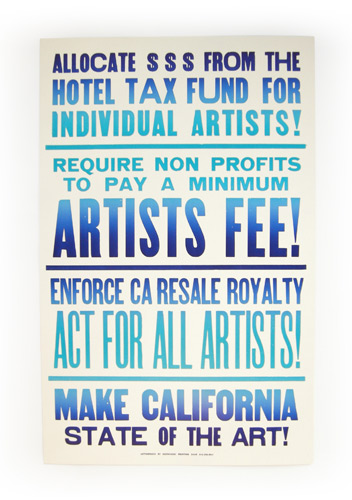
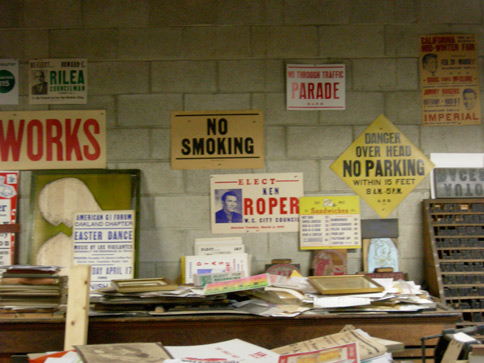
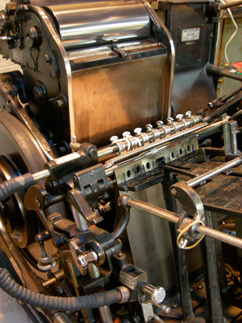
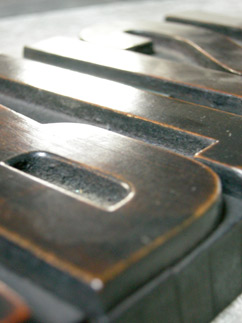
JdP: Historically groups like the Art Workers Coalition (est. 1969 in New York), which included revered artists like Hans Haacke and Carl Andre, created an open platform for discussion about the situation for artists and led to an open hearing and a statement of demands. The statement includes a demand that a percentage of the resale of artworks should go back to the artist. This demand was made law in California as the California Resale Royalty Act, which took effect on January 1st, 1977. This is a small demonstration that social will can create political change and that artists and their advocates can work together to make it happen. Contemporary iterations of this impulse can be found in the California Lawyers for the Arts. I think the goal is not to start the movement but to locate the people who are already aware of these issues and to work to continue to expand and connect the network. Part of the State of the Arts project is to connect artists directly to elected officials in the form of a poster edition, to make something compelling and aesthetic that might get their attention. It also subtly points back to the union and protest posters letter-pressed by Horwinski Printing in their hundred plus years of business.
TPG: From our perspective, one of the central problems that came up in conversation was that there are all these local organizations with fairly large budgets whose mission is to support visual artists, but this group of well-known local artists did not feel supported. There was even talk of feeling exploited by the art auctions many of these organization use to raise money, where artists are encouraged to donate their works to support the organizations that are there to support them.
Most artists basically want two things: To work on their projects and to support themselves while they do it. It’s no coincidence that those are the two areas where The Present Group spends all its money, on artist stipends and project material costs. But as it is now, most non-profits focus on setting up shows, and while that’s important, a show is an indirect solution to this particular problem. I guess the idea is that exposure may lead to patrons, gallery support or help as a resume line for getting grants. But everyone at our meeting was in favor of direct artist grants. It makes so much sense I wonder how the system has gotten where it is now, and why so few organizations give direct artist grants.
JdP: It’s important to note that despite the dramatic cuts in recent years there are at least a few grants available for individual artists: the Creative Work Fund is a generous grant that is too invisible in the community, and the occasional Artadia foundation grants, which began in San Francisco and have since gone nation-wide, are two examples. There’s also the new Center for Cultural Innovation grant which supports an individual artist’s sustainability by helping them invest in tools and marketing. But the key point is that too much of the money available for the visual arts is eaten up by the art space non-profits who give, on average, about 10% of their overall budget directly to artists, some of them are worse. This kind of low level support might have made sense in the 70s when the cost of living was about one third what it is now, but most of these institutions are simply enabling an inadequate system to continue.
The other side of this is political. The climate for direct artists grants has remained cloudy in the US since the mid 90s when the NEA killed individual-artist grants after controversy surrounding artists like Maplethorpe and Serrano. Since then it seems there’s a kind of pervasive reluctance in government that stems from a distrust of artists and what worrisome things they might do if given monetary support. The only way this attitude is going to change is with time and persistent reminders from the artist community. Artists undoubtedly want fellowships and commissions, but how about health insurance and travel grants? How about a serious contemporary art publication? Perhaps its a combination of new attitudes and new institutions that will make it possible. In my opinion, initiatives like the Present Group are part of the next generation of hybrid non-profit/for-profit organizations that will support visual culture in the coming decades.
TPG: We certainly hope so. If nothing else, throughout our experience with TPG, we have gained a much broader understanding of the fact that there are many good artists out there who are forced to stop for financial reasons, that there is a definite need for art, art understanding, quality art criticism, and artist funding. There are a lot of ideas out there, and we are encouraged every day we hear a new one.
Thank you Joseph for putting together such an engaging project. We look forward to seeing how this project grows and develops. I hope it breeds as much conversation as it was borne out of.
Art Worker’s Coalition at PS1 Gallery
JdP: Historically groups like the Art Workers Coalition (est. 1969 in New York), which included revered artists like Hans Haacke and Carl Andre, created an open platform for discussion about the situation for artists and led to an open hearing and a statement of demands. The statement includes a demand that a percentage of the resale of artworks should go back to the artist. This demand was made law in California as the California Resale Royalty Act, which took effect on January 1st, 1977. This is a small demonstration that social will can create political change and that artists and their advocates can work together to make it happen. Contemporary iterations of this impulse can be found in the California Lawyers for the Arts. I think the goal is not to start the movement but to locate the people who are already aware of these issues and to work to continue to expand and connect the network. Part of the State of the Arts project is to connect artists directly to elected officials in the form of a poster edition, to make something compelling and aesthetic that might get their attention. It also subtly points back to the union and protest posters letter-pressed by Horwinski Printing in their hundred plus years of business.
TPG: From our perspective, one of the central problems that came up in conversation was that there are all these local organizations with fairly large budgets whose mission is to support visual artists, but this group of well-known local artists did not feel supported. There was even talk of feeling exploited by the art auctions many of these organization use to raise money, where artists are encouraged to donate their works to support the organizations that are there to support them.
Most artists basically want two things: To work on their projects and to support themselves while they do it. It’s no coincidence that those are the two areas where The Present Group spends all its money, on artist stipends and project material costs. But as it is now, most non-profits focus on setting up shows, and while that’s important, a show is an indirect solution to this particular problem. I guess the idea is that exposure may lead to patrons, gallery support or help as a resume line for getting grants. But everyone at our meeting was in favor of direct artist grants. It makes so much sense I wonder how the system has gotten where it is now, and why so few organizations give direct artist grants.
JdP: It’s important to note that despite the dramatic cuts in recent years there are at least a few grants available for individual artists: the Creative Work Fund is a generous grant that is too invisible in the community, and the occasional Artadia foundation grants, which began in San Francisco and have since gone nation-wide, are two examples. There’s also the new Center for Cultural Innovation grant which supports an individual artist’s sustainability by helping them invest in tools and marketing. But the key point is that too much of the money available for the visual arts is eaten up by the art space non-profits who give, on average, about 10% of their overall budget directly to artists, some of them are worse. This kind of low level support might have made sense in the 70s when the cost of living was about one third what it is now, but most of these institutions are simply enabling an inadequate system to continue.
The other side of this is political. The climate for direct artists grants has remained cloudy in the US since the mid 90s when the NEA killed individual-artist grants after controversy surrounding artists like Maplethorpe and Serrano. Since then it seems there’s a kind of pervasive reluctance in government that stems from a distrust of artists and what worrisome things they might do if given monetary support. The only way this attitude is going to change is with time and persistent reminders from the artist community. Artists undoubtedly want fellowships and commissions, but how about health insurance and travel grants? How about a serious contemporary art publication? Perhaps its a combination of new attitudes and new institutions that will make it possible. In my opinion, initiatives like the Present Group are part of the next generation of hybrid non-profit/for-profit organizations that will support visual culture in the coming decades.
TPG: We certainly hope so. If nothing else, throughout our experience with TPG, we have gained a much broader understanding of the fact that there are many good artists out there who are forced to stop for financial reasons, that there is a definite need for art, art understanding, quality art criticism, and artist funding. There are a lot of ideas out there, and we are encouraged every day we hear a new one.
Thank you Joseph for putting together such an engaging project. We look forward to seeing how this project grows and develops. I hope it breeds as much conversation as it was borne out of.
art and politics State of the Arts TPG8
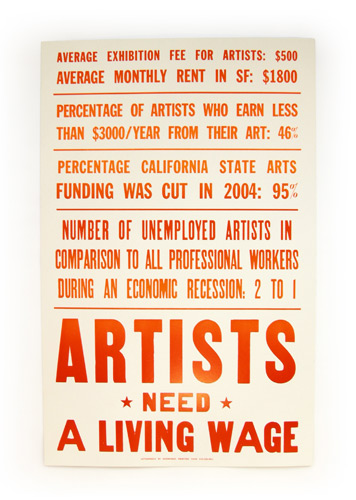
 The 2003-2004 budget of the California Arts Council was slashed by 95% (from $18.3 million to $1.1 million) and the council was forced to suspend most of its grant programs to arts organizations.
“During my first year as Director (of the California Arts Council), we were able to grant just under a million dollars. This past year (2008), I’m proud to tell you, the CAC expended over $3 million in programs, grants, convenings and assistance. This is largely due to the sale of Arts License Plates, which brought in $2.8 million last year.”
Artists in SF are well-educated, stable and engaged in their communities, yet they are spending less time on their art each year, with fewer of them earning income from it and almost half earning under $3,000.
In 2002, when the U.S. job market conditions worsened; unemployment for artists was twice as high as for all professional workers. Note: This doesn’t bode well for artists in the current economic climate.
In the early 80s an unnamed non-profit art space in SF was paying $500 artists fees. With the rate of inflation that $500 today would be more like $1500. Almost 30 years later, most non-profit art spaces in the Bay Area are still paying $500 or less. On top of this, each year these same art spaces are bleeding the artist community with their auctions.
It’s a legal obligation of the 501 (c)(3) non-profit organization to make the tax forms: Form 1024 and Form 990-T public. Note: You can go to http://www.guidestar.org/ to find specifics
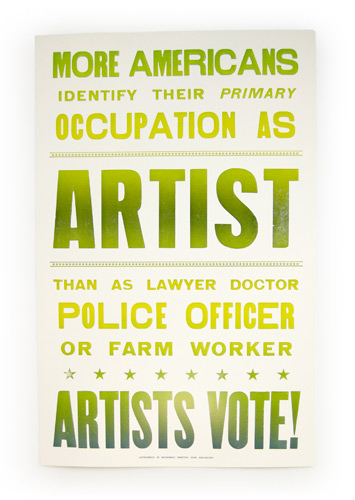
If every artist in America’s work force banded together, their ranks would be double the size of the United States Army. More Americans identify their primary occupation as artist than as lawyer, doctor, police officer or farm worker. Shouldn’t Artists have a voice as much as these and any other profession?
References for Statistics:
http://www.sff.org/about/publications/IOA_3_FINAL.pdf
http://www.forbes.com/realestate/2005/10/27/richest-cities-US-cx_sc_1028home_ls.html
http://www.nytimes.com/2008/06/12/arts/12nea.html
http://www.nea.gov/research/ArtistsInWorkforce.pdf
http://www.cac.ca.gov/director.php
The 2003-2004 budget of the California Arts Council was slashed by 95% (from $18.3 million to $1.1 million) and the council was forced to suspend most of its grant programs to arts organizations.
“During my first year as Director (of the California Arts Council), we were able to grant just under a million dollars. This past year (2008), I’m proud to tell you, the CAC expended over $3 million in programs, grants, convenings and assistance. This is largely due to the sale of Arts License Plates, which brought in $2.8 million last year.”
Artists in SF are well-educated, stable and engaged in their communities, yet they are spending less time on their art each year, with fewer of them earning income from it and almost half earning under $3,000.
In 2002, when the U.S. job market conditions worsened; unemployment for artists was twice as high as for all professional workers. Note: This doesn’t bode well for artists in the current economic climate.
In the early 80s an unnamed non-profit art space in SF was paying $500 artists fees. With the rate of inflation that $500 today would be more like $1500. Almost 30 years later, most non-profit art spaces in the Bay Area are still paying $500 or less. On top of this, each year these same art spaces are bleeding the artist community with their auctions.
It’s a legal obligation of the 501 (c)(3) non-profit organization to make the tax forms: Form 1024 and Form 990-T public. Note: You can go to http://www.guidestar.org/ to find specifics
If every artist in America’s work force banded together, their ranks would be double the size of the United States Army. More Americans identify their primary occupation as artist than as lawyer, doctor, police officer or farm worker. Shouldn’t Artists have a voice as much as these and any other profession?
References for Statistics:
http://www.sff.org/about/publications/IOA_3_FINAL.pdf
http://www.forbes.com/realestate/2005/10/27/richest-cities-US-cx_sc_1028home_ls.html
http://www.nytimes.com/2008/06/12/arts/12nea.html
http://www.nea.gov/research/ArtistsInWorkforce.pdf
http://www.cac.ca.gov/director.php
arts funding blog State of the Arts TPG8
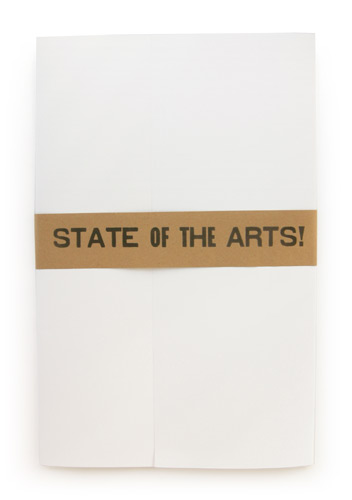
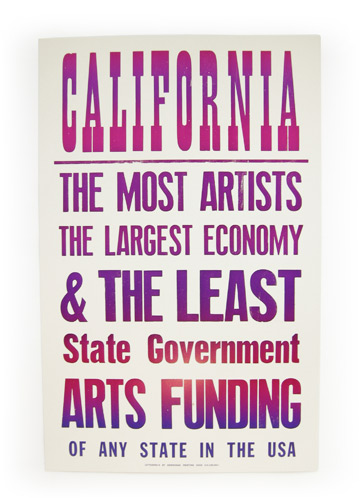
 Facilitated by Artists Space curator Joseph del Pesco, “State of the Arts” is an unconventional exhibition project where the medium is the message. The four enclosed letterpress posters are the result of two think-tank style conversations between groups of artists living and working in San Francisco and Oakland. During a series of follow-up emails with the curator, major points were identified and distilled into arguments, demands, and observations about the conditions for artists. Two of the posters address the situation in the state of California in general, and the other two speak directly to the SF Bay Area. All four posters will be delivered to elected officials in the Bay Area in addition to the subscribers of The Present Group.
It is an edition of 96.
In the conversations:
Amy Balkin, Anthony Discenza, Aaron Gach, Eleanor Hanson, Packard Jennings, Helena Keeffe, Mads Lynnerup, Anthony Marcellini, Christian Maychack, Lee Montgomery, Lucas Murgida, Steve Shearer, Chris Sollars, David Stein, Oliver Wise
Facilitated by Artists Space curator Joseph del Pesco, “State of the Arts” is an unconventional exhibition project where the medium is the message. The four enclosed letterpress posters are the result of two think-tank style conversations between groups of artists living and working in San Francisco and Oakland. During a series of follow-up emails with the curator, major points were identified and distilled into arguments, demands, and observations about the conditions for artists. Two of the posters address the situation in the state of California in general, and the other two speak directly to the SF Bay Area. All four posters will be delivered to elected officials in the Bay Area in addition to the subscribers of The Present Group.
It is an edition of 96.
In the conversations:
Amy Balkin, Anthony Discenza, Aaron Gach, Eleanor Hanson, Packard Jennings, Helena Keeffe, Mads Lynnerup, Anthony Marcellini, Christian Maychack, Lee Montgomery, Lucas Murgida, Steve Shearer, Chris Sollars, David Stein, Oliver Wise
 Joseph del Pesco is curator-at-large for Artists Space (New York) and co-founder of the Shotgun Review (San Francisco). He has organized independent curatorial projects for the Walter Phillips Gallery at the Banff Centre, Canada; the Yerba Buena Center for the Arts in San Francisco; the Rooseum in Malm, Sweden; and the Fondazione Sandretto Re Rebaudengo in Turin, Italy among others. His writing has appeared in various magazines including Proximity, Fillip, NUKE, (and the next issue of Flash Art) in addition to several international exhibition catalogues. Documentation of these exhibitions and other projects can be found at www.delpesco.com
artist resources bay area blog making of others lives TPG8
 more after the jump >> Continue Reading »
 Funny- maybe I’m not looking hard enough, but somehow I can’t find the word art.














Lego Hello World
I wish all my printers were made of legos.
LIFE photo archive hosted by Google
Images from Life Magazine going back to 1860’s, hosted by Google
Coming Face To Face With The President
Well crafted story about an under-heard point of view.
In California, Pot Is Now an Art Patron
A new funding source for the arts – reaping big rewards and funding many projects. It’s pot.
Notes on Portraiture in the Facebook Age
Celebrity Book Club: A List to End All Lists
Because, well, it’s sortof awesome.
Are "Artists' Statements" Really Necessary?
The pros and cons about that nemesis for most artists.
This to That
You tell it what you’ve got and it’ll tell you what to glue them together with.
Work of art: Online store for buyers, sellers
Not the TV show! Kelly Lynn Jones from Little Paper Planes is interviewed on her project, gives us a cheat sheet to local affordable art resources.
