Ughrrr
 Oliver says that I seriously cut myself every six months. Seeems about right. Luckily, after last night’s tetnus booster I don’t have to go to the ER (hopefully) for another 7 years.
PS- it isn’t as bad as it looks.
Oliver says that I seriously cut myself every six months. Seeems about right. Luckily, after last night’s tetnus booster I don’t have to go to the ER (hopefully) for another 7 years.
PS- it isn’t as bad as it looks.
 Oliver says that I seriously cut myself every six months. Seeems about right. Luckily, after last night’s tetnus booster I don’t have to go to the ER (hopefully) for another 7 years.
PS- it isn’t as bad as it looks.
Oliver says that I seriously cut myself every six months. Seeems about right. Luckily, after last night’s tetnus booster I don’t have to go to the ER (hopefully) for another 7 years.
PS- it isn’t as bad as it looks.
Annotated Links Hermosa Beach TPG9
 Sunrise, Sunset Calendars and Local Time
South Bay, Los Angeles
La Perruque
New York Public Library Map Division
Other related Links:
Tickets to the Sunset– “A time based solar transaction” They make use of ticketmaster. “Money back guarantee if sun does not set”
Xiu Xiu – The band that David tours with and does projects with
Emily Jacir – an American/Palestinian artist, in her project resulting with the show “Where We Come From” asked other Palestinians from around the world, “If I could do something for you, anywhere in Palestine, what would it be?” The artist used her American passport and its accompanying “freedom of movement” status in an attempt to realize desires of people who have limited or no access to their own nation. The exhibition documents in text, photography and video the artist’s fulfillment of these requests across artificial and dangerous borders.
Josh Greene – Another artist interested in financial transactions spurring actions. Greene’s ongoing Service Works project used one night of tips per month to fund varied small projects
Artists working in 3D:
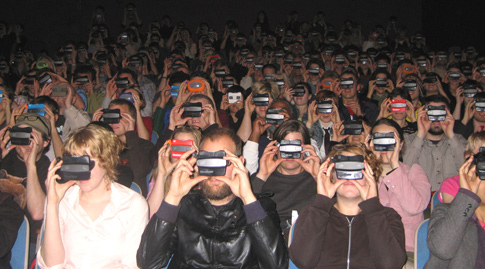
Vladimir makes Vladmasters. She also has performances. A Vladmaster performance is a simultaneous Vladmaster experience. Every attendee is given a viewer and set of disks and then led through the story by a soundtrack featuring music, narration, sound effects, and ding noises to cue the change from image to image. The CLACK of hundreds of viewers turning simultaneously fills the air. Mass euphoria ensues.
Sunrise, Sunset Calendars and Local Time
South Bay, Los Angeles
La Perruque
New York Public Library Map Division
Other related Links:
Tickets to the Sunset– “A time based solar transaction” They make use of ticketmaster. “Money back guarantee if sun does not set”
Xiu Xiu – The band that David tours with and does projects with
Emily Jacir – an American/Palestinian artist, in her project resulting with the show “Where We Come From” asked other Palestinians from around the world, “If I could do something for you, anywhere in Palestine, what would it be?” The artist used her American passport and its accompanying “freedom of movement” status in an attempt to realize desires of people who have limited or no access to their own nation. The exhibition documents in text, photography and video the artist’s fulfillment of these requests across artificial and dangerous borders.
Josh Greene – Another artist interested in financial transactions spurring actions. Greene’s ongoing Service Works project used one night of tips per month to fund varied small projects
Artists working in 3D:
Vladimir makes Vladmasters. She also has performances. A Vladmaster performance is a simultaneous Vladmaster experience. Every attendee is given a viewer and set of disks and then led through the story by a soundtrack featuring music, narration, sound effects, and ding noises to cue the change from image to image. The CLACK of hundreds of viewers turning simultaneously fills the air. Mass euphoria ensues.
 Florence Thomas was an Oregon scluptor who was employed by View Master to create and photograph many clay scenes and dioramas of fairy tales, nursery rhymes, comic strips, and other popular childrens stories. The techniques she developed have been put into use by many major motion picture studios.
Georgette Freeman made “contemporary stereo cards” from 1995 to 2002. Her stereo cards utilize the blank back of the card to put the card in “context” where she creates narratives for the work. She continues to teach classes at the San Francisco Center for the Book.
Viewmaster Resources:
Reel mounts from Fresa Volante – based in San Francisco, they are one of the only remaining reel mount manufacturers.
Oakland Camera Club, Stereo Division meets every third Monday at 7:30 pm.The Oakland Camera Club (OCC) was founded in 1934 and is a member of the Photographic Society of America (PSA) and the Northern California Council of Camera Clubs (N4C).
Viewmaster Resource: A repository of View-Master information-information about the View-Master Personal Stereo camera, printable copies of manuals, printable reproduction packets, and a general resource page with info and links to other related sites.
3D Stereo, Inc.: All sorts of 3-D supplies
3D Center for Art and Photography is a non-profit museum/gallery featuring the best in antique and contemporary 3D imagery. The Center houses everything from antique stereocards to View Master, contemporary 3D photography, lenticulars, anaglyphs, and computer generated 3D art. Apparently the home for 3D is Portland, Oregon.
Florence Thomas was an Oregon scluptor who was employed by View Master to create and photograph many clay scenes and dioramas of fairy tales, nursery rhymes, comic strips, and other popular childrens stories. The techniques she developed have been put into use by many major motion picture studios.
Georgette Freeman made “contemporary stereo cards” from 1995 to 2002. Her stereo cards utilize the blank back of the card to put the card in “context” where she creates narratives for the work. She continues to teach classes at the San Francisco Center for the Book.
Viewmaster Resources:
Reel mounts from Fresa Volante – based in San Francisco, they are one of the only remaining reel mount manufacturers.
Oakland Camera Club, Stereo Division meets every third Monday at 7:30 pm.The Oakland Camera Club (OCC) was founded in 1934 and is a member of the Photographic Society of America (PSA) and the Northern California Council of Camera Clubs (N4C).
Viewmaster Resource: A repository of View-Master information-information about the View-Master Personal Stereo camera, printable copies of manuals, printable reproduction packets, and a general resource page with info and links to other related sites.
3D Stereo, Inc.: All sorts of 3-D supplies
3D Center for Art and Photography is a non-profit museum/gallery featuring the best in antique and contemporary 3D imagery. The Center houses everything from antique stereocards to View Master, contemporary 3D photography, lenticulars, anaglyphs, and computer generated 3D art. Apparently the home for 3D is Portland, Oregon.
contemporary art criticism Hermosa Beach TPG9
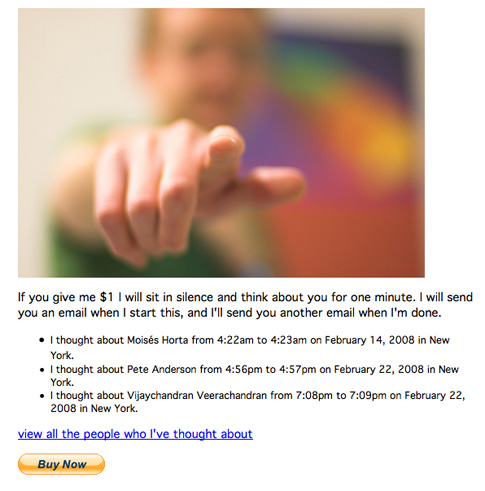 the hot springs thinking about you. All three items will be mailed to participants who donate more than $150 or who buy the whole piece for $2,443. For some, Horvitz’s work begins with his website, then progresses to purchasing or donating through Pay-pal, then receiving documentation or souvenirs through the mail, and lastly the participant may monitor his website for further updates. All of this may occur without ever meeting or speaking to Horvitz himself. For most of us who do not participate by donating or purchasing Things for Sale. . ., our involvement is even more remote, as we only participate through monitoring Horvitz’s website. Moreover, the souvenirs and documents that Horvitz mails his participants and displays on his website verify that the events have actually taken place, as the anonymity of the web makes us all incredulous consumers and participants. Susan Stewart explains that, “[w]e do not need or desire souvenirs of events that are repeatable. Rather, we need and desire souvenirs of events that are reportable, events whose materiality has escaped us, events that thereby exist only through the invention of narrative.” (135 Stewart) Because the, “materiality [of Horvitz’s work] has escaped us”, the only ways that we, as remote viewers of his work, can experience Things for Sale. . . are through his website where he constructs his narratives and through the synecdochical souvenirs and documents. The souvenirs that Horvitz mails his participants are traces or residue of the art act itself. The art piece is not so much the lava rock or the photographs, but the act of trust and cooperation that occurs between Horvitz and his participants.
In Hermosa Beach, CA, Horvitz utilizes the View-Master, which was based on the late nineteenth century stereoscope and debuted at the 1939 New York World’s Fair as a 3-D alternative to the post-card, itself a souvenir. Like the stereopticon and magic lantern (the forerunner to the slide projector) that preceded the development of the motion picture camera, the View-Master operates asyndetically: like jump cuts, it shrinks time by juxtaposing or creating a series of ideas, words, or images without transitions. When the viewers are screening the images in Hermosa Beach, CA with the View-Master, they do not see the sequence numbers printed on the reels and quickly loose track of where they are in the series of images, as the only difference is the shifting formation of waves in the background. The beginning and end are irrelevant or nonexistent as the viewer moves abruptly from image to image. While Horvitz indicates in the accompanying text that the whole shoot took an hour or two, the time frame between images is ambiguous, as any transitions that would indicate how much time has passed have been eliminated. Moreover, Horvitz explains that he would shoot his images, tell his mother he was done, she would turn around, and he would reload his camera and repeat the process with much of the time spent in silence. The repetitiveness and silence of the shooting is mirrored in the viewer’s experience of screening the images through the View-Master. The narrative that Horvitz provides transforms the images on the View-Master reels into documents or souvenirs of an event and urges the viewers to compare their experience of looking through the View-Master with what we know from the text about this event in December 2008. Like much of Horvitz’s other work, the viewers participate in this event remotely, voyeuristically, through rather banal textual and image based narratives.
Horvitz’s strategies range from mailing souvenirs from distant locations and sharing simplistic images all with a wry sense of humor or a sincerity suggestive of a naive boyishness. Horvitz uses the ease with which communication is established (email, YouTube, Tumblr, websites, etc.) to establish contact with his viewers and balances the alienation of the web, where everyone is a MySpace friend, with the very personal relationships between friends and family. While Horvitz’s participants may do very little in terms of actual interaction with him, they are necessary for the work to be successful. As, De Certeau would assert, while most of us are not primary producers, from a top down perspective, we are neither passive consumers. Rather, by working within the pre-existing social, spatial, conceptual structures, we have the ability to reconfigure and restructure meaning. By applying synecdochical and asyndetic devices, Horvitz creates alternative stylistic ways of organizing the world, communicating with each other, and creating narratives.
Sources:
De Certeau, Michel, The Practices of Everyday Life, University of California Press, Berkeley, Los Angeles, London, 1984.
Stewart, Susan, On Longing: Narratives of the Miniature, the Gigantic, the Souvenir, the Collection, Duke University Press, Durham and London, 1993.
Genevieve Quick received her MFA from the San Francisco Art Institute and has shown her work in galleries in the Bay Area. She has done residencies at Yaddo and Djerassi and included in exhibitions at the Headland’s Center for the Arts. Quick is co-curator of the traveling exhibition “Gold Rush: Artist as Prospector”,
Her personal website is www.genevievequick.com.
the hot springs thinking about you. All three items will be mailed to participants who donate more than $150 or who buy the whole piece for $2,443. For some, Horvitz’s work begins with his website, then progresses to purchasing or donating through Pay-pal, then receiving documentation or souvenirs through the mail, and lastly the participant may monitor his website for further updates. All of this may occur without ever meeting or speaking to Horvitz himself. For most of us who do not participate by donating or purchasing Things for Sale. . ., our involvement is even more remote, as we only participate through monitoring Horvitz’s website. Moreover, the souvenirs and documents that Horvitz mails his participants and displays on his website verify that the events have actually taken place, as the anonymity of the web makes us all incredulous consumers and participants. Susan Stewart explains that, “[w]e do not need or desire souvenirs of events that are repeatable. Rather, we need and desire souvenirs of events that are reportable, events whose materiality has escaped us, events that thereby exist only through the invention of narrative.” (135 Stewart) Because the, “materiality [of Horvitz’s work] has escaped us”, the only ways that we, as remote viewers of his work, can experience Things for Sale. . . are through his website where he constructs his narratives and through the synecdochical souvenirs and documents. The souvenirs that Horvitz mails his participants are traces or residue of the art act itself. The art piece is not so much the lava rock or the photographs, but the act of trust and cooperation that occurs between Horvitz and his participants.
In Hermosa Beach, CA, Horvitz utilizes the View-Master, which was based on the late nineteenth century stereoscope and debuted at the 1939 New York World’s Fair as a 3-D alternative to the post-card, itself a souvenir. Like the stereopticon and magic lantern (the forerunner to the slide projector) that preceded the development of the motion picture camera, the View-Master operates asyndetically: like jump cuts, it shrinks time by juxtaposing or creating a series of ideas, words, or images without transitions. When the viewers are screening the images in Hermosa Beach, CA with the View-Master, they do not see the sequence numbers printed on the reels and quickly loose track of where they are in the series of images, as the only difference is the shifting formation of waves in the background. The beginning and end are irrelevant or nonexistent as the viewer moves abruptly from image to image. While Horvitz indicates in the accompanying text that the whole shoot took an hour or two, the time frame between images is ambiguous, as any transitions that would indicate how much time has passed have been eliminated. Moreover, Horvitz explains that he would shoot his images, tell his mother he was done, she would turn around, and he would reload his camera and repeat the process with much of the time spent in silence. The repetitiveness and silence of the shooting is mirrored in the viewer’s experience of screening the images through the View-Master. The narrative that Horvitz provides transforms the images on the View-Master reels into documents or souvenirs of an event and urges the viewers to compare their experience of looking through the View-Master with what we know from the text about this event in December 2008. Like much of Horvitz’s other work, the viewers participate in this event remotely, voyeuristically, through rather banal textual and image based narratives.
Horvitz’s strategies range from mailing souvenirs from distant locations and sharing simplistic images all with a wry sense of humor or a sincerity suggestive of a naive boyishness. Horvitz uses the ease with which communication is established (email, YouTube, Tumblr, websites, etc.) to establish contact with his viewers and balances the alienation of the web, where everyone is a MySpace friend, with the very personal relationships between friends and family. While Horvitz’s participants may do very little in terms of actual interaction with him, they are necessary for the work to be successful. As, De Certeau would assert, while most of us are not primary producers, from a top down perspective, we are neither passive consumers. Rather, by working within the pre-existing social, spatial, conceptual structures, we have the ability to reconfigure and restructure meaning. By applying synecdochical and asyndetic devices, Horvitz creates alternative stylistic ways of organizing the world, communicating with each other, and creating narratives.
Sources:
De Certeau, Michel, The Practices of Everyday Life, University of California Press, Berkeley, Los Angeles, London, 1984.
Stewart, Susan, On Longing: Narratives of the Miniature, the Gigantic, the Souvenir, the Collection, Duke University Press, Durham and London, 1993.
Genevieve Quick received her MFA from the San Francisco Art Institute and has shown her work in galleries in the Bay Area. She has done residencies at Yaddo and Djerassi and included in exhibitions at the Headland’s Center for the Arts. Quick is co-curator of the traveling exhibition “Gold Rush: Artist as Prospector”,
Her personal website is www.genevievequick.com.
Artist Interviews artist interviews Hermosa Beach others lives TPG9
Listen: (~15:50) [display_podcast]
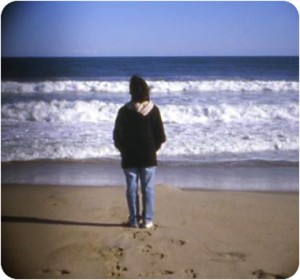
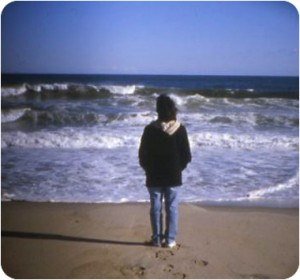
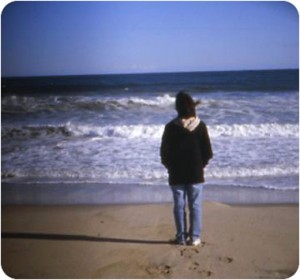
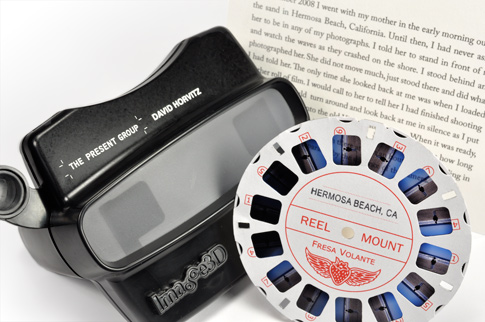 Hermosa Beach, CA is an edition of 50 viewmaster reels and viewers accompanied by text written by the artist, David Horvitz. The reels depict a lone figure, the artist’s mother, with her back turned to the viewer as the waves of the sea crash endlessly in the background.
Text:
In December 2008 I went with my mother in the early morning out on the sand in Hermosa Beach, California. Until then, I had never asked her to be in any of my photographs. I told her to stand in front of me and watch the waves as they crashed on the shore. I stood behind and photographed her. She did not move much, just stood there and did what I had told her. The only time she looked back at me was when I loaded another roll of film. I would call to her to tell her I had finished shooting a roll, and she would turn around and look back at me in silence as I put the next roll of film into the old Viewmaster camera. When it was ready, she turned back around again to the sea. I do not remember how long we did this. We must have been there at least an hour or two, standing in silence on the beach separated by the distance of the camera.
Hermosa Beach, CA is an edition of 50 viewmaster reels and viewers accompanied by text written by the artist, David Horvitz. The reels depict a lone figure, the artist’s mother, with her back turned to the viewer as the waves of the sea crash endlessly in the background.
Text:
In December 2008 I went with my mother in the early morning out on the sand in Hermosa Beach, California. Until then, I had never asked her to be in any of my photographs. I told her to stand in front of me and watch the waves as they crashed on the shore. I stood behind and photographed her. She did not move much, just stood there and did what I had told her. The only time she looked back at me was when I loaded another roll of film. I would call to her to tell her I had finished shooting a roll, and she would turn around and look back at me in silence as I put the next roll of film into the old Viewmaster camera. When it was ready, she turned back around again to the sea. I do not remember how long we did this. We must have been there at least an hour or two, standing in silence on the beach separated by the distance of the camera.
 Bio:
David Horvitz was born in Los Angeles and currently lives in New York. He is an artist that works in many forms, including photography, books, curated projects, writing, multiples, and video. He has been featured internationally in exhibitions and publications, and has had solo shows in the US
Bio:
David Horvitz was born in Los Angeles and currently lives in New York. He is an artist that works in many forms, including photography, books, curated projects, writing, multiples, and video. He has been featured internationally in exhibitions and publications, and has had solo shows in the US
bay area blog CA events others lives personal pictures


 From Wednesday night’s vigil and rally at City Hall, San Francisco
blog CA life without a car other personal
blog neat projects personal we make stuff
art and politics arts funding blog TPG8
artist interviews blog others lives reblog
The Box Game is the traveling stage of a larger artwork called ‘What’s in the Box’. In the month of March a black box will be taken to various locations throughout the United States and Canada by Lukas Geronimas and David Horvitz. At each location they will set up a game that asks people what they think is in the box.
The votes/guesses will determine what is actually in the box and the result will be an exhibition of the box and the guesses. They will be in San Francisco on March 19th at Clayton Space. Or, check here to find out when they’ll be near you.art and politics arts funding blog events TPG8
art and politics arts funding blog news TPG8
“Arts organizations generate $166.2 billion in economic activity, support 5.7 million jobs, and return nearly $30 billion in revenue to the government each year, according to a 2007 study by The Americans for the Arts.”With the arts and music among the many industries being hit hard in economic downturn, U.S. Rep. George Miller (D-CA), chairman of the House Education and Labor Committee, recently announced plans to hold a series of hearings this Spring to examine how the arts benefit the nation’s economy and schools – and what can be done to improve support for the arts and music fields. Continue reading here >> thanks lori
art and politics arts funding bay area blog events news State of the Arts TPG artists TPG8
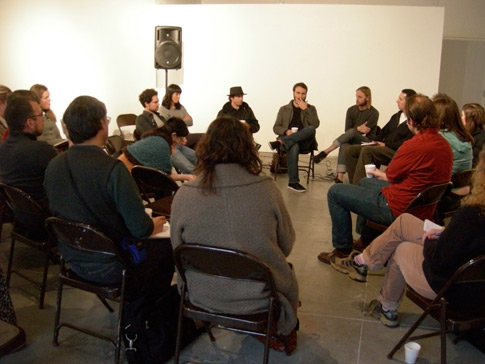
 Oliver and I thank everyone for coming, introduce ourselves, the State of the Arts project, and Joseph
 The first panel settles in (L-R: David Huff’s legs (Pro Arts), Christian Frock (Invisible Venue), Svea Lin Vezzone (Swarm Gallery), Kerri Johnson (Blank Space), Mike Bianco (Queens Nails Projects)
 The Artist Respondents move front and center
The goal of the day was to get a bunch of people talking about issues like arts funding, government and the arts, the stimulus, the economy and what that means for artists, and interesting ways that all these areas may interact. This we accomplished. It is incredibly hard to get a bunch of artists and arts activists who already have an incredibly full work load together and come up with some immediate solutions to any problems, so we didn’t leave the meeting with a clear course of action, but I think that is ok. We’re still really early on, and just hearing out different ideas and perspectives is always fruitful.
I came away with a couple of things in particular though:
1. If artists want more money from government, they have to show up to meetings and prove themselves as a constituency and fight for what they want. They could team up with real estate brokers who know how artists turn areas from bad neighborhoods to desirable ones. They can fight for money in all aspects of government. Someone suggested that every single government project could have some sort of artistic element to it. Even if the budgets for this type of work are small, if these jobs are given only to Oakland (or whichever city you live in) artists, the impact could add up. Mike Bianco spoke about the possibility of starting a union. If a union charged some dues, maybe each locality could hire a lobbyist.
2. The stimulus for the NEA, in comparison to a lot of things, is still very small. Lori Zook, from the Oakland Cultural Arts and Marketing Division, suggested that we look not just to the NEA to get our hands on some stimulus money, but also through Education programs and Community Development Programs. She said there are billions of dollars being funneled into those programs. Now, this assumes that you’d have to fit your art into one of those categories, which is not always the easiest things to do. I was talking to my sister about grants and writing for them in general. Grant writers are incredibly adept at not necessarily fibbing about their projects, but just using the language and framework that the granters want to see. Perhaps we need to become creative in thinking of the ways that our work could be framed.
I was just talking to Joseph and he thinks this idea is a little bogus, as art should be funded because it is art and we and others should see the value in doing just that. I believe that, but it seems clear in this country that many policy makers do not believe that. So I’m ending at one of the very first topics/quandries of the discussion: how to make people understand, believe in, and fund art for its simple value as cultural capital.
The Artist Respondents move front and center
The goal of the day was to get a bunch of people talking about issues like arts funding, government and the arts, the stimulus, the economy and what that means for artists, and interesting ways that all these areas may interact. This we accomplished. It is incredibly hard to get a bunch of artists and arts activists who already have an incredibly full work load together and come up with some immediate solutions to any problems, so we didn’t leave the meeting with a clear course of action, but I think that is ok. We’re still really early on, and just hearing out different ideas and perspectives is always fruitful.
I came away with a couple of things in particular though:
1. If artists want more money from government, they have to show up to meetings and prove themselves as a constituency and fight for what they want. They could team up with real estate brokers who know how artists turn areas from bad neighborhoods to desirable ones. They can fight for money in all aspects of government. Someone suggested that every single government project could have some sort of artistic element to it. Even if the budgets for this type of work are small, if these jobs are given only to Oakland (or whichever city you live in) artists, the impact could add up. Mike Bianco spoke about the possibility of starting a union. If a union charged some dues, maybe each locality could hire a lobbyist.
2. The stimulus for the NEA, in comparison to a lot of things, is still very small. Lori Zook, from the Oakland Cultural Arts and Marketing Division, suggested that we look not just to the NEA to get our hands on some stimulus money, but also through Education programs and Community Development Programs. She said there are billions of dollars being funneled into those programs. Now, this assumes that you’d have to fit your art into one of those categories, which is not always the easiest things to do. I was talking to my sister about grants and writing for them in general. Grant writers are incredibly adept at not necessarily fibbing about their projects, but just using the language and framework that the granters want to see. Perhaps we need to become creative in thinking of the ways that our work could be framed.
I was just talking to Joseph and he thinks this idea is a little bogus, as art should be funded because it is art and we and others should see the value in doing just that. I believe that, but it seems clear in this country that many policy makers do not believe that. So I’m ending at one of the very first topics/quandries of the discussion: how to make people understand, believe in, and fund art for its simple value as cultural capital.
art and politics art market blog others lives TPG8
art and politics arts funding blog reblog TPG8
When it comes to funding for state arts agencies, California remains not-so-proudly ensconced in its customary slot — dead last — according to a report from the National Assembly of State Arts Agencies.















Lego Hello World
I wish all my printers were made of legos.
LIFE photo archive hosted by Google
Images from Life Magazine going back to 1860’s, hosted by Google
Coming Face To Face With The President
Well crafted story about an under-heard point of view.
In California, Pot Is Now an Art Patron
A new funding source for the arts – reaping big rewards and funding many projects. It’s pot.
Notes on Portraiture in the Facebook Age
Celebrity Book Club: A List to End All Lists
Because, well, it’s sortof awesome.
Are "Artists' Statements" Really Necessary?
The pros and cons about that nemesis for most artists.
This to That
You tell it what you’ve got and it’ll tell you what to glue them together with.
Work of art: Online store for buyers, sellers
Not the TV show! Kelly Lynn Jones from Little Paper Planes is interviewed on her project, gives us a cheat sheet to local affordable art resources.


 found on a teeny notebook pad.