Annotated Links: Nava Lubelski
Annotated Links blog Old Tricks for New Monkeys TPG15
Nava’s Links:
Nava’s successful proposal for the TPG15 subscriber’s choice edition. Art Seen Asheville – Nava Lubelski – a video interview with Nava from 2008 Nava’s Book – The Starving Artist’s Way “Make it yourself. Make it cool. Make it cheap.”
Aleatoric Art:
Aleatoricism/ Aleatoric Art – Composition depending upon chance, random accident“I don’t use the accident. I deny the accident.”- Pollack “the prototypically “male” arts of paint-splashing and canvas-pierced fused to “female” fabric-staining and needlework.” – Karen RosenbergUntitled (Collage with Squares Arranged according to the Laws of Chance) Jean (Hans) Arp (French, born Germany (Alsace). 1886-1966)
Arp challenged existing notions of art and experimented with spontaneous and seemingly irrational methods of artistic creation. This work is one of several collages he made by scattering torn rectangular pieces of paper onto a paper support. He and other Dada artists embraced the notion of chance as a way of relinquishing control—a kind of depersonalization of the creative process that would influence many subsequent generations of artists.
Artists “Painting with thread”
Cayce Zavaglia: realistic, densely embroidered portraits Ghada Amer: sexual female line portraits, patterns and repeats Michael Raedecker: dream-ish still lifes and landscapes, acrylic and thread Tucker Schwarz: landscapes of buildings and power lines, threads revealed Steven MacDonald: “A variety of imagery act out fantastical narratives, where tigers, rainbows, cityscapes, skulls and shipping containers are juxtaposed against the backdrop of a traditional Japanese print form.”Artists playing with chaos and control
Heidi Trepanier: a drip painter similar to Nava, in the way that she outlines her drips and controls them so that they look almost cartoon-y. A subscriber sent us this link, calling her work “Dr. Seuss meets Jackson Pollock”
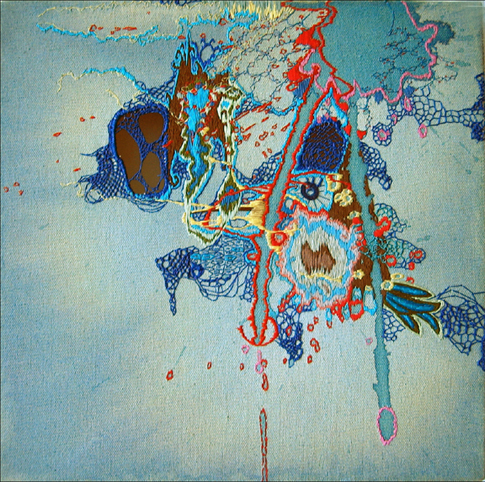 Monkey See and Do, 12″ x 12″, thread on canvas, 2006. Image courtesy of the artist.
This work began as organic stains on fabric that were then hand embroidered by the artist. The process of embroidery is a laborious one, at once meticulous and fine. So from first glance one sense’s the accidental nature of a stain, and begins appreciating the shape and color, only to find that there is a complicated handiwork involved, one with very intentional impulses. The artist has said about her own work in general,
Monkey See and Do, 12″ x 12″, thread on canvas, 2006. Image courtesy of the artist.
This work began as organic stains on fabric that were then hand embroidered by the artist. The process of embroidery is a laborious one, at once meticulous and fine. So from first glance one sense’s the accidental nature of a stain, and begins appreciating the shape and color, only to find that there is a complicated handiwork involved, one with very intentional impulses. The artist has said about her own work in general,
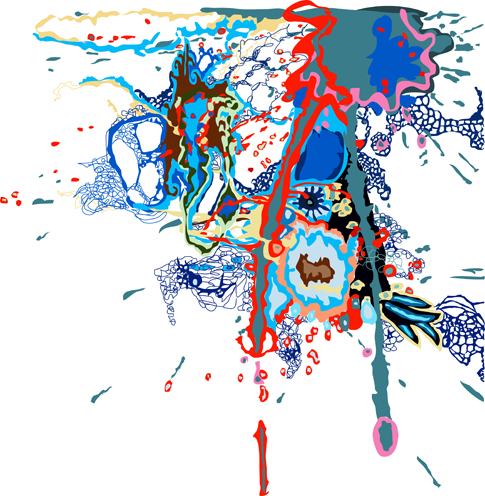 Monkey See and Do, digital tracing, 2010. Image courtesy of the artist.
In order to produce this work for The Present Group, Lubelski chose to work with a machine to embroider her original design. She began by doing a computer drawing that was a tracing of an earlier piece that she had stitched by hand in response to an organic stain, wanting to see what would happen if she fed that drawing into a computer stitching program without any changes or explanations. In the context of her process, she was letting go of control and trusting the machine to reproduce an image in its own way. Lubelski described this change in process as simultaneously embracing chaos and control.
Is something lost in the translation of the machines paths, something that existed in the hand-embroidered stitches? Or is the translation actually more direct due to the nature of the process? Does the machine embroidery change the value of the piece? Much has been written in postmodern theory about the loss of the original in nearly every medium from film to painting. As Baudrillard referenced,
Monkey See and Do, digital tracing, 2010. Image courtesy of the artist.
In order to produce this work for The Present Group, Lubelski chose to work with a machine to embroider her original design. She began by doing a computer drawing that was a tracing of an earlier piece that she had stitched by hand in response to an organic stain, wanting to see what would happen if she fed that drawing into a computer stitching program without any changes or explanations. In the context of her process, she was letting go of control and trusting the machine to reproduce an image in its own way. Lubelski described this change in process as simultaneously embracing chaos and control.
Is something lost in the translation of the machines paths, something that existed in the hand-embroidered stitches? Or is the translation actually more direct due to the nature of the process? Does the machine embroidery change the value of the piece? Much has been written in postmodern theory about the loss of the original in nearly every medium from film to painting. As Baudrillard referenced,
 Nava Lubelski in her studio. Photo courtesy of the artist.
[display_podcast]
Nava Lubelski in her studio. Photo courtesy of the artist.
[display_podcast]
 Lubleski’s Studio, 2010 Photo courtesy of the artist.