
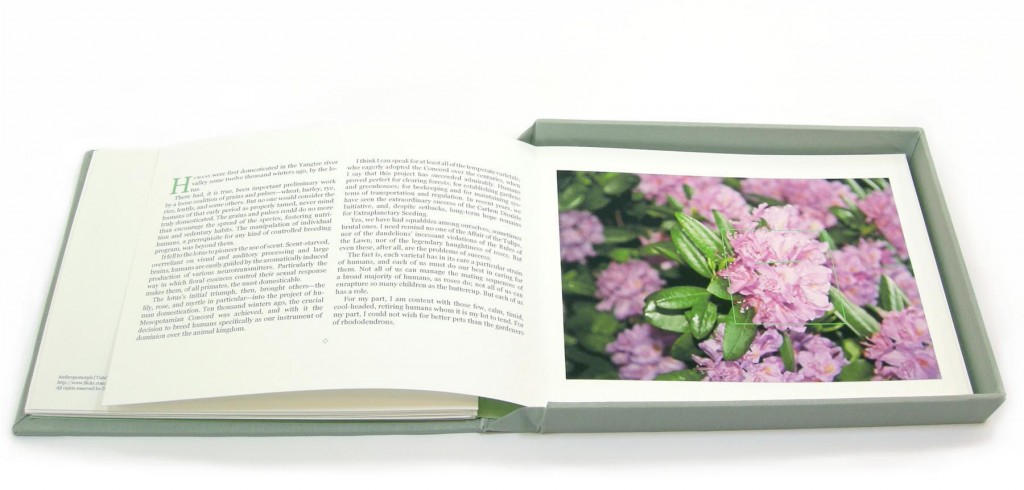
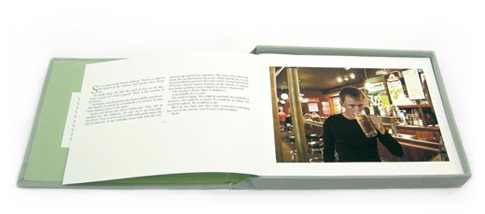
“Anthroptic” is an edition of 80 hand-made artist books that represents the collaboration between new media artist Ethan Ham and writer Benjamin Rosenbaum. The book contains 8 folios that pair one image with one “chapter” of the story. The images were taken from Ethan’s online project “Self-Portraits” in which he trained a facial recognition program to his face before unleashing it onto the internet photo service Flickr. While searching the millions of photos on Flickr for its creator, the computer program sometimes made mistakes, identifying inanimate objects as Ethan. These mistake images became the starting point for Benjamin’s short short story. Benjamin weaves these images into an exquisitely interconnected tale that can be read in any order. (Read the full text. . .) . . Ethan Ham is an artist living in New York. His work often uses new media (computers and/or the internet) as well as mechanical and sculptural elements. He is particularly interested in generative and emergent art. His recent projects include commissions from Rhizome.org (the New Museum of Contemporary Art) and Turbulence.org. Ethan is Assistant Professor of New Media at City College, CUNY. Project sites: www.turbulence.org/Works/self-portrait www.emailerosion.org www.drunkenboat.com/db8/panlitvideo/ham/ Personal site: www.ethanham.com Reviews and critiques: New England Journal of Aesthetic Research blog Missing Links (news.com column) . Benjamin Rosenbaum is a writer living in Northern Virginia. His works have appeared in Asimov’s, F&SF, Harper’s, McSweeney’s, Strange Horizons, Infinite Matrix, and other fine venues. Benjamin’s stories have been nominated for both the Hugo and Nebula awards and has been included on a number of recommended & “best of” lists. Other Cities short, short story collection: Strange Horizons Personal site: www.benjaminrosenbaum.com complete bibliography . .

A Conversation with Ethan Ham and Benjamin Rosenbaum
This interview took place on February 19th, 2007 at 9PM EST in an internet chat room. It was conducted by Oliver Wise and Eleanor Hanson Wise of The Present Group.
Oliver Wise: Let’s start with a little history about the two of you. How did you come to meet and work together? Have you worked together in the past?
Benjamin Rosenbaum: Ethan and I met in the middle of a swordfight – in a cafeteria – on the campus of UCSC.
Ethan Ham: Ben was visiting a high school buddy of his who was a college buddy of mine…
BR: I believe it was an impromptu swordfight.
EH: Yep, I won…but I had taken fencing, so I had an advantage.
BR: I believe I was wielding a bamboo newspaper holder.
EH: Ambush really. Ben ended up recruiting me to work at his mom’s computer summer camp.
BR: The first place we worked together.
OW: Counselors?
EH: Yep… I learned to program in order to get the job.
BR: Yep. Ethan was very good at teaching the youngest campers Logo by bribing them with M&M’s.
EH: Hee hee.
OW: How did you come to collaborate on this project?
EH: I had been wanting to do a project with Ben for a while.
BR: Ethan called me up and said, “Hey, do you want to write some stories?”
EH: When I saw the call for proposals, I wanted to do something using the facial recognition software I had been playing with (and used on another project). . .
BR: I loved the Self-Portrait project.
EH: But it seemed too thin… So it occurred to me that this might be a perfect opportunity to work with Ben.
BR: We chat often about the different things we’re working on, but we hadn’t gotten to collaborate (or not since we were making video games in the 90s…).
BR: Ethan wanted to do the project based on what he called “anthopomorphs.”
OW: Ethan, maybe you could talk about “anthropomorphs” and “Anthroptic.”
EH: Well, I have another project where I’m using facial recognition to find people who the software identifies (incorrectly) as being myself.
BR: I called those “Almost-Ethans”.
EH: I noticed that the facial recognition software often identifies faces where there are none. Sort of like how humans see shapes in clouds.
BR: …”Almost-Faces”, or anthropomorphs.
EH: I found this so interesting that I wanted to make it the central concept of a project.
BR: I was initially unsure if that would work, actually.
Eleanor Hanson Wise: Why?
BR: I wasn’t sure there would be enough warmth or variety, if it were all pictures of, you know, logs that looked sort of like people, but Ethan talked me into it, especially after I started looking at the pictures.
EH: Yeah, you were worried about the human element being missing (by definition).
BR: Well, not really.
EH: No?
BR: Since in a lot of cases I “cheated.” No, you’re right. That is what I was worried about, but I mean, I picked several photos that actually do *have* faces even though the face is not the face the computer found.
EH: Yeah, bystanders’ faces…
BR: So that Tibor, Gustav, Istvan, and Vreeder are all actually shown…and Ostrich!
EH: Or in some cases faces that are faces, but aren’t human…
BR: Right. Ostrich and the rhododendron.
EH: The biggest cheat was Tibor & Gustav. 🙂
BR: Right
EH: Because it actually is a human face that the computer found–but the face is photograph within the photo, so technically it isn’t human.
BR: So it was a mixture of “pure” anthropomorphs like the flower and the city, and ones that actually did have faces in the picture.
OW: With the advent of photo sharing services like Flickr you find people posting very personal images to the public sphere, some of them probably thinking only their friends and family will look at them. But then this program comes along, and it searches methodically, without regard for social relationships or privacy. Ethan, you contacted all the owners of the photos you used. What were their reactions? Not only to being included in an art project, but to being located in this way?
EH: They all gave us permission… perhaps half of them were excited by the project (though I didn’t give them any details about it). None of them seemed too surprised about being contacted. All the photographers had Creative Commons their photographs, so they were all people who were inclined to share their artwork.
BR: In the Istvan and Sonia story I tried to suggest that there’s something a little sinister about this project… 🙂
OW: Right, exactly. Maybe you don’t agree, but to me it seems like Flickr and Myspace have these sort of underbellies.
BR: Or just the internet in general.
EHW: People putting their whole lives on display.
EH: That’s true, though I think Flickr has a bit more air of innocence about it. I mean that my feeling is that a lot of people are using it to share their photos with friends & family, but not necessarily with quite the same exhibitionist flavor that other social spaces have.
BR: My daughter’s six, I think about things like the fact that her prom dates or high schools social rivals will have her baby pictures, etc., at their fingertips… I think the unintentional exposure is if anything sort of more sinister than on-purpose exhibitionism and posturing.
OW: Like we’re getting used to less privacy?
BR: You can still dig up Usenet posts I made back in the 90s, when Google was unimaginable.
EH: Yeah… I had to track down one of the photographers via Google searching him and poking around.
OW: Yeah, it all sticks around on the internet.
EH: I do occasionally cringe at the old postings I made that will never go away.
BR: I think part of the loyalty I see in Livejournal users, why they consider what they do distinct from blogging, has to do with the levels of privacy restrictions, etc.
BR (cont): The whole idea, in Myspace and LJ and so on, of “to friend” as a verb — internet culture now is a lot about exposure and concealment
EHW: What is LiveJournal?
BR: Another one of those social networking sites, which a lot of my writer friends like; and it distinctively has “friends-only” posts you decide who gets to see what; it’s (notably) not Google-searchable unless you choose it to be so.
OW: Ethan, one of the things that appealed to us about your project was how it combined new media aspects like the internet and facial recognition software, with the more traditional art forms of literature and book making. The same could be said of your E-Mail Erosion with sculpture. Maybe you could talk about that theme in your work.
EH: When I originally started doing art it was to get away from my day-job doing computer programming, so I tended to do very traditional hands on mediums. I started in clay, then stone, then bronze, then iron… at some point I realized I was working may way up the technological timeline.
EHW: When did you then jump ahead in time to the present?
EH: About my second year in graduate school…by then I was recovering from being burnt out on computers. I had seen a Roxy Paine piece (“PMU” I think) at the Baltimore Museum of Art and wanted to do something in reaction to it. So I began working on a generative art project that created digital paintings from user input–it was supposed to evoke arcade games. It’s my “Art 25 Cents” installation. Since then I’ve kept exploring generative art…sometimes using computers or electronics and sometimes using less technical materials. Usually even the technical pieces, as you point out, still have some more traditional, hands-on component.
OW: You guys made video games?
BR: Well, one video game. Computer game really — online strategy-fantasy game.
EH: We did. We actually helped co-found an internet game company (now defunct).
BR: Which was, I think, an important step for both of us in getting back to art. We’d been programmers for a decade.
EH: (I made more than one computer game–Ben moved on to more mature programming jobs)
BR: While making that game I started writing again seriously.
EHW: Was that how you (Ben) got into science fiction writing? Creating new worlds?
BR: Well, I had always wanted to be a writer as a kid, but I gave it up in college. So it was while working on the game that I decided to get back into it. There was a good bit of writing in the game — backstory, and also “flavor text.” Flavor text is an interesting form, because ideally you get a story across in a packet of 25-50 words which accompany, say, a magic spell in the game.
EH: My favorite was the flavor text for “Armor to Meat”–you wrote that, right?
BR: Right. . .Something like “Before, dwarves so tinny and unpalatable! Now can eat eight at a sitting!” — Ixbyl, Manticore
EH: Hee hee
OW: Is your game still online?
BR: Yes. http://sanctum.nioga.net
EH: Yes, when we closed the company we turned it over to a group of players to keep running as a non-profit.
BR: The company went the way of most tech startups of the nineties, but… Ethan beat me to it.
OW: Ben, Could you explain the difference between speculative fiction and science fiction?
BR: Ah, a very interesting question. The subject of many religious wars. I guess the traditional and boring answer is that “speculative fiction” is an umbrella term encompassing “proper” science fiction, fantasy, horror, and other weird stuff. All of those categories actually break down when looked at too closely. In the old days, before commercial fantasy became the dominant genre and beat up its older brother, “science fiction” was used as a broad-church term meaning “any popular literature written (at least partly) for the thrill of strangeness, wonder, and ideas.” Nowadays people often use “science fiction” in a stricter sense, meaning something like “stories in which the reader’s pleasurable suspension of disbelief hinges on the impression that while this probably isn’t how the world works, it maybe *could* be” or even, more strictly still, “stories exploring the effects of (postulated future) technological change on society and human experience”
EH: Slipstream is the more narrow genre you might be categorized in…
EHW: Slipstream?
BR: Well, I think some of my stuff is really traditional, core, speculative SF and some of it is literary fabulism. Slipstream is another much fought-over term. A story of mine was just in an anthology called “Feeling Very Strange”, which was, I think, a pretty strong attempt to be a definitive “slipstream” anthology and it defined slipstream as “stories that make you feel very strange.” More or less, I guess what I would say is the term “speculative” fiction is a good one, for one kind of fantastic literature because you’re
“speculating”, you’re saying “what if?” What if aliens come and they don’t want to talk to us, because we’re at the wrong scale? Or even, what if someone bent Ethan’s Self-Portrait software to another, more private purpose.
EHW: What if rhododendrons domesticated humans?
BR: Right. But other fiction, that I write, while it’s strange in a way which perhaps attempts to thrill in the same way, it isn’t necessarily asking “what if?” The Tibor story, for instance, doesn’t really “speculate.” You can’t really get back to a “What if there was a Well of Miracles which did weird stuff to people and then there was this kind of flamboyant guy and… yeah.” It’s more a story built around a mood, an effect, a series of images than around a speculation, a logical exploration of an idea and you see this “non-speculative strange fiction” a lot lately, both inside the formally defined “science fiction” genre and in “high literary” fiction. My favorite examples being Kelly Link and Aimee Bender.
OW: It seemed to us that many of the stories dealt with themes of control, or lack there of. Events have unseen and unexpected causes. Flowers domesticating humans, the scene when Tibor and Vreeder are being compelled to talk to each other, and when you talk about how it wasn’t so much what Vreeder did, but what he let happen that led to his fame,. . . Is this your view of our fate?
BR: Hmm, well, I do think that our control over the world is contingent and unreliable, that the world is full of surprises, unintended consequences, and mysteries, and that we spend a lot of time fooling ourselves into believing we understand what’s going on, ever more, as we grow older, but I don’t think we are entirely without influence. We have some effect, and we are not excused from trying, just because we don’t know what we’re doing but I think epistemological arrogance is at the root of many of the things that bother me…I would like to unsettle everyone a bit, and make them less sure of their sureties.
EHW: Is that partly why you try to create stories that suspend reality or ask (as we were talking about)…what if?
BR: Yes, indeed. A lot of literature, but particularly speculative literature goes for an effect of “inevitable surprise” where you totally didn’t see something coming, but in retrospect you cant imagine how you could have missed it, and that’s an experience designed to make people look at things again, to get them to be willing to be surprised
EHW: Ethan, you sort of bring in those aspects to your work, like in the email piece where people want to see something happen.
EH: There’s a term for that in art Ostranenie (if I’m remembering my Russian), meaning something like “to make strange”
BR: Yes, maybe “estrangement.”
EH: A lot of my work offers the view the chance to impact the art, but not control the impact. So in the Email Erosion piece, a person can send an email that will have a determined effect, but the user/viewer can’t really direct how things are going to go
EHW: or where the work interacts with itself to degrade
OW: Impact not control.
EH: Exactly–impact but not control. The “Self-Portrait” and “Anthroptic” projects are a bit unusual for me because it didn’t really offer any user interaction (aside from posting photos to Flickr)
EHW: But really those people’s photos were collaborators, unknowingly.
BR: Unintentional collaborators! 🙂
OW: One last question, what websites do you frequent?
EH: BoingBoing.net, edwardwinkleman.blogspot.com, portlandart.net, BBC news
BR: Hmm. I have been fighting a BoingBoing.net addiction for a while now. Strangehorizons.com. I use a bloglines.com feed to keep up with various ongoing google searches, peoples’ blogs.
EH: benjaminrosenbaum.com (though he doesn’t post to his blog often enough for my taste)� 🙂
BR: heh
BR: I am addicted to internet go and to several webcomics: megatokyo.com, sinfest.net, xkcd, cat and girl… It’s a bit of a golden age for web comics.
EHW: Well, we’d like to thank you two for all of your work and for taking the time to “talk” to us tonight.
BR: Thank you! It has been really lovely working with you guys
EH: Thanks, it’s been great working with Ben & you folks
Fear, The Robot, Resistance – by Michael Betancourt
contemporary art criticism TPG1
Anthroptic is a collaboration between new media artist Ethan Ham and writer Benjamin Rosenbaum. What is immediately striking about this collaboration is the way that their combined efforts exceed the individual contributions of either artist; the whole is more than a sum of parts. Each image and its companion text present us with a brief glimpse into an imaginary world. Opened and closed by a pair of poetic vignettes, the eight sections of this work assume a serial character whose collective impact is a sense of both fear and foreboding. This sensation is crucial to the meaning of the whole.
The threat of these tales, when coupled with the opening and the associated images, requires some background. Each image in this work was chosen from the on-line database of pictures known as Flickr by an automated program, a sophisticated piece of software that does something we humans usually take for granted: it recognizes faces. Facial recognition is normally taken to be a sign of sentience of some sort; does the machine then qualify as intelligent? No, or at least not in the sense that the functional AIs of popular entertainment are “intelligent.” This machine is not HAL; instead it is a variety of program that has been developed for a variety of uses-and the most famous of these all have sinister overtones of surveillance, automated control, and suggestions of totalitarian police-state tactics:
The robot watches.
The poetic opening frames what follows, but what follows is different than the threat these statements of automated observation imply. Of the eight photographs this software system has identified as faces, two are pictures of faces, but not actual faces, one is a Public Market sign in Seattle, one is a cat, another a flower, a third is the background behind a man drinking beer, a section of a city, and finally a tram. Sometimes we see a “good gestalt” and other times we don’t. Should we relax? These are all “false-positives” things the machine believes to be faces, but we being humans can instantly recognize that they aren’t. The robot is broken.
However, it is the possibility that the software may not be broken that is implicit in each of these stories and it is this possibility that produces the threat. In looking at the pictures we can imagine the program is not broken at all, but is instead daydreaming. We can imagine the software is insane. This potential interpretation requires us to admit that the machine can be like a human; at the same time, it means that people are like machines. It is the overlap of human and machine that disturbs the easy assumptions of there being a difference between intelligence (human) and device (robot).
There are elements to these pictures that support an overlapping of mechanical and biological intelligences. If we look at the photographs of things we don’t commonly see as “faces” – such as the tram – and allow ourselves to see them as the machine has, what we find are faces. It is the observation made in the Italian Renaissance by Leonardo-that when confronted by a random splattering of paint our imaginations start to see definite shapes, people, animals, faces. They are there only for the duration of our glance, then they vanish. It is these that the robot has found, presenting them to us for our inspection.
In Ethan Ham’s original project, the photographs were presented on a website where viewers could see both the current photo being considered and past identified faces. The idea of this project was simple: his robot was set loose on Flickr to find one face, that of the artist. In a sense, it was sent to try and find it’s maker. But demiurge-like, Ham “tweaked” the robot’s face recognition processes at the start of the project so it would misidentify faces. Some of these faces are part of Anthroptic. However, the joke is on us: because the machine “sees” faces where there are none, Ham has introduced a variable into it that under normal circumstances would be error. Yet, what it finds can be recognized as “faces” if we allow ourselves the opportunity to look at these pictures with eyes trained by a century of avant-garde art such as Surrealism or Cubism. In doing so, we share in the robot’s delusion.
Benjamin Rosenbaum’s narratives range across a wide territory. The Public Market narrative offers a degree of explanation about what is happening, that the robot is simply a software program that measures certain physical measurements, like the aspect ratio and the distance between the eyes. While this may be true of the mechanism driving the software, his description is also lacking in a crucial aspect – affect – thus his explanation of how his robot identifies faces is similar to describing color by the specific wavelength of light. Rosenbaum’s narrative recognizes this fact about the images.
The historical conflict between artists and scientists over the nature of humanity and the world that shaped the art world in the early twentieth century – the conflict over whether humans are machines, (or machine-like), or not – is implicitly in this work. The sense of threat and fear that pervade these stories is the heritage of this division between the empirical, technical description of reality and the subjective, interpretative response to reality. Abstraction may be one of the most visible of the results of this debate; to be able to locate it continuing in a contemporary work may be a necessity since that debate never actually ended. The threat the robot poses arises precisely because it is instrumental in its engagement with the world; the robot, being a machine necessarily engages the world in a mechanical fashion. Software does not dream, it cannot be insane. To consider that possibility it to admit the machine into the realm of the human. This admission forces us to also admit that there is something machine-like about humanity. Thus when confronted by these images, we try to avoid the threat the robot always poses for us. The robot threatens the idea of what it means to be “human.” The irony of this situation is that we assign the robot more human characteristics, bringing it closer to ourselves as a way to dispel the fear it evokes.
We humans may prefer to see these “errors” as the robot dreaming or as insane than to consider the alternative, mechanistic implication: that we are closer to the machine than it is to us. The idea of a bifurcation – the mind/body split, the “ghost in the machine,” – has been a way of avoiding the implication that humans are elaborate systems, physical in nature and subject to malfunctions of the same type as the robot.
It is comforting to imagine the artist as demiurge deluding his creation in its search for its creator on Flickr. But this imaginary narrative is just that, a comforting tale invented to dispel the threat the robot implicitly poses to our ideas of being”human.” The various serial narratives that emerge in Rosenbaum’s writings all speak to this fear: that the robot is mechanical, not intelligent, that it acts is service of other humans, able only to follow instructions and do what it is built to do. The AI fantasy of a dreaming machine is just that – and the repressed fear emerges in these stories as a managed threat. The International Banker who rules the world by accident, and then does nothing with it; the photographer who shoots a picture, uncertain of her subject’s true nature; the domestication of humans.
Semiologist Umberto Eco has observed that serials build depth through repetition, and the complexity of serials is a result of what doesn’t change. The constants here are the robot’s recognitions, the threats contained and implied by these stories and the resistance to the underlying proposition that we are like the machine. This is the message of the paired poetic vignettes: one is the robot, the other is you, the reader. Superimpose one on the other and we can recognize both the fear and the resistance. Our invention of these stories helps cushion the fear the robot poses. They are an act of resistance that describe a complex engagement with the pictures and their implications. It is this combination that makes Anthroptic a true collaboration. Each artist reveals something implicit in the other through their mutual engagement.
.
.
Michael Betancourt is a curator, avant-garde theorist, and multi-disciplinary artist. He has been making movies, site-specific installations, and non-traditional art forms (and exhibiting his work in unseen, unusual, or public spaces) since 1992. Journals such as Leonardo, Semiotica and CTheory have published his essays. His blog is located at cinegraphic.net and his portfolio can be seen at www.michaelbetancourt.com.
Introduction to Archival Materials
An introduction to “acid-free”, archival materials, and their use in Anthroptic.
You know how that old newspaper clipping you’ve saved since forever has turned brown and crumbly? This happens because newsprint is made of wood and wood contains an acidic substance called lignin. This naturally occurring substance attacks the contents of the paper and degrades it over time. That is one reasons why many artists, especially those who work with paper, often try to use materials that are pH neutral.
Manufacturers of higher quality papers sometimes remove the lignin in wood-based papers and/or “buffer” them with alkaline additives (such as calcium carbonate) to neutralize their acidity. This process also helps to protect them from future exposure to acids in the atmosphere. Cotton (rag) papers are 100% cellulose, meaning they’re a pH neutral product from the start. Cotton papers also have long, strong fibers. This is why US currency is printed on cotton paper and why your bills don’t fall apart when they accidentally go through the washing machine.
The term “archival” is somewhat misleading, as the root of the word means forever. While nothing lasts forever, the goal of many art collectors is to extend the longevity of their pieces for at least a few generations. The fight against time, light, and air is a daily concern for conservators and framers around the country. The easiest way to fight these naturally destructive forces is to use materials that are stable to begin with. But don’t let the materials stop you from buying a work you love; there are numerous ways to protect your piece. A conservator can even de-acidify paper!
For “Anthroptic” we wanted to create something that would stand the test of time. Let’s examine the materials we used and why:
The Box – Binder’s board is made in a single ply which gives it extra strength and durability. The board that we choose has been buffered to give it a neutral pH. However, most binders board still has some degree of instability due to it’s paper content. It is widely evidenced that this does not create a problem. This is because the board used in books is almost completely encased in glue and covered with other (neutral) materials. Therefore any harmful elements do not have access to air to assist in the natural process of breaking down. The Glue – We used pH neutral PVA: polyvinyl acetate. It is extremely stable and pH neutral. Bookmakers also prize PVA for its transparency, its “stickyness”, and the fact that it remains very flexible even when dry. The other adhesive we used in this book was Daige Rollataq, an acrylic-based adhesive that is also transparent, non-yellowing, and acid-free. The Paper – The box is lined with pH neutral paper and the folios are 100% cotton rag paper, creating a very stable base for the images and words. The photographs are printed on Epson Heavyweight Matte paper which combined with the pigmented inks we used have a print permanence rating of over 150 years. Pigmented Inks – With the advent of the digital image, we have come to terms with what paper/printer combinations work well together for lasting durability. As many of us have found out, we can print our digital pictures beautifully on our inkjets, but after they have been on the fridge for even a year, the color has significantly shifted and faded. The inks in most inkjets are dye-based inks. These are the ones that fade rather quickly, even though they come out of the printer looking bright and beautiful. Additionally, commercial digital printers don’t often use high quality papers. You can sometimes extend the life of these images by using higher quality paper, but in general, dyes fade. Pigmented inks have made a big impact in the world of art printing as they are still reasonably affordable and have a much longer life. Wilhelm Research, which specializes in testing the life expectancy of different ink and paper combinations, found that while most dye-based inks have an expectancy of only about 15-25 years, pigmented inks have an expectancy of 75-200 years. . . GLOSSARY: A selected glossary taken from Archival Methods: A resource for archival storage and presentation products acid – In chemistry, a substance capable of forming hydrogen ions when dissolved in water. Acids can weaken cellulose in paper, board, and cloth, leading to embrittlement. Acids may be introduced in the manufacture of papers and may be lift in intentionally (as in certain sizings) or incidentally (insufficient bleaching). Acids may also be introduced by migration from other materials or from atmospheric pollution. See also pH and acid migration. acid migration – The transfer of acid from an acidic material to a less acidic or pH neutral material. This may occur directly, when the two materials are in intimate contact. For instance, acid may migrate from boards, endpapers, and protective tissues, as well as the paper covers of books and pamphlets, to the less acidic paper of the text. acid-free – In chemistry, materials that have a pH of 7.0 or higher. Sometimes used incorrectly as a synonym for alkaline or buffered. Such materials may be produced or buffered. Such materials may be produced from virtually any cellulose fiber source (cotton and wood, among others), if measures are taken during manufacture to eliminate active acid from bleaching, aluminum sulfate from sizing, or pollutants in the atmosphere may lead to the formation of acid unless the paper or board has been buffered with an alkaline substance. archival; archivally sound – A non-technical term that suggests that a material or product is permanent, durable, or chemically stable, and that it can therefore safely be used for preservation purposes. the phrase is not quantifiable; no standards exist that describe how long an “archival” or “archivally sound” material will last. binder’s board – A heavy grade of single-ply solid paperboard used for book covers. It is made from mixed paper stock and low grade rags. Davy Board is a brand name. Kappa binder’s board a bookmaking board with no glue between layers. buffering – The addition of alkaline agents such as calcium or magnesium carbonate during the papermaking process in order to counteract the effect f acidic contamination; the degree of buffering (usually 2-3%) is measured by percentage of paper weight. See alkaline. burnishing bone (or folding bone) – Smooth, flat, non-abrasive utensil used for smoothing and finishing of mat edges, especially at corners. Also used as a folding and scoring instrument in book binding and box making. cotton board – Matboard whose pulp originates from cotton which is chemically and physically broken down to fibers and molded into paper stock or board. “Cotton” as a term is usually recognized as a board that is archival and composed of only cotton, as opposed to wood pulp which is, in general, perceived as non-archival when untreated. Also see Rag Board, Museum Board. cotton fibers – Selected new cotton cuttings acquired from the textile industries. They are free of synthetic fibers and are a source of cotton fibers used in the manufacture of cotton content papers. Basic cotton and cotton linters are also used in the manufacture of pulp. fiber content – A statement of the types and percentages of fibers used in the manufacture of a paper, board, or cloth. Important because the quality of the fiber significantly affects both the durability and chemical stability of the material. lignin – An acid organic substance found in wood pulp. It is removed in the chemical pulping process, but is not removed in the manufacture of low grade papers made of ground wood pulp, such as newsprint. lignin-free – In paper, this term indicates there are only trace amounts of lignin (usually less than 1%). This is desirable because lignin in paper tends to decompose into corrosive and acidic elements. neutral pH – Exhibiting neither acid nor base (alkaline) qualities; 7.0 on the pH scale. Paper and board stock with a neutral pH are recommended as a storage material for photographic materials. P.V.A – See polyvinyl acetate. pH – In chemistry, pH is a measure of the concentration of hydrogen ions in a solution, which is a measure of acidity or alkalinity. The pH scale runs from 0 to 14, and each number indicates a ten- fold increase. Seven is pH neutral; numbers below 7 indicate increasing acidity, with I being most acid. Numbers above 7 indicate increasing alkalinity, with 14 being most alkaline. Paper with a pH below 5 is considered highly acidic. Buffered storage materials typically have a pH between 7 and 9. See also acid; alkaline. polyvinyl acetate – A plastic usually abbreviated as PVA. A colorless transparent solid, it is usually used in adhesives, which are themselves also referred to as PVA or PVA adhesive. There are dozens of PVA adhesives, some are “internally plasticized” and are suitable for use in conservation, due to greater chemical stability among other qualities. rag content – 1. Paper that is made chiefly from linen or cotton fibers rather than from wood pulp, which is highly acidic. High rag content usually indicates a neutral pH. 2. A term that indicates the presence of cotton fibers in a sheet of paper. The content can vary from 25% to 100%. rag paper – Cotton fiber paper. It is made from cotton cuttings and linters. wet-mount – The technique of gluing artwork to a support with water-based adhesives. wood pulp – Prepared for papermaking from trees of various kinds. The process of manufacture includes two distinct classes: (1) mechanical wood pulp or ground wood from which newsprint is made; (2) chemical pulp, produced by various methods, which is a higher grade since more lignin and other impurities are removed. Continue Reading »Anthroptic Annotated Links
Creative Commons:
Benjamin Rosenbaum reading Anthroptic – Audio files on the Internet Archive Anthroptic Images on Flickr:
Anthroptic Text – Read the full text.
Anthroptic Images on Flickr:
Anthroptic Text – Read the full text.
Generative Art:
Roxy Paine’s “PMU” – Paine’s PMU is part of a series of flawlessly-built art-making machines that include a Drawing Machine, several SCUMAK (Auto Sculpture) machines and an Erosion Machine. Constructed with an industrial scale and durability, the PMU is built to produce unique, vaguely Abstract Expressionistic canvases. At regular intervals, a red warning light flashes, signaling the start of each painting cycle. A large robotic arm spews white paint in a neatly choreographed trajectory from left to right towards a canvas dangling from the center of a large network of stainless steel frames, tubes and vats. Each layer is allowed a long drying period before the cycle begins again. CAP – Computer Aided Poetry – Billed as “A tool for blocked poets” this site is a straightforward example of using generative principles for creative ends. Type in a phrase or a poem and the program will replace each word with a word it thinks relates. CAP’s creator, Eugenio Tisselli, sees broader implications. In “about machine poetry. a manifesto for the destruction of poets.” he writes, “poetic machines, or poem-generating algorithms, open up the last possible way towards liberation: overcoming art in order to find the fullness of life. let the machines do poetry, so we can dedicate ourselves to living our lifes.”
 “Something to do with Emergent Art” by Tim Burke – An introduction to the principles behind the use of emergence in cultural work. Some relevant quotes:
“Artists working with computer graphics have been long been aware that as the sophistication and power of computer animation and imagery has improved, a visual paradox arises. A computer-generated representation of a human being or real-life life form actually seems “less” life-like to human observers as it improves because the distance between how it looks and real-life narrows. Human visual processing will readily perceive life-like properties (like a face) in visual patterns that seem very unlifelike (say, the random patterning of lines on a tree or the shape of clouds) but as the image becomes more life-like, the gap between the inanimate and the organic is exaggerated, both in terms of how it looks and how it behaves. A life-like representation whose every action is prescripted actually tends to look “wrong” somehow to most human observers.”
“There is a somewhat undeveloped but growing discussion of “emergent narrative” as an idea. The use of the word is not the strict form of emergence that the Working Group has explored so far: it is very difficult to identify what the agents and environment in a narrative system would be. The term is used to describe the post-facto narratives that can be told about the actions of agents in a creative or dramatic system governed partially or largely by emergent principles. Surprise and the unexpected are the key virtues of how such an environment deviates from a prescripted one.”International Generative Art Conference Webpage – A wealth of information on Generative Art. Most of the papers and talks from 9 years of conferences are available on-line. Be warned, it’s organized by year instead of topic, so finding your way back to the same place twice may be difficult. “Generative Art in the City” by Carol-Ann Braun – A paper from GA2005 considering the esthetic issues raised by public generative art installations at the Festival Premier [website in French] contact on the outskirts of Paris.
Artist Books:
“Artists Books” on Wikipedia – A short history and description, along with a great compilation of links to exhibitions, presses, organizations, and places to buy. The San Francisco Center for the Book – A place where you can learn about the many arts and crafts of the book. Through workshops, exhibitions and public events, the SFCB promotes both knowledge of traditional book arts and exploration of experimental book forms. Book Arts Web – The electronic meeting place for all facets of the book arts. The mother of all conversations about making books. Conversations about everything from cleaning your brushes to discussions on glue, paper, everything you can think of. Years of archives. Bookworks – A commissioning organisation for artists’ publications. Printed Matter – A good resource for all sorts of art publications. They have a good selection of artists books. Rowan Morrison – A fine arts gallery and bookstore specializing in artist’s books, small edition prints, unique paper goods, and
self-published zines. Located in Oakland, CA, but they also have an online shop.
Priscilla Juvelis Rare Books -Priscilla Juvelis Rare Books specializes in literary first editions, especially women authors, 19th and 20th century reform movements, especially suffrage and temperance, as well as 20th century book arts.
Rowan Morrison – A fine arts gallery and bookstore specializing in artist’s books, small edition prints, unique paper goods, and
self-published zines. Located in Oakland, CA, but they also have an online shop.
Priscilla Juvelis Rare Books -Priscilla Juvelis Rare Books specializes in literary first editions, especially women authors, 19th and 20th century reform movements, especially suffrage and temperance, as well as 20th century book arts. Mary Reynolds Collection at the Art Institute of Chicago – An online collection of the bookbinding works of Mary Reynolds. According to Marcel Duchamp, she “was an eye-witness of the Dadaist manifestations and on the birth of Surrealism in 1924…. [and] was among the ‘supporters’ of the new ideas. In a close friendship with André Breton, Raymond Queneau, Jean Cocteau, Djuna Barnes, James Joyce, Alexander Calder, [Joan] Miró, Jacques Villon, and many other important figures of the epoch, she found the incentive to become an artist herself. She decided to apply her talents to the art of bookbinding.”
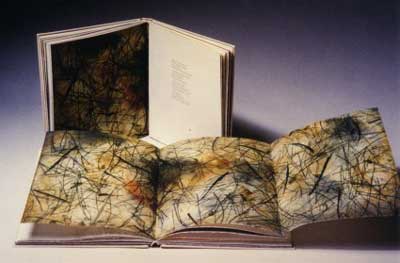 Limited-Edition Books as Multi-Media Art: The Work of Vincent FitzGerald & Co. displayed at Columbia – Review of a Summer 2000 show at Columbia University’s Rare Book and Manuscript Library highlighting the work of Vincent FitzGerald & Co. For over 20 years the Manhattan-based press has issued hand-made books representing the collaborations between arists, writers and poets. Click the image to the right to see more images from the show.
TPG1 – Discussion
Blog Mentions and Comments
“see what you mean” 4.18.07 on ads without products “Internet art made from facial-recognition app’s Flickr mistakes” 4.4.07 on BoingBoing “Flickr Bots Eats Facebook” 4.4.07 on New Visuals “Stories about faces only robots can see” 4.4.07 on Techslut 4.3.07 on networked_performancePlease feel free to use this space to discuss “Anthroptic” and any other related topic.
Ethan and Ben at it again
blog internet neat projects TPG artists TPG1
Our very first artist/writer pair have teamed up again for an exciting new web project entitled “Tumbarumba.”
Tumbarumba, by Ethan Ham and Benjamin Rosenbaum, is a frolic of intrusions, a conceptual artwork in the form of a Firefox extension. Tumbarumba hides stories, twelve new stories by outstanding authors where you least expect to find them, turning your everyday web browsing into a strange journey.
 The project is a 2008 commission of New Radio and Performing Arts, Inc., (aka Ether-Ore) for its Turbulence web site. It was made possible with funding from the Jerome Foundation.
The project is a 2008 commission of New Radio and Performing Arts, Inc., (aka Ether-Ore) for its Turbulence web site. It was made possible with funding from the Jerome Foundation.
Anthroptic in Australia!
 Our very first piece, Anthroptic by Ethan Ham and Benjamin Rosenbaum, has made its way into the permanent collection of Australia’s National Portrait Gallery and is being shown in “Present Tense: An Imagined Grammar of Portraiture in the Digital Age.” Technical Curator Michael Desmond introduces some of the ideas behind the Portrait Gallery’s winter (or summer here) exhibition:
The National Portrait Gallery exhibition Present Tense: An imagined grammar of portraiture in the digital age considers the alliance between portraiture and technology and investigates how different ways of imaging reflect how the individual is perceived as well as how the various mechanisms of imaging that are used to manipulate that perception. Present Tense includes examples of the informal and immediate digital snapshots made with mobile phones; images recorded with sonograms that reveal faces that cannot be seen by the unaided eye; 2D and 3D portraits generated exclusively from binary code; and the more expected videos and manipulated photographs.
 It is a wide ranging show, with works from Justine Khamara, Julian Opie, Rineke Dijkstra, and Loretta Lux among them. Maybe the cast of “Work of Art” should have taken a trip to go see this show before their less than stellar look at portraiture in their first show.
The show will be up until August 22nd for anyone visiting Parkes, Australia this summer!
It is a wide ranging show, with works from Justine Khamara, Julian Opie, Rineke Dijkstra, and Loretta Lux among them. Maybe the cast of “Work of Art” should have taken a trip to go see this show before their less than stellar look at portraiture in their first show.
The show will be up until August 22nd for anyone visiting Parkes, Australia this summer!






LINKS
Archives









Lego Hello World
I wish all my printers were made of legos.
Comment >>
LIFE photo archive hosted by Google
Images from Life Magazine going back to 1860’s, hosted by Google
Coming Face To Face With The President
Well crafted story about an under-heard point of view.
In California, Pot Is Now an Art Patron
A new funding source for the arts – reaping big rewards and funding many projects. It’s pot.
Notes on Portraiture in the Facebook Age
Celebrity Book Club: A List to End All Lists
Because, well, it’s sortof awesome.
Are "Artists' Statements" Really Necessary?
The pros and cons about that nemesis for most artists.
This to That
You tell it what you’ve got and it’ll tell you what to glue them together with.
Work of art: Online store for buyers, sellers
Not the TV show! Kelly Lynn Jones from Little Paper Planes is interviewed on her project, gives us a cheat sheet to local affordable art resources.