Art Fag City » Recessionary Art World Posting

via artfagcity.com
An interesting compendium put together by Art Fag City of what people are saying about what’s happening in the arts as a result of the recession.
art and politics blog blogs internet

The Camel Collective began as a loose affiliation of artists, architects, and writers in the Spring of 2005. The U.S. invasion of Iraq, the dominant media’s tacit support for an illegitimate administration, and the hysterical real estate speculation in New York City motivated us to consider how we might orient our individual practices towards collective organization. Our belief in the productive force of collectivity and exchange across disciplines, along with the necessity to address social, political and economic issues as artists is what motivates our activities. C-M-L is an ongoing online project of Camel Collective. We invite similarly engaged artists to submit works and documents to build an archive available online and distributed in the form of a newsletter. This newsletter includes two main sections—a growing archive of projects selected by the editors, and a bimonthly guest curatorial examination thereof. C-M-L also extends an open invitation for project submissions. Please write us at mail@c-m-l.org. We intend C-M-L to be a forum that circulates projects—produced for other spaces and translated into web-based documentation—among artists, curators, political organizers, and whoever else might happen by. We enjoy works that refuse the division between the aesthetic and the political, and insist that just as any political practice has an aesthetic dimension, any aesthetic practice has political consequences. Subscription is free.
art and politics blog good things TPG8
President Barack Obama has established a staff position in the White House to oversee arts and culture in the Office of Public Liaison and Intergovernmental Affairs under Valerie Jarrett, a senior adviser, a White House official confirmed.
Though it isn’t the cabinet-level position that the petition was advocating for, it still seems like a step in the right direction.
art and politics arts funding bay area blog press reblog State of the Arts TPG8
“Just mention Germany or Sweden and most U.S. artists break into a reverie (or tirade) over the kind of support their European counterparts receive from their governments. Here, surviving as an artist takes talent, a do-it-yourself attitude and the patience to hunt down funding.” read more….
art and politics arts funding blog TPG8
art and politics arts funding blog events TPG8
art and politics arts funding blog news TPG8
“Arts organizations generate $166.2 billion in economic activity, support 5.7 million jobs, and return nearly $30 billion in revenue to the government each year, according to a 2007 study by The Americans for the Arts.”With the arts and music among the many industries being hit hard in economic downturn, U.S. Rep. George Miller (D-CA), chairman of the House Education and Labor Committee, recently announced plans to hold a series of hearings this Spring to examine how the arts benefit the nation’s economy and schools – and what can be done to improve support for the arts and music fields. Continue reading here >> thanks lori
art and politics arts funding bay area blog events news State of the Arts TPG artists TPG8
 Oliver and I thank everyone for coming, introduce ourselves, the State of the Arts project, and Joseph
 The first panel settles in (L-R: David Huff’s legs (Pro Arts), Christian Frock (Invisible Venue), Svea Lin Vezzone (Swarm Gallery), Kerri Johnson (Blank Space), Mike Bianco (Queens Nails Projects)
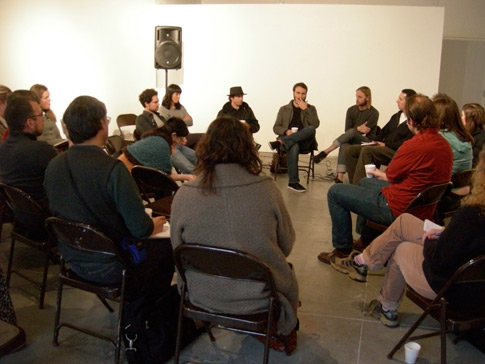 The Artist Respondents move front and center
The goal of the day was to get a bunch of people talking about issues like arts funding, government and the arts, the stimulus, the economy and what that means for artists, and interesting ways that all these areas may interact. This we accomplished. It is incredibly hard to get a bunch of artists and arts activists who already have an incredibly full work load together and come up with some immediate solutions to any problems, so we didn’t leave the meeting with a clear course of action, but I think that is ok. We’re still really early on, and just hearing out different ideas and perspectives is always fruitful.
I came away with a couple of things in particular though:
1. If artists want more money from government, they have to show up to meetings and prove themselves as a constituency and fight for what they want. They could team up with real estate brokers who know how artists turn areas from bad neighborhoods to desirable ones. They can fight for money in all aspects of government. Someone suggested that every single government project could have some sort of artistic element to it. Even if the budgets for this type of work are small, if these jobs are given only to Oakland (or whichever city you live in) artists, the impact could add up. Mike Bianco spoke about the possibility of starting a union. If a union charged some dues, maybe each locality could hire a lobbyist.
2. The stimulus for the NEA, in comparison to a lot of things, is still very small. Lori Zook, from the Oakland Cultural Arts and Marketing Division, suggested that we look not just to the NEA to get our hands on some stimulus money, but also through Education programs and Community Development Programs. She said there are billions of dollars being funneled into those programs. Now, this assumes that you’d have to fit your art into one of those categories, which is not always the easiest things to do. I was talking to my sister about grants and writing for them in general. Grant writers are incredibly adept at not necessarily fibbing about their projects, but just using the language and framework that the granters want to see. Perhaps we need to become creative in thinking of the ways that our work could be framed.
I was just talking to Joseph and he thinks this idea is a little bogus, as art should be funded because it is art and we and others should see the value in doing just that. I believe that, but it seems clear in this country that many policy makers do not believe that. So I’m ending at one of the very first topics/quandries of the discussion: how to make people understand, believe in, and fund art for its simple value as cultural capital.
The Artist Respondents move front and center
The goal of the day was to get a bunch of people talking about issues like arts funding, government and the arts, the stimulus, the economy and what that means for artists, and interesting ways that all these areas may interact. This we accomplished. It is incredibly hard to get a bunch of artists and arts activists who already have an incredibly full work load together and come up with some immediate solutions to any problems, so we didn’t leave the meeting with a clear course of action, but I think that is ok. We’re still really early on, and just hearing out different ideas and perspectives is always fruitful.
I came away with a couple of things in particular though:
1. If artists want more money from government, they have to show up to meetings and prove themselves as a constituency and fight for what they want. They could team up with real estate brokers who know how artists turn areas from bad neighborhoods to desirable ones. They can fight for money in all aspects of government. Someone suggested that every single government project could have some sort of artistic element to it. Even if the budgets for this type of work are small, if these jobs are given only to Oakland (or whichever city you live in) artists, the impact could add up. Mike Bianco spoke about the possibility of starting a union. If a union charged some dues, maybe each locality could hire a lobbyist.
2. The stimulus for the NEA, in comparison to a lot of things, is still very small. Lori Zook, from the Oakland Cultural Arts and Marketing Division, suggested that we look not just to the NEA to get our hands on some stimulus money, but also through Education programs and Community Development Programs. She said there are billions of dollars being funneled into those programs. Now, this assumes that you’d have to fit your art into one of those categories, which is not always the easiest things to do. I was talking to my sister about grants and writing for them in general. Grant writers are incredibly adept at not necessarily fibbing about their projects, but just using the language and framework that the granters want to see. Perhaps we need to become creative in thinking of the ways that our work could be framed.
I was just talking to Joseph and he thinks this idea is a little bogus, as art should be funded because it is art and we and others should see the value in doing just that. I believe that, but it seems clear in this country that many policy makers do not believe that. So I’m ending at one of the very first topics/quandries of the discussion: how to make people understand, believe in, and fund art for its simple value as cultural capital.
art and politics art market blog others lives TPG8
art and politics arts funding blog reblog TPG8
When it comes to funding for state arts agencies, California remains not-so-proudly ensconced in its customary slot — dead last — according to a report from the National Assembly of State Arts Agencies.
art and politics arts funding blog good things news TPG8
The nation’s 100,000 nonprofit arts organizations and their audiences generate $166.2 billion annually in U.S. economic activity. They support 5.7 million jobs and provide nearly $30 billion in government revenue. This economic stimulus will minimize the concern that ten percent of arts groups could close this year and helps save thousands of arts workers from losing their jobs.Hotly contested, called “pork,” “non-stimulative,” and “wasteful” by many republicans led by Sen. Tom Coburn (Oklahoma), Lynch’s statements (see audio recording below) bring into focus the true economic benefits of the arts in this country. This will be a big boon for the NEA and new arts projects. 40% of the money will be dispersed to existing state and regional arts organiztions and agencies and the other 60% will go towards funding new arts projects. (!) Robert Lynch presents the importance of the Arts to Congress
art and politics art market blog TPG8
 Panelists for the Feb. 3 debate included (from left) Jerry Saltz, Amy Cappellazzo, Chuck Close and Adam Lindemann. Longview Photography
art and politics bay area blog events news State of the Arts TPG8
 Building on the discussion that began with our eighth issue, “State of the Arts“, we’ll be hosting a Visual Arts Town Hall Meeting in Old Oakland Saturday February 21st from 3-5. Moderated by curator Joseph del Pesco, the meeting will be a chance for artists, gallerists, political figures and the public to discuss the way government can influence and support local art production. We’ll share opportunities that already exist and try to identify simple steps to creating a more sustainable visual arts community.
Participants will include: David Huff (Program Coordinator/Curator Pro Arts), V Smoothe (“A Better Oakland” blog Editor ), Mike Bianco (Queens Nails Projects), Christian L. Frock (Invisible Venue), Kerri Johnson (Blankspace Gallery) Svea Lin Vezzone (Swarm Gallery) and artists: Amy Balkin, Steven Barich (Artopic.org), Helena Keeffe, Aaron Gach, Chris Sollars, David Stein
Visual Arts Town Hall
465 Ninth St. Oakland, CA 94607
February 21st: 3-5 pm
1st hour: moderated panel of gallerists, arts administrators, and politicos
coffee and snack break
2nd hour: artists from the State of the Arts project take the “stage” and respond to the panel and audience questions and comments
This event is sponsored in part by PSAI Old Oakland Associates and Southern Exposure
Building on the discussion that began with our eighth issue, “State of the Arts“, we’ll be hosting a Visual Arts Town Hall Meeting in Old Oakland Saturday February 21st from 3-5. Moderated by curator Joseph del Pesco, the meeting will be a chance for artists, gallerists, political figures and the public to discuss the way government can influence and support local art production. We’ll share opportunities that already exist and try to identify simple steps to creating a more sustainable visual arts community.
Participants will include: David Huff (Program Coordinator/Curator Pro Arts), V Smoothe (“A Better Oakland” blog Editor ), Mike Bianco (Queens Nails Projects), Christian L. Frock (Invisible Venue), Kerri Johnson (Blankspace Gallery) Svea Lin Vezzone (Swarm Gallery) and artists: Amy Balkin, Steven Barich (Artopic.org), Helena Keeffe, Aaron Gach, Chris Sollars, David Stein
Visual Arts Town Hall
465 Ninth St. Oakland, CA 94607
February 21st: 3-5 pm
1st hour: moderated panel of gallerists, arts administrators, and politicos
coffee and snack break
2nd hour: artists from the State of the Arts project take the “stage” and respond to the panel and audience questions and comments
This event is sponsored in part by PSAI Old Oakland Associates and Southern Exposure
art and politics bay area blog TPG8
art and politics bay area blog TPG8
art and politics bay area blog TPG8
 Click image to see full map.
As Barack Obama enters office next week, his mantra of change will finally have a chance to prove itself. Looking at this map from the Atlantic, we see not only the state of the nation he inherits, but also that things over the past 8 years have changed quite a bit already.
Sources
Click image to see full map.
As Barack Obama enters office next week, his mantra of change will finally have a chance to prove itself. Looking at this map from the Atlantic, we see not only the state of the nation he inherits, but also that things over the past 8 years have changed quite a bit already.
Sources
art and politics State of the Arts TPG8
 Gran Fury:A group in the 80’s and 90’s focused mostly on AIDS awareness, education, and visibility. They produced images and staged events to increase awareness, almost an ad campaign for AIDS awareness and education, yet funded through art institutions. An interview with Avram Finkelstein, an original member.
Guerrilla Girls: Raising awareness about sexism and racism in the art world since 1985.
Women’s Action Coalition [WAC]: is a grassroots radical women’s organization first formed in New York in January, 1992 when a group of women angered by the Anita Hill-Clarence Thomas hearings met to turn their outrage into creative street action for change. There were strong chapters in cities all around the country, notably Chicago and San Franciso.
Art Worker’s Coalition: Though short lived, (1969-71) this group did cause some real change for artists, especially in their relationships with museums. Documents from their Open Hearing and other materials available here.
Artists involved in the conversations:
Amy Balkin
Anthony Discenza
Aaron Gach
Eleanor Hanson
Packard Jennings
Helena Keeffe
Mads Lynnerup
Anthony Marcellini
Christian Maychack
Lee Montgomery
Lucas Murgida
Steve Shearer
Chris Sollars
David Stein
Oliver Wise
Gran Fury:A group in the 80’s and 90’s focused mostly on AIDS awareness, education, and visibility. They produced images and staged events to increase awareness, almost an ad campaign for AIDS awareness and education, yet funded through art institutions. An interview with Avram Finkelstein, an original member.
Guerrilla Girls: Raising awareness about sexism and racism in the art world since 1985.
Women’s Action Coalition [WAC]: is a grassroots radical women’s organization first formed in New York in January, 1992 when a group of women angered by the Anita Hill-Clarence Thomas hearings met to turn their outrage into creative street action for change. There were strong chapters in cities all around the country, notably Chicago and San Franciso.
Art Worker’s Coalition: Though short lived, (1969-71) this group did cause some real change for artists, especially in their relationships with museums. Documents from their Open Hearing and other materials available here.
Artists involved in the conversations:
Amy Balkin
Anthony Discenza
Aaron Gach
Eleanor Hanson
Packard Jennings
Helena Keeffe
Mads Lynnerup
Anthony Marcellini
Christian Maychack
Lee Montgomery
Lucas Murgida
Steve Shearer
Chris Sollars
David Stein
Oliver Wise













Lego Hello World
I wish all my printers were made of legos.
LIFE photo archive hosted by Google
Images from Life Magazine going back to 1860’s, hosted by Google
Coming Face To Face With The President
Well crafted story about an under-heard point of view.
In California, Pot Is Now an Art Patron
A new funding source for the arts – reaping big rewards and funding many projects. It’s pot.
Notes on Portraiture in the Facebook Age
Celebrity Book Club: A List to End All Lists
Because, well, it’s sortof awesome.
Are "Artists' Statements" Really Necessary?
The pros and cons about that nemesis for most artists.
This to That
You tell it what you’ve got and it’ll tell you what to glue them together with.
Work of art: Online store for buyers, sellers
Not the TV show! Kelly Lynn Jones from Little Paper Planes is interviewed on her project, gives us a cheat sheet to local affordable art resources.
