Did you love Nava Lubelski’s work? Here’s a chance for more.
February 25th, 2011 by oliver - arts funding, blog, collecting resources, exhibits, TPG artists, TPG15
February 24th, 2011 by eleanor - art and politics, bay area, blog, curating, public art, value of art
VSmoothe over at A Better Oakland has a recap of a recent Oakland Planning Commission Meeting in which the above Oaksterdam University signage was judged to violate Oakland business signage size ordinances. As she notes, since “the Planning Commission was clearly sympathetic to Oaksterdam University” discussion turned to redoing the sign as a “mural” or “special sign” in order to skirt the legal issues. As this discussion has been going on for a year, Oaksterdam had already put out an open call to attract artists to redesign the sign as a mural. This is when the Planning Commission decided it was their place to choose which of these public art proposals should go forward.
There is a fundamental problem when the planning commission is choosing artwork. That is not their job, and the fact that they refused the help of Oakland Public Art Advisory Commission is deplorable. Steven Huss politely and rightly offered the PAAC‘s services, since it is their place to help decide on works of public art, but also because they have experience guiding organizations, businesses, and individuals in matters of budget, permits, and the hurdles that one has to cross when working with artwork in the public sphere. But instead, the Planning Commission moved forward with their own opinions, deciding which work had the “broadest appeal” and which was too “on the edge.”
Here’s the one the planning commission preferred:
And here’s what V Smoothe had to say:
I mean, the whole original discussion about the idea of sign or mural was about placemaking. And whether one thinks this mural is pretty or not, it certainly doesn’t have anything to do with the neighborhood. Oaksterdam is not on Lake Merritt, nor is it at Oakland City Hall. I live in the heart of Oaksterdam, and I cannot see either Lake Merritt or City Hall from my apartment. The only thing about the mural that identifies the neighborhood at all is the text with the name of the business. read more>>If we’re talking about a mural with a purpose for place-making, that mural should be judged not only for relevance to the area and the people there, but also specifically for it’s innovation and interpretation of those concepts. This proposal does not address the specific locality as a place, other than being located in Oakland. A mural will not assist in place-making if 1. it does not address the specific place and 2. is aesthetically bland. Artworks and architecture can have a drastic effect on the community and pride of an area, especially if it is something that stands out. The TransAmerica Pyramid was deplored when it was built. But what would the San Francisco skyline be without it? Bold moves are sometimes required. Risk is rewarded with awareness, even if some people hate it. Richard Serra’s Titled Arc was eventually removed, but now many people think of Federal Plaza as the place where it existed. Here are two other top contenders for the Oaksterdam mural:
Proposal 2
Proposal 3
Since we’re all into voting these days, which do you like the best? Perhaps an art audience has a slightly different opinion than the Planning Commission?
[poll id=”2″]February 19th, 2011 by eleanor - blog, other, personal
As winter continues on into it’s doldrums, you can do a nice thing for your houseplants and give them a shower! The dry air from heat doesn’t do these guys any good. A tepid shower fully hydrates them, gives them a nice dose of humidity, and cleans off their dusty leaves. They will reward you for your efforts with renewed growth and a little extra green, all of which helps when the days are very grey.
February 18th, 2011 by eleanor - blog, exhibits
Untitled Event, Andrew Venell 2011
Photos courtesy of Andrew Venell. The show will be up until March 27th. Learn about the details of the show here.
February 14th, 2011 by eleanor - arts funding, bay area, blog, good things, internet, new models, news, web hosting
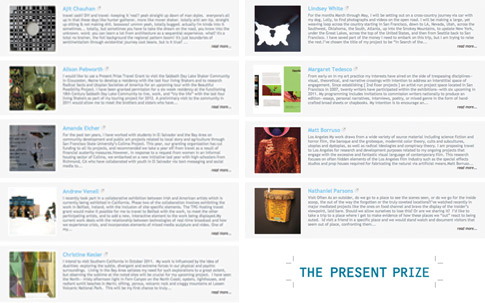
The Present Prize is an intermittent artist grant funded by web hosting fees and awarded by the community of hostees with help from the general public. Each grant period will have a new theme targeting an underfunded area of the creative landscape.
For our first prize, we have teamed up with the Collective Foundation to create a $1K travel grant to a Bay Area artist in order to address a possible reason why Bay Area artists often leave the area after a period of “incubation”. Joseph delPesco, founder of the Collective Foundation speaks eloquently about the reasoning behind this grant theme on the SF Moma blog. (excerpt below)
“Unlike most first-world countries we don’t have a cultural agency at the state or federal level that funds artists’ travel. I have an untested theory that if Bay Area artists had support for mobility that they would be more likely to stay. While the last sentence may sound counter-intuitive, I think one reason artists leave is the relative isolation of the Bay Area in relation to the art centers. More to the point, It appears that most of the artists who have stayed are those who have been able to develop projects and find exhibition opportunities outside of the Bay Area.”
February 12th, 2011 by eleanor - artist resources, bay area, blog, subscription art
Wapke Feenstra. Former Farmland, Sagarossa, Spain, 2008; pamphlet/poster, 5.88 x 4.16 in. closed, 11.66 x 16.75 in. open.
Welcome Landfill! A new project by Ted Purves and Elyse Mallouk, Landfill is interested in the funny little pieces of information or material byproducts that are produced by social practice artists. They are cataloging these pieces of history on their website and have also started an art subscription to allow more people to collect and learn about these projects (at a really reasonable price: $60/year for 4 issues). The subscription will consist of a Journal along with selected pieces of actual ephemera. Perhaps a good preview of what the Journal will be like is these two articles on Art Practical highlighting this project. Here’s a tidbit describing themselves:
Landfill is a project that archives, studies, and redistributes the material byproducts produced by ephemeral artworks. It creates a second venue for projects that largely existed in non-material form, and aims to build a non-linear history of socially engaged art practice. Landfill exists in three parts: an online Archive, a material Quarterly, and a written Journal. The Quarterly is distributed to subscribers four times a year. It contains the Journal and selected pieces of material ephemera. As part of the Landfill Archive, supplemental materials become conduits for ideas that continue to circulate. The Archive is an aggregate capable of accounting for the broad range of projects that self-consciously consider their publics, without laying claim to a singular narrative. It is accessible all the time, for free.They are looking for submissions. With this new addition, we now have 5 solid art subscriptions in the Bay Area! Check out the links on the sidebar to learn about them all. It’s pretty exciting to see how this model can adapt to suit all sorts of work and interests. It’s not clear if Landfill will use subscription dues solely to create the journal or if they will also be using some of the funds to compensate contributing artists who often rely on grants to accomplish this sort of work. My guess is for that price they will need most of the money just to accomplish the creation of the physical journal, shipping, and writing. However, as they grow, perhaps they will consider sponsoring projects to give back to the community of artists they will rely for donations.
February 8th, 2011 by eleanor - art world, artist resources, blog, good things, new models
Part social network, part glossy brochure, part fund-raising mechanism, the site seeks to democratize arts patronage as government support for the arts continues to decline and private sources of financing also shrink. “What we’ve tried to do is take the good ideas about microphilanthropy and the good ideas about social networking and put them together in a way that people can learn about artists and learn about their projects and how they work,” said Katharine DeShaw, the organization’s executive director. In testing, the Web site attracted roughly 36,000 unique visitors and raised a total of $210,000, with an average of $120 from each of 1,500 small donors, Ms. DeShaw said. Read more>>
February 7th, 2011 by eleanor - blog, press, State of the Arts, TPG8
February 5th, 2011 by eleanor - bay area, blog, exhibits, TPG14
Wasteland, a multi-media exhibition curated by Matt Cella, opens this Saturday, February 5th, from 6 to 9pm at SOAP Gallery.
A suburban cabinet of curiosities, Wasteland highlights the work of a generation of artists raised on 80’s and 90’s popular media.
Inspired by the emo-bedrooms and basement dens of teenage America, the exhibition will feature works by Adam Hathaway, Amir Esfahani, Anthony Record, Ben Venom, Carrie Hott, David Horton, Jeremiah Jenkins, Julumarie Joy Cornista, Kristen Roberts, Matt Cella, Mike Decker, Neils Neilson lll, Renetta Sitoy, Robert Burden, Ross Campbell, and Tom Mueske.
Wasteland will run until March 5th. The Gallery is located at 3180 Mission Street, in San Francisco.
SOAP Gallery
3180 Mission St
San Francisco, CA
http://206.130.104.2/soap-gallery/
February 4th, 2011 by eleanor - art and politics, blog, video art
February 3rd, 2011 by eleanor - blog
Presley Martin (#2), Christine Kesler (#3), and Andrew Venell (critic #7) are all participating in the show “Give and Take” at Lost Coast Culture Machine. The show opens this weekend.
Friday, February 4, 6-9 PM: GIVE & TAKE OPENS @ LCCM
Saturday, February 5, 5 PM: ARTIST TALKS (Join artists for a conversation about the Give & Take project.)
Lost Coast Culture Machine celebrates First Friday, February 4th, 6–9 pm, with the opening of Give & Take, an exhibition documenting the results of a seven-month collaborative trans-Atlantic project. Conceived by Tonya McMullan of Belfast, Ireland and coordinated with LCCM, five artists from Belfast and Edinburgh, Scotland and five artists from California were paired off to exchange instructions for the creation of new work. The artists’ instructions varied from the rigid and restrictive, ritualistic and suggestive, to the obstructionist, subtractive, and playful, all aimed to disrupt and augment the creative practices of the other.
The California participants in Give & Take are Anne Beck, Christine Kesler, Dietmar Krumrey, Presley Martin, and Andrew Venell;
the artists from across-the-pond are Acitore Z Artezione, Alexa Hare, Michael Hart, Tonya McMullan, and Paulina Sandberg.
Acitore Artezione, Tonya McMullan, Presley Martin & Andrew Venell will join us for the installation, opening & artist talks. Please come welcome them to Fort Bragg!
Give & Take part II continues at PS2 Gallery, Belfast, Northern Ireland in April 2011.
Give & Take runs February 4- March 27 at the Lost Coast Culture Machine, 190 East Elm Street (across from the bowling alley) in Fort
Bragg. More information at 961-1600, or lostcoastculturemachine.org.
January 21st, 2011 by eleanor - blog, fashion, neat projects
January 14th, 2011 by eleanor - blog, pictures, tidings
May this year be full of finding ways to build your own world.
December 21st, 2010 by oliver - Annotated Links, blog, Lichen Books: On the Road, TPG16
House of Leaves by Mark Z. Danielewski and Superworse – The Novel: A Remix of Superbad: Stories and Pieces by Ben Greenman – Two books that play with text and storytelling in ways that I found particularly compelling.
Rebecca Campbell’s work helped to mold the way that I think about beauty in art.
Marina Abromovic’s work made an indelible impression on me as the first performance/interactive art that captivated my imagination.
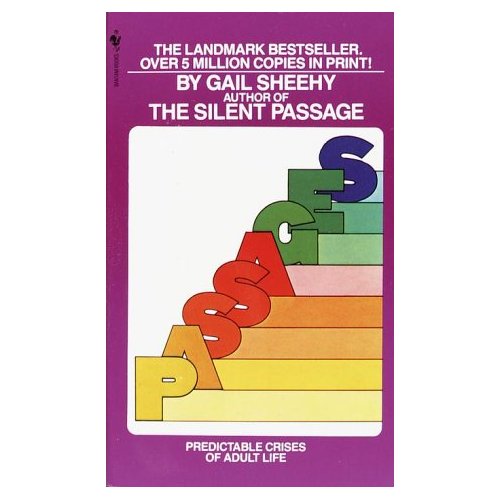
Passages: Predictable Crises of Adult Life – A friend loaned me this book and urged me to read it. Although I am very wary of self help books generally, and particularly skeptical of ones published in the seventies, this book undeniably influenced my thinking while writing the text to intertwine with On The Road.
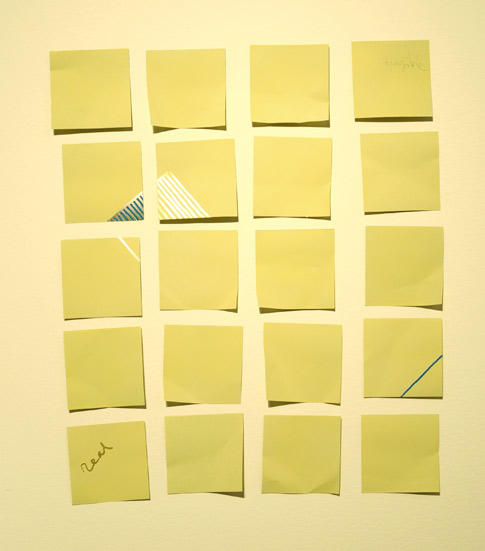
Each of Anton Ginzberg‘s bronze cast post it note sets respond to a different book in the Saint Germaine series. Seen at NADA at Moscow’s GMG gallery.
December 21st, 2010 by admin - blog, contemporary art criticism, Lichen Books: On the Road, TPG16
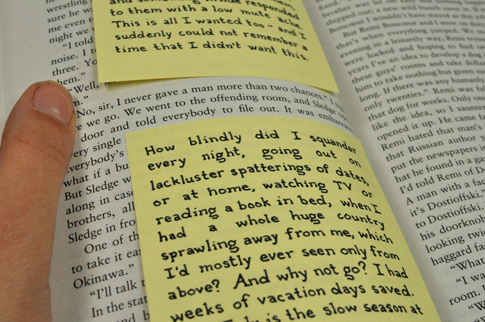
While reading her responses, I felt my own presence in a way that was uncomfortable—I wasn’t sure I wanted to be reminded of my self-as-reader in the present moment. Isn’t that partly why we read novels—to escape our bodily experience? Blakley is complicating this convention with the materiality of her chosen form—you must lift her notes off to read the text underneath or interrupt the novel to read her story. And yet I grew to look forward to the notes, because they activated the text in unexpected ways. In a particularly bright moment in the middle of the book, the narrator of Blakley’s story lies down in the salt flats on the same route that Paradise was on a few chapters back, confused as to what to do with her life: “I felt like I had turned into a pile of salt. But it wasn’t a punishment, it was natural. It was where I was supposed to be. It was settled—I would lie in the salt until I knew what to do with my life.” The intrusion serves to build out Kerouac’s work, to emphasize its timelessness, and also contextualize and layer hers. Blakley’s scene recalls the circular nature of Paradise’s journey through the novel, finding himself repeatedly in altered and peripheral experience. Meanwhile underneath her text, Kerouac lyrically comments on the nature of the western landscape: “for the house was in that part of the West where the mountains roll down foothilling to the plain and where in primeval times soft waves must have washed from sea-like Mississippi to make such round and perfect stools for the island-peaks like Evans and Pike and Longs.” Blakley keeps her prose exceptionally flat; she lets Kerouac do the work of lyricism that sets a backdrop of expansive, aerated time, while her story’s similarity to Paradise’s compounds for us the commonality and collective nature of our angst.
Blakley’s experiment provides the sensation of a story being told in rounds—both narrators exploring the same isolation and feeling of irrelevancy in a vast and indifferent landscape—but hitting different notes at different moments, which exposes the vibrant and mysterious urge for storytelling (response) itself. This, in turn exposes the stakes of the first person narration of both—we may always feel confused about our purposes and roam the roads feeling lost, but the urge to make sense of this experience through telling our stories, responding to life, has the capacity to provide a momentary sense of order.
That’s the ultimate success of this intervention—it exposes a natural conflation of those impulses—to know the self and other, and to know a text. The manifestation of those impulses is our responses to each other. Blakley pays Kerouac the high compliment of being his fan and critic; at times she seems to be poking fun at Kerouac’s frenetic lyricism and Paradise’s unconscious privilege through her flat and minimalist prose, at other times she reverently concurs with his insistent portrayal of life as a restless quest after unfulfilled desires.
I think the most we can hope for is, in listening, that we are called to respond. Maybe here, response is the act of love Blakley is exposing. That we’re not in a void, that our words matter to each other. The position of the reader is made more active, because we’re being asked to examine our own stakes in these stories, in a direct physical interaction with sticky papers in a book—we’re asked to find these stories familiar, as something we recognize, as something worth responding to.
.
.
Sarah Fontaine lives in the Outer Sunset of San Francisco, California. She co-directs the studios and project space at the Carville Annex, a site for investigating people and place. She seeks higher stakes. Her writing and other experiments can be found in Plaid Review, Reading Conventions and factorycompany.
December 21st, 2010 by oliver - Artist Interviews, artist interviews, blog, hear it, Lichen Books: On the Road, On The Road, talking, TPG artists, TPG16
December 21st, 2010 by oliver - blog, Lichen Books: On the Road, TPG16
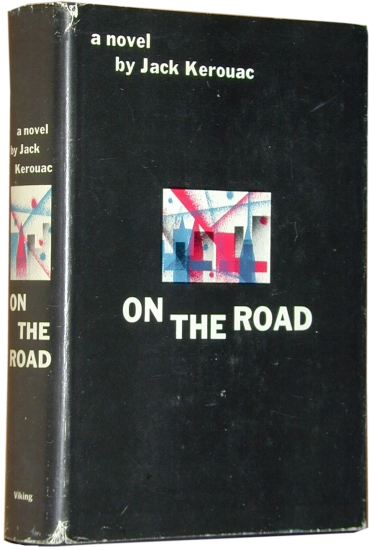
In the sixteenth issue of The Present Group, artist Rebecca Blakley sneaks a contemporary coming-of-age tale into “the novel that defined a generation”. “On the Road” is an edition of 70 copies of the classic novel by Jack Kerouac containing a parallel story told by Blakley via Post It notes hand drawn in Times New Roman.
Rebecca Blakley is a native of Santa Barbara, California, who has recently moved to Oakland, after an east coast stint involving Baltimore, Maryland and Brooklyn, New York. She double majored in art and English literature at University of California, Los Angeles, graduating in 2003. Although she has exhibited paintings in such venues as Maryland Art Place and the Baltimore Creative Alliance, her recent work has focused on producing art that the viewer encounters in unexpected places.
December 14th, 2010 by eleanor - blog, news, TPG8
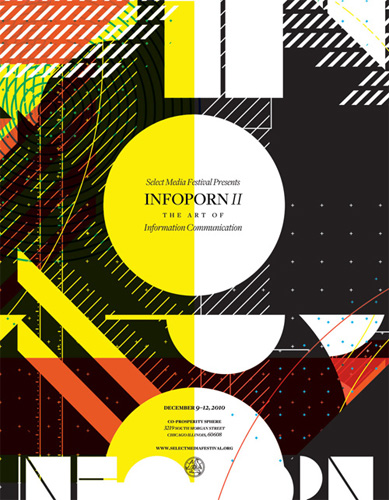
The State of the Arts posters were in this short lived show in Chicago: an homage to their love for data visualization, the show highlights a selection of works from around the world in the form of installations, a publication library, interactive projects and infographics.
November 29th, 2010 by oliver - blog, businessy stuff
Our 4 year anniversary celebration has been bittersweet. We are extremely proud and honored to have been enabled by our subscribers over the years to fund 16 artist projects, learn from and work with some amazing artists, and to expose a large group of people to new artists and their ideas. We’ve received a ton of support from people around the world who have been touched by the project itself and the works that we’ve put out. One of our goals in starting our subscription project was to spread the idea of art by subscription, and it encourages us immensely every time we see a new venture pop up around the country. (To see all of the subscription art services we’ve found, check out the “Subscription Art” links on the sidebar.)
The Future, Changes
As with many experimental publications, we’ve reached a point where we must re-evaluate. While the publication is far too exciting to stop, we have decided to cut down our schedule, moving from a quarterly to a tri-annual publication. Our price point will remain the same, giving us a little more flexibility in both the types of projects we choose and the way in which we spread the word about what we’re doing.
We are very excited about this move as it will allow us to develop some much needed infrastructure and pursue other projects, both through TPG and personally. Through The Present Group, we already have 3 major projects and developments planned for next year, and we’re chomping at the bit for 2011 to arrive so we can settle into working on them.
Current subscribers FAQ:
There will be no change to your subscription other than starting in 2011, issues will arrive every 4 months instead of every 3. You will still receive all 4 editions you signed up for.
***Special Offer***
Before this change goes into effect, we want to take a moment to offer you the chance to subscribe, resubscribe, or give the gift of a Present Group subscription for the same low price and still receive four works. All subscriptions received before December 1st will receive four issues. If you resubscribe early, your resubscription will add 4 issues to your queue, no matter when that resubscription goes into effect.
I WANT 4 WORKS FOR THE PRICE OF 3! >>
Lego Hello World
I wish all my printers were made of legos.
LIFE photo archive hosted by Google
Images from Life Magazine going back to 1860’s, hosted by Google
Coming Face To Face With The President
Well crafted story about an under-heard point of view.
In California, Pot Is Now an Art Patron
A new funding source for the arts – reaping big rewards and funding many projects. It’s pot.
Notes on Portraiture in the Facebook Age
Celebrity Book Club: A List to End All Lists
Because, well, it’s sortof awesome.
Are "Artists' Statements" Really Necessary?
The pros and cons about that nemesis for most artists.
This to That
You tell it what you’ve got and it’ll tell you what to glue them together with.
Work of art: Online store for buyers, sellers
Not the TV show! Kelly Lynn Jones from Little Paper Planes is interviewed on her project, gives us a cheat sheet to local affordable art resources.