New Media, New Modes: On ‘Rethinking Curating: Art after New Media’

Nathaniel Stern takes a look at this new book by Sarah Cook and Beryl Graham, co-editors of the CRUMB site and list (the Curatorial Resource for Upstart Media Bliss

Fiscal Sponsorship: 6 Things You Should Know

Oliver and I are thinking about fiscal sponsorship for TPG again and this time around we’re trying to learn as much as possible about the process before we invest our time in applying.  I thought I would share what we’ve learned about how it works and what one should think about in choosing/applying for fiscal sponsorship.

$$$$$$$$$$

1. What is it?

Fiscal Sponsorship allows organizations, individual artists, projects, or companies that have a non-profit mission to align themselves with a designated 501c(3) non profit organization and apply for grants and accept donations under their umbrella.

Why do people do it?
Many times it is simply too costly or time consuming for fledgling organizations or projects to set up legal non-profits.  Fiscal Sponsorship allows organizations to learn the ins and outs of grant writing and test out whether a non-profit structure is a good fit for them.  Sponsoring Organizations can create a bigger impact when multiple projects are pursuing their mission.  They can also mentor and assist smaller organizations  who may grow up to be big kid non profits. ..And I’m pretty sure some of the organizations see the profit they make through their administrative fees as a plus.  This is more the case when they have over 50 sponsored projects (Tides Center, Fiscal Sponsorship Field Scan, pg10.)  I’m not knocking them; they are providing a valuable service for projects that otherwise wouldn’t be able to get grants and it does take time and work to oversee the sponsored projects.

2. Different Financial/Legal Models

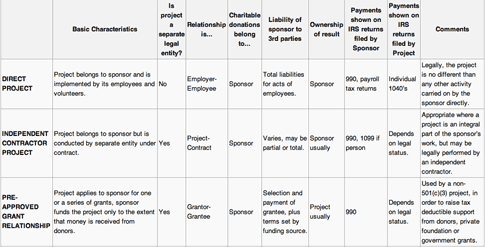
There are different ways that fiscal sponsorships are legally set up.  According to  “Fiscal Sponsorship: 6 Ways to do it right” by Gregory Colvin, the three most widely used fiscal sponsorship models are:

Model A: Direct Project
In this model, the Sponsoring Organization assumes all legal and fiduciary responsibility for the project.   The sponsored project becomes, in essence, part of the sponsoring organization.  The sponsoring organization maintains control over the project and all funds that pass through the project, not just funds that are donated to the project.   Often in these cases the sponsoring organization takes care of payroll, benefits, and disbursement of all money.  As they are responsible for the project, they may weigh in and have control over the direction of the project as a whole.

Model B: Independent Contractor Project
In an Independent Contractor relationship, the Sponsoring Organization still usually has ownership of the results of the project, but the project itself is treated as a separate legal entity.  The organization, in essence, is contracting the project to do its work for them.  The “work” I am talking about is the actions of the project that fulfill the sponsor’s mission.

Model C: Preapproved Grant Relationship
A preapproved Grant Relationship is one where the sponsoring organization and the sponsored project are completely separate entities.  The organization approves the granting process and the fact that the project is pursuing aims that fulfills its nonprofit mission.  Once it receives the funds, it re-grants the money (less its fee) to the project.  Financial and legal responsibility stays in the hands of the project.

I found this chart on wikipedia especially helpful:
fiscalsponsorshipchart

3. Fees

Most organizations charge between 5-10% of the funds that pass through them.  Some will charge up to 15%, especially for government grants that have a lot of red tape to deal with.  The average, according to The Tides Center, is 5.6% for non governmental grants and 7.7% for governmental grants.  Most of the ones I have found in the Bay Area for Arts organizations range from 6-10%.

Some places require you to be a “member” of their organization in order to apply to be fiscally sponsored.  These prices are usually up to $200/year.

4. Which organization to apply to?

The most important factor for the majority of organizations when deciding whether to sponsor a project is alignment of mission.  In most cases, it simply works best for both parties and makes the most sense if the two groups share the same goals.

Though there are some national sponsors (like Fractured Atlas or NYFA), the second most important factor for most organizations is geographic location.  A sponsored project should take location into consideration as well if they want to take advantage of non-profit sales tax exemptions.  If they do, they need to be in the same state as their parent organization.

5. What can they do for you?

Every sponsor has a different program for their projects.  Each offers different benefits, like advising on grant applications, legal stuff, and organizational/business development, discounts to events or classes, different promotional opportunities, different ways that they are able to accept donations (like credit card processing, monthly billing of donors, whether they can deal with non-monetary donations, etc).

They all also have different ways of handling the money.  Some will cut you a check on demand, some on a regular basis, and a few have online tools to manage your account.  Most will make you provide documentation for how the money is being spent.   All these things are good to take into consideration when deciding who will be the right fit for you.

6. Size of their Sponsorship Program

One last thing to take into consideration is the number of projects that an individual organization sponsors.  While on one hand, the larger the number the more familiar they may be with how sponsorship works and they may have more tools and benefits as a result.  But on the other hand, many granting organizations and foundations will only accept one application for a specific grant per organization.   When there are 2000 projects under one umbrella, the chances are higher that you may find some conflict in this area.

So! In conclusion.
Some non-profits are very cautious about fiscal sponsorship arrangements and prefer to have a lot of control over the projects in order to ensure legality.  (I’ve read one critique of this process likening it to money laundering.)  But some are much more laid back.  It seems every organization takes their own view on how it should work.   The Tides Center sums up it’s review of Fiscal Sponsorship practices with the view:

As evidenced by the findings of this report, the array of policies and practices
employed by fiscal sponsors is wide ranging. From large to small,
sophisticated to naïve, and focused to broad, there clearly is no “typical”
fiscal sponsor. What is clear, however, is that there is a growing number
of organizations involved in fiscal sponsorship with increasing project
loads. Few of these organizations feel confident that they are “doing it
right” and, due to the complexities of the law and tax codes, there is good
reason for that lack of confidence.

Go out and be sponsored! Maybe?
Here are some resources to find sponsors in your area.

Fiscal Sponsor Directory

National Network of Fiscal Sponsors through the Tides Center

Foundation Center: A comprehensive listing of websites, guides, and publications about fiscal sponsorship.  They also have a web video explaining fiscal sponsorship.

Project Space Survival Strategies

projectspace

Thinking about money and how it can work in the art world is on a lot of people’s minds these days.  Elysa Lozano, an artist working as “Autonomous Organization”, has created a compendium of project spaces around the world, all talking about how and why they started and how their funding works.

From her statement:

The motivations behind these initiatives are inextricably linked to the manner of funding them. What constitutes an acceptable way to get funding is as much a question of the integrity of the intention as it is a question of survival… It is also my hope that by publishing the anecdotes and experiences of the people who run these spaces that the creative ideas and strategies will become a resource to anyone currently running an independent project or thinking of starting one up.

Project Space Survival Strategies was produced in collaboration with Invisible Venue.  The project is ongoing, and accepts contributions from anyone running project spaces.  You can find the survey here.

2 x 15K for Public Art in the Bay Area: Southern Exposure Offers a New Award

graueaward

For two years, Southern Exposure, enabled by the Graue Family Foundation, is going to offer a 15K award for Public Art Projects in the Bay Area.  Artists nationally and internationally are encouraged to apply.  It is really wonderful to see some significant awards coming out of the Bay Area.

The Graue Award is an initiative of SoEx Off-Site, a program of Southern Exposure’s founded in 2006 that seeks to commission and present new public work by emerging artists that intervenes and interacts in the social and political spheres beyond the space of gallery. SoEx supports and encourages these practices as few venues support emerging artists working in the public. The artists selected through the program will make a proposal and develop their work in relation the San Francisco Bay Area.

It is an Open Call!  Applications for the 2011 project are due May 26th, 2010.
Details Here.

Somebody wrote about us!

oaklandlocal_logo

We’re honored to be included in this roundup by Emilie Raguso of Oakland Local of Art Subscriptions in the Bay Area.  There’s starting to be quite a number of us! It is really wonderful how this idea is spreading, and people are making it their own.  Thanks to Emilie and Oakland Local, and Welcome to any new visitors!

$200,000 awarded to 26 Califonia Artists: CCI announces it’s Round 5 “Investing in Artists” Grantees.

Congratulations to all!

“We know that grants to individual artists are an important means to help them advance their work, and this is particularly true during an economic recession when financial resources are so scarce,” said CCI President and CEO Cora Mirikitani.

Round V of the Center for Cultural Innovation‘s  Investing in Artists grants program specifically provided support to working artists in the Visual Arts, Craft and Literary Arts in two categories: 1) for the acquisition of Artistic Equipment & Tools; and 2) for Artistic Innovation.

In the Artistic Equipment & Tools category, fourteen (14) artists received Investing in Artists grants:

· Susan Avila (Craft, Oakland)
· Amy Balkin (Multidisciplinary, San Francisco)
· Chris Bell (Multidisciplinary, San Mateo)
· Cindy Bernard (Visual Arts, Los Angeles)
· James Buckhouse (Multidisciplinary, Palo Alto)
· Heather Bursch (Visual Arts, Los Angeles)
· Joshua Churchill (Multidisciplinary, San Francisco)
· Binh Danh (Photography, San Jose)
· David Gurman (Multidisciplinary, San Francisco)
· Taro Hattori (Visual Arts, Oakland)
· Packard Jennings (Multidisciplinary, Oakland)
· Larry Kline (Visual Arts, Escondido)
· Blaine Merker (Multidisciplinary, San Francisco)
· Kim Stringfellow (Multidisciplinary, Joshua Tree)

In the Artistic Innovation category, twelve (12) artists received Investing in Artists grants:

· Jeff Chang (Literary Arts, Berkeley)
· Sara Daleiden (Multidisciplinary, Los Angeles)
· Sergio de la Torre (Multidisciplinary, San Francisco)
· Amy Franceschini (Visual Arts, San Francisco)
· Guillermo Gomez-Pena (Multidisciplinary, San Francisco)
· Desiree Holman (Multidisciplinary, Oakland)
· Ali Liebegott (Literary Arts, San Francisco)
· Kelly Nipper (Multidisciplinary, Los Angeles)
· Scott Oliver (Visual Arts, Oakland)
· Alison Pebworth (Visual Arts, San Francisco)
· Jessica Rath (Visual Arts, Los Angeles)
· Philip Ross (Multidisciplinary, San Francisco)

TPG Expands: Web hosting that Support Artists

orangebanner

We are on a mission to find more ways to get money into artists hands.  Following the funding models that seem to work, models that seem to use what people are paying for anyway, we have decided to start hosing websites.  A website has almost become a business card these days.  So we wanted to create a platform that would not only help people create their own websites in an affordable way, but give them the opportunity to do something good with the money they would be spending anyway to host their sites.

So host with us! At $84/year, it is comparable to most quality hosting sites out there.  Over a quarter of that payment goes directly into The Present Group granting fund.  Each granting period, we will choose a theme, accept nominations from within that theme, and allow all the hostees to vote on the winner.

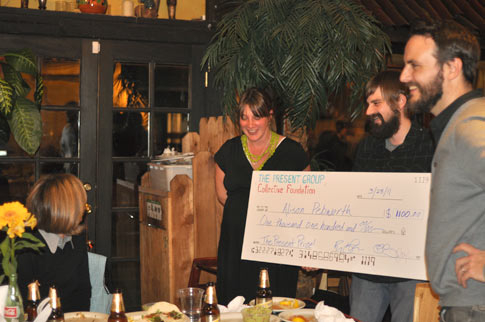
For the first grant, we are teaming up with the Collective Foundation to fund a travel grant for a Bay Area artist.  As Renny Pritikin has noted on the SFMOMA blog, the Bay Area sometimes has a hard time holding on to its notable artists.  Inspired by the way many other governments work, Joseph del Pesco‘s idea is that part of keeping artists here is to help them with the funds to travel away for opportunities and come back.

Alula Editions: A new art subscription & An open call

alula

TPG #11 artist Helena Keeffe has teamed up with Amber Cady to start Alula Editions, a new art subscription whose focus is to work with artists to create repeat patterns for textiles. They collaborate with individual artists and also organize participatory group drawing activities in order to create textiles that defy expectations and move beyond purely aesthetic considerations.

They have an Open Call for Submissions with a deadline of April 28th, and artists receive a $500 stipend.

Starting off with a bang, Alula Editions was a recipient of this year’s Southern Exposure Alternative Exposure Grant, will be collaborating with artists in Portland, Oregon to create the official tote bag for the Open Engagement Conference at Portland State University, and will be printing their first edition as part of a residency at the Headlands Center for the Arts.

They haven’t figured out their pricing structure yet, so subscriptions are not yet on sale.  But you can get on a mailing list so you will be the first to know when they are.  The first work is projected to go out this summer.

Welcome Alula!

In class: CCA

cca0021

Yesterday Oliver and I spoke at CCA for a little bit about The Present Group.  The class is a really neat investigation of different systems of exchange co-taught by TPG#5 critic Scott Oliver and Rachel Robinette.

One of the underlying questions was whether our project, as commendable as it may be, is sustainable.  Can the desire to learn about art be a powerful enough tool in marketing?  Can people wrap their heads around collecting artwork for the sake of learning about it rather than it be an investment, or a chosen work to keep in your home?

We’re still not sure.  We are still a small project, and we haven’t had as much success financially as some of our competitors.  But we believe that the system already exists for people to support artists whose work they know and like and collect their artwork in particular.   We know that we are asking a lot of people when we ask them to think that what they are supporting is the creation of art in general, not just the result that they receive.

The funny thing to me is that it doesn’t seem foreign.    Museum memberships and Season Pass holders to theatres work under this same assumption, and for a similar price point.    The main difference is that they aren’t filling up their home with anything.   Perhaps what we need to focus on is a way for people to support us without having to keep the pieces once they’ve learned about them.

Just some musings…

Southern Exposure 2009 Alternative Exposure Grant Recipients

Congratulations to all the awardees!  I hope all the projects conceived or energized by applying to this grant continue to follow through.  It always irks me that Southern Exposure doesn’t link to the projects right away so I did a bit of googling.  If anyone has any insight on unlinked projects, let me know!

The 2009 Alternative Exposure grant recipients are:

Adobe Books Backroom Gallery
Alula Editions (a project by TPG#11 artist Helena Keeffe and Amber Cady)
Art Practical
ArtXX Magazine
Average
Chris Fitzpatrick & Post Brothers
Critter
Destructibles.org
Happenstand
iiiahh
Pueblo Nuevo Gallery
Ribbons
SMITHS
Stop & Go Rides Again
THE THING Quarterly
The Upper Left Ethnography Project
VOLUMESou

Open Call For TPG13 – Deadline 11/9/09

Our next review date for TPG13 is NOVEMBER 9th, 2009.

The Present Group, a quarterly art subscription service, seeks proposals from artists for projects that are reproducible in intent. We are looking for projects that will result in a limited edition, artist multiples, or a single work that consists of multiple parts. Every year TPG subscribers receive limited edition works from 4 different contemporary artists. A $500 honorarium is awarded to each season’s artist. Artists must submit a proposal to submit[at]thepresentgroup.com or via USPS: The Present Group Attn: Submission 593 8th St. #3 Oakland, CA 94607.

For more information please visit: www.thepresentgroup.com/?tpg=artists

To download full submission guidelines: http://www.thepresentgroup.com/TPG-submissions.pdf

The latest in food-funding-art: Portland Stock

stock_logoblackcr

Stock is a monthly public dinner event and presentation series, which funds small to medium-sized artist projects. Hosted at Gallery Homeland in Portland, Oregon, diners pay a modest $10 for a dinner of homemade soup and other local delicacies and the chance to take part in deciding which artist proposal will receive the evening’s proceeds. In other words, the dinner’s profits immediately become an artists grant, which is awarded according to the choice of the diners. Winning artists will present their completed work at the following Stock dinner.

Posted via web from thepresentgroup’s posterous

Why, bake sales of course!

I just learned about a new attempt at helping artists raise money. Brooklyn based Tracy Candido started Sweet Tooth of the Tiger as “a way to talk with people about dessert,” but it has grown into a new funding model for artists projects. Artist submit for “residencies” where they say what project they’re trying to raise money for. Tracy sets them up with an event where there will be lots of people to buy their goods (we’re talking bake sale – brownies, cupcakes, sugar in all forms) and find out about their project. She meets the artist at the venue, helps out in the selling, takes a small cut of the profit, and interviews the artist for her blog throughout the night. fun!

sweettooth

Spicy Dark Chocolate Ginger Brownies at WORK gallery (Brooklyn, NY)
photograph by Tracy Candido

About Sweet Tooth of the Tiger: Sweet Tooth of the Tiger is part entrepreneurial/d.i.y. food service project and part participatory art project that uses sugar as a medium and explores eating as social practice. The project takes the form of a bake sale that utilizes the community and public sphere as a place for eating, feeding, and talking with your mouth full. Sweet Tooth is invited by members of its community to set up a bake sale table at awesome events and engage with participants by exchanging baked goods for some money. Hopefully, participants are activated by their sugar high to engage in conversation with other participants, heightening their awareness of their own social position as well as a broadened perspective concerning their present environment.

Scott Oliver’s “Once Upon A Time, Happily Ever After”

Our friend and critic for TPG5, Scott Oliver is leading a collaborative artist and community project here in Oakland.  In these times when funding models for the arts are changing, he is reaching far and wide for small donations that will be matched by a larger organization. Here’s another example of a community funded project and the power of collective contributions.

I thought I would post his letter here not only to show how funding models are expanding and changing, but also because I think that this is an interesting project that I would help spread the word about.  Help support great projects!

once-upon-a-time

I am writing to tell you about an exciting project I am currently working on that will debut in January of 2010. Briefly, it is a self-guided audio walking tour for the loop around Lake Merritt in Oakland. Entitled Once Upon A Time, Happily Ever After, the tour will use a mixture of ambient field recordings, interviews, music and narration to weave an idiosyncratic but approachable narrative guiding listeners through the various natural and artificial elements that surround Lake Merritt. With an emphasis on local history, cultural diversity, urban ecology, and the power of imagination, Once Upon A Time, Happily Ever After will explore the invisible that surrounds the visible—the stories and forces that shape the lake and our perceptions of it. The audio tour will be free to the public and widely accessible to Lake Merritt visitors through both on-site and remote locations. Please see the attached project narrative for more details.

I have been seeking funding for this project over the past several months and recently received a generous matching grant from the East Bay Community Foundation in the amount of  $4,000. The funds are contingent upon my ability to raise an equal amount from individual donors. The intention of EBCF’s Fund for Artists matching grants is to create a broad constituency of support for the creation of new works sited in the East Bay. With this in mind I humbly ask for your support of my project with a donation of any size. In order to receive the full grant amount from the East Bay Community Foundation I have to raise the matching funds by June 29th, 2009. Whether you can give $5 or $500, every donation will be doubled up to the $4,000, all of which will go toward the research, development, and production of this project.

Though I am the lead artist, the making of Once Upon A Time, Happily Ever After will be a collaborative and cross-disciplinary process. I will be working closely with recording engineer and musician Michael Blodgett; musical ethnographer, composer, and musician Mark Gergis; and visual artist, writer, and educator Maria Porges. A number of other local musicians will provide the soundtrack for the tour and the Rotary Nature Center located in Lakeside Park has agreed to present the project and provide research support. Additionally The Oakland History Room at the main public library, the Natural Sciences Department at the Oakland Museum of California, the African American Museum and Library, the Nature Sound Society, local historical societies such as the Oakland Heritage Alliance, and cultural organizations such as the Oakland Asian Cultural Center, Eastside Arts Alliance, Oaklandish, and Junior Center of Art and Science will serve as valuable resources for the project.

I recognize that these are difficult economic times but believe deeply in the potential of this project to be a genuinely public artwork—seeking connection with the lives of the individuals who experience it. For me art is first and foremost a form of active looking, a way of seeing and making sense of the world around us. It can readjust or expand the frame through which we peer, focusing our attention on something we have never noticed before or synthesizing ideas and experiences we previously thought were unrelated. Guided by these principles Once Upon A Time, Happily Ever After will offer an immersive audio experience to listeners in a unique urban public space. I hope you’ll join me in bringing this dynamic project to fruition.

If you would like to support this project in the form of a donation that will be doubled by EBCF’s Fund for Artists matching grant, you may do so by mail. All donations must be received by June 22nd to be eligible for the matching grant. And all donations are tax deductible through my fiscal sponsor the Oakland Museum of California who have generously agreed to offer this service non gratis. Please send checks or money orders made out to “Oakland Museum of California Foundation” with “Once Upon A Time Audio Tour” written in the memo area to:

Once Upon A Time, Happily Ever After
c/o Scott Oliver
321 Henry Street
Oakland, CA 94607

Donors to the project will be invited to preview Once Upon A Time, Happily Ever After prior to its public debut. Additionally the names of donors will appear on printed materials associated with the project as well as on the project web site unless they request otherwise.

Thank you for your time and consideration. I very much appreciate your interest and support of my work over the years. I would not be able to continue my practice without a supportive community, but more importantly the Bay Area arts culture thrives because of individuals like you.

Sincerely,
Scott Oliver

Download and read the full “Once upon a time” project description here

The idea of Art Subscriptions: Individual artists are getting into it.

I have found two examples (via Exposure Compensation) of artists taking cues from the art subscription model as a way for a community to help fund their work and then reap the benefit of that support.

Dalton Rooney has started a Print of the Month Club.  He’s got some interesting ideas: tiered involvement- you can sign up for 3, 6, or 12 month intervals, and he allows subscribers to occasionally skip a month if they aren’t interested in that month’s piece.

CStein is trying out another method- he asks for a monthly $10 payment support, and then at the end of the year you can get two prints from a selection he puts up for subscribers, or you can apply your contribution towards buying any other of his prints (though they are typically more expensive)

The power of collective support can be huge- and subscribers reap the benefit in lower cost works for their collections.  Hooray!

With Funding Dwindling, Artists seek New Ways to Survive

A followup article to the Town Hall Meeting by Angela Woodall appears today in the Oakland Tribune.

“Just mention Germany or Sweden and most U.S. artists break into a reverie (or tirade) over the kind of support their European counterparts receive from their governments. Here, surviving as an artist takes talent, a do-it-yourself attitude and the patience to hunt down funding.”

read more….

NEA releases guidelines for how it’s gonna spend da money

The NEA announced yesterday the details for how it plans on distributing the $50 million dollars as part of the Recovery Act.  Rumors that 60% of the money would be spent on individual projects are simply not true.  That 60% will be competitively awarded to nonprofit agencies throughout the country for salary support for positions in jeopardy or for which the positions have already been eliminated, and/or for fees for artists and/or contract personnel.

The big stipulation is that these non-profits have to have received an NEA grant within the past 4 years.  So I guess it’s only for big, well established places.  Too bad for all you little guys.  Also, the deadline for applications is April 2nd.

It is possible that some little guys might have luck through re-granting through some of the bigger agencies or through their state agencies.  Hopefully the state agencies are very much on watch for this money because their deadline is March 13th.

You can view the details here.

Sidenote: I am a blogging machine today!

Thanks Stephanie.

March 30th and 31st are National Arts Advocacy Days

How apropos!

We might consider going to this conference in light of the really cheap airfare prices right now (we just got tickets from SFO to IAD for $230 RT!) and the reasonable price tag of the conference if we weren’t going to be in Utah.  (We are spending one month there for those of you who don’t know and working from there but also exploring.  It’s gonna be great.)

But maybe some of you would like to go?  It will be a good chance to connect with people trying to organize and pursue more sustainable funding for the arts in this country.  You can also lunch with your state leader for the lobbying group Americans for the Arts and possibly start some conversations about what can be done on a more local level.

Get info here: 2009 Arts Advocacy Days

There’s also a Facebook page

Rep. George Miller Announces Hearings to Examine How Arts and Music Benefit the Economy and Education

“Arts organizations generate $166.2 billion in economic activity, support 5.7 million jobs, and return nearly $30 billion in revenue to the government each year, according to a 2007 study by The Americans for the Arts.”

With the arts and music among the many industries being hit hard in economic downturn, U.S. Rep. George Miller (D-CA), chairman of the House Education and Labor Committee, recently announced plans to hold a series of hearings this Spring to examine how the arts benefit the nation’s economy and schools – and what can be done to improve support for the arts and music fields.  Continue reading here >>

thanks lori

Town Hall Meeting Recap

townhall1Oliver and I thank everyone for coming, introduce ourselves, the State of the Arts project, and Joseph

townhall3The first panel settles in (L-R: David Huff’s legs (Pro Arts), Christian Frock (Invisible Venue), Svea Lin Vezzone (Swarm Gallery), Kerri Johnson (Blank Space), Mike Bianco (Queens Nails Projects)

townhall2The Artist Respondents move front and center

The goal of the day was to get a bunch of people talking about issues like arts funding, government and the arts, the stimulus, the economy and what that means for artists, and interesting ways that all these areas may interact.  This we accomplished.  It is incredibly hard to get a bunch of artists and arts activists who already have an incredibly full work load together and come up with some immediate solutions to any problems, so we didn’t leave the meeting with a clear course of action, but I think that is ok.  We’re still really early on, and just hearing out different ideas and perspectives is always fruitful.

I came away with a couple of things in particular though:

1. If artists want more money from government, they have to show up to meetings and prove themselves as a constituency and fight for what they want.  They could team up with real estate brokers who know how artists turn areas from bad neighborhoods to desirable ones.  They can fight for money in all aspects of government.  Someone suggested that every single government project could have some sort of artistic element to it.  Even if the budgets for this type of work are small, if these jobs are given only to Oakland (or whichever city you live in) artists, the impact could add up.  Mike Bianco spoke about the possibility of starting a union.  If a union charged some dues, maybe each locality could hire a lobbyist.

2. The stimulus for the NEA, in comparison to a lot of things, is still very small.  Lori Zook, from the Oakland Cultural Arts and Marketing Division, suggested that we look not just to the NEA to get our hands on some stimulus money, but also through Education programs and Community Development Programs.  She said there are billions of dollars being funneled into those programs.  Now, this assumes that you’d have to fit your art into one of those categories, which is not always the easiest things to do.  I was talking to my sister about grants and writing for them in general.  Grant writers are incredibly adept at not necessarily fibbing about their projects, but just using the language and framework that the granters want to see.  Perhaps we need to become creative in thinking of the ways that our work could be framed.

I was just talking to Joseph and he thinks this idea is a little bogus, as art should be funded because it is art and we and others should see the value in doing just that.  I believe that, but it seems clear in this country that many policy makers do not believe that.  So I’m ending at one of the very first topics/quandries of the discussion: how to make people understand, believe in, and fund art for its simple value as cultural capital.

Next Page »

  • TPG14
  • TPG13
  • TPG12
  • TPG11
  • TPG10
  • TPG9
  • TPG8
  • TPG7
  • TPG6
  • TPG5
  • TPG4
  • TPG3
  • TPG2
  • TPG1

Celebrity Book Club: A List to End All Lists
Because, well, it’s sortof awesome.

Are "Artists' Statements" Really Necessary?
The pros and cons about that nemesis for most artists.

This to That
You tell it what you’ve got and it’ll tell you what to glue them together with.

Work of art: Online store for buyers, sellers
Not the TV show!  Kelly Lynn Jones from Little Paper Planes is interviewed on her project, gives us a cheat sheet to local affordable art resources.

How to make a Daft Punk helmet in 17 months
whoa.

The Annual League of NH Craftsmen’s Fair - the Oldest Craft Fair in America
An amazing conglomerate of fine craft in Newbury, NH August 7th -15th.  Check out the show and say hi to my Mom in booth 406.

Wringing Art Out of the Rubble in Detroit
Detroit doesn’t cease to fascinate me.

New Media, New Modes: On 'Rethinking Curating: Art after New Media'
Nathaniel Stern takes a look at this new book by Sarah Cook and Beryl Graham, co-editors of the CRUMB site and list (the Curatorial Resource for Upstart Media Bliss

California Legal Requirements When Selling Multiples
Good to know

Congolese Dandies
Apparently there is a new trend in the Congo: gentlemen, in both appearance and action.  The Société des Ambianceurs et des Personnes Élégantes (SAPE), which roughly translates to a society of elegant people that have an ambiance about them, has a dress code restricted to 3 colors and encourages pacifism.